Start here for my top posts. Scroll down for latest posts.
Jan 2026 update (been a while): hit 150k views. Y’all still come here?? Give you kiss okay
emdash abuser
Start here for my top posts. Scroll down for latest posts.
Jan 2026 update (been a while): hit 150k views. Y’all still come here?? Give you kiss okay

I was recently diagnosed with a sleep disorder – and I couldn’t be happier about it.
But before I share why, let me tell my story.
I have a circadian rhythm disorder, which means my body clock is out of sync with my environment. Specifically, I have delayed sleep phase disorder (DSPD), where my body clock is misaligned with conventional sleep-wake hours. I also have idiopathic hypersomnia – a fancy way of saying I sleep a lot more than the average person, but it’s not clear why.

Neither diagnosis was surprising to me.
Since adolescence, I’ve struggled with sleeping and waking. I had an inkling something was wrong after I was nearly debarred from one 9am class in polytechnic for oversleeping every lecture. I attempted to seek treatment in 2017 but gave up after finding no leads and later becoming preoccupied with university.


Uni offered a flexibility that kept my condition dormant (there’s a reason I’m in academia). But recent events have reminded me that the flexibility I’ve enjoyed will not last forever. Besides, my haphazard way of life could do with some improvement. That resolution brought me to the doctor’s office, a sleep study, and where we are now.
So what’s the deal, really?
I’m probably late to the game but I recently read Atomic Habits and found it a game-changer for my own life! Due to the sheer volume of tips and content covered, I found myself writing a summarised version of each chapter after reading. But I went beyond to include my own tables and exercises based on James’s suggestions. And thus the Action Guide to Atomic Habits was born.
I’d like to share it here in the hopes that others will find it useful!
Mandatory recommendation to support James Clear by buying his book. While I think my modified guide is fantastic, it can never beat learning from the author himself.

Before we begin, my review of Atomic Habits: 5/5 stars. This book marked a paradigm shift for me. It is also well-integrated with psychological principles, so bonus points! I also love that there are many action pointers interspersed throughout the book, though I would have appreciated it even more if he straight up had “exercises”. But it’s alright because I’ve created them – problem solved.
*This post is the first of two. It covers the first 10 chapters in the book (of 17), because writing a summary takes time. Also, because the content covered can be dense, don’t expect to be able to finish the summary/exercises in one sitting. Yes – you know what that means! Bookmark this page, subscribe to me for updates, and send love if you enjoyed it!
USING THIS GUIDE
For starters, I recommend selecting one habit – and only one – that you hope to build and focusing on it via the exercises in this guide. The habit I’ve been working on is reading academic journal articles every day. Well then, without further ado…
Found this film while browsing NTU Film Society‘s past screenings and fell into a rabbit hole. Its synopsis is about a woman caught between two men who look the same, as it is a meditation on unresolved pasts, future possibilities, and present choices.
The film’s snippets (particularly the above homage) are mesmerising, but what elevates the viewing experience is the knowledge that the two leads were later discovered to be in an extramarital affair. Was it that art imitates life, or life imitates art?
Updated 20/7/22
Hello everyone and welcome to the world of Psychology! This post is written for poly/JC students considering a future with NTU Psychology. The sheer amount of online information can be daunting, so I have kept it to the essentials. I hope that it will be useful to you in making an informed decision.
All links open in new tabs.
Contents
[1] Curriculum: Overview, course structure, modules, lesson format
[2] Academic supplements: internships, research opportunities
[3] Work/future prospects: pay, career pathways
[4] Admission information: IGP for JC/poly
[5] Why NTU psychology: comparing NUS and NTU + some considerations
[6] Scholarships available
For a future post: how to maximise chances of admission + student life
A bit about me for context
I graduated from the NTU Psychology programme in 2021 with Honours, Highest Distinction. I’m pursuing a Master’s degree in NTU now, researching social psychology. In addition, I’m the incumbent President of the Singapore Psychological Society (Youth Wing), which you should follow for more psychology opportunities! Oh and I also studied psych in poly.
In short, I literally have no identity besides “I do psych UwU”, but in exchange, I think about it ALL the time and that means I can deliver quality information to you, my dear reader.
How better than to start with some common misconceptions? Let’s see:
Common misconceptions
These are not to scare you, merely to illustrate the realities of what it’s like to study psychology in Singapore. If you are willing to accept the above, it marks a great start for your journey ahead!
Essential information
The full name of the NTU Psych degree as of 2022 is a BSocSci(Hons) in Psychology – short for Bachelor of Social Sciences. It used to be the Bachelor of Arts, and I believe the nomenclature change marks a transition to recognising it as more of a “science”. Some folks make a distinction between BA, BSc, and BSocSci, but imo it doesn’t matter.
What’s important is this – all students that enroll in NTU Psych are guaranteed an Honours degree. That means all students do a 4-year programme, since a conventional undergrad degree is typically 3 years. In comparison, an Honours is optional for NUS FASS.
To fulfill the honours requirements in Year 4, you will write a 10,000-word research paper (aka the fearsome Final Year Project) or take 2 additional higher-level modules in its place.
[1] Curriculum – click here for the full curriculum document.
Students take three types of modules in NTU:
For simplicity’s sake, we’ll only look at the first. Suffice it to say that the interdisciplinary cores will provide a good foundation. You will learn both skills (e.g. writing, critical thinking) and an appreciation of big trends in the world today (e.g. sustainability, big data). As for the broadening and deepening electives (every time I see this phrase I wanna laugh lol), use them as an opportunity to explore without fear of jeopardising your GPA.
The modules that you take for psychology are split into two main types – the major-cores and major-electives. You will be clearing the 9 major-cores in the first two years, which are compulsory modules that the entire cohort has to take. These serve the function of exposing you to the diverse fields within psychology – e.g. social, biological, cognitive psychology – which can be poles apart in the methods and theories that they use. They’re all introductory-level modules, so don’t worry if you don’t have a H2 from JC.
You will also be introduced to statistics from your very first semester. Even though students are only required to take two statistics modules (there are more, but they’re optional), you’ll realise that the subject matter bleeds into everything else. For example, to evaluate a journal article, you need to know what the numbers mean. Some students erroneously believe “oh since my future career goal is to become a therapist [for example], it’s not that important”. But without the numbers, we’re not a science at all. Either way, no matter how much mental gymnastics or procrastination you put yourself through, it will find its way back to you. So, you might as well tackle it head-on and set aside a lot of time to practice.
Most of the major-cores are lecture and exam-based. Lectures are usually 3 hours in a large lecture theatre or possibly online with COVID. Alternatively, it will be 2-hour lectures and 1-hour tutorials with more room for discussion. There is a heavy focus on content absorption and regurgitation. You will be expected to read a lot, from textbooks to journal articles. Some assignments will require you to write essays, where you will have to synthesise and evaluate the literature. There may also be presentations and posters to deliver. Nonetheless, the weightage of your grade is primarily determined by exams. Most of the exams are a combination of MCQs and short-answer questions.
Moving on to the major-electives. NTU Psychology offers over 50 (!) electives, though not all are available every semester. You won’t be taking all of them, of course. That’s why they’re called electives – because you get to choose. You won’t be taking them until earliest Y2S2, though it never hurts to plan ahead.
Here are some examples of electives I’ve taken:
You might note a few things from the above. First, the topics are rather niche. You can think of them as “offshoots” of the core modules. They are also more integrative, e.g. social cognition blends social and cognitive psychology. Second, there are level 3000 and 4000 modules. Level 4000 modules are the most specialised, with a focus on the state of the art and application. Classes are smaller, with less lecturing and more student discussion. At this level, we move away from exams towards applying the knowledge to create new ideas and products. These are the modules that will stretch you the most. The instructors of those modules range from experts to superstars, who often have fanbases (LOL).
Single majors can expect to have a workload of about 15-18 AUs per semester, which is about 5-6 modules including the miscellaneous ones. This means you will be taking about 3-4 psych modules every semester. Double majors do a bit more, and 2nd majors are stressed a bit more because they have fewer modules they can S/U. Each module may further split into a number of quizzes, ranging anywhere from 2 to 5 (bless these students). The lesson is clear: consistent work is the only way to survive and thrive.
A brief note regarding the Final Year Project (FYP) that students will take in Year 4. I quote from the website:
The objective of the Graduation Project/FYP is to expose students to the elements that are inherent in independent research work in psychology. With the guidance of an advisor, the student will learn to identify a research issue in an area of psychology, conduct empirical, meta-analytical (use of secondary data), or library research, and write up a research report of about 9,000 to 10,000 words.
“Empirical” just means “run your own study”, meta-analytical just means “take a bunch of existing studies and run analyses on them”, and library research means “literature review”. All worthwhile and fun. FYP is compulsory for GPAs >=3.9/5, optional for 3.75-3.89, and disallowed for those below 3.75. The third group will take two 4000-level modules in its place. You’ll graduate with an Honours regardless of whether you do your FYP, though it’s required for the award of Distinction and above.
You don’t have to worry about the FYP because it’s so far away. But if you need to ease your kiasuism, what you can do is to take your first semesters to find out more about the professors. Learn about their personalities, their work, their interests, and decide if you’re aligned with those aspects. If you have an idea of who/what you like early on, you can also volunteer as a research assistant at their labs to get a headstart. More on that below.
At some point, every student probably goes through the phase of “this was not what I was expecting”. If you want a clearer idea of what to expect, check out my guide to NTU Psych modules, where I cover the content, assessments, and personal tips for all modules I took.
[2] Academic Supplements
Research opportunities are useful if you are gearing for a career that is research-oriented. Internships offer an avenue to demonstrate your aptitude and interest in a field of work.
Research Opportunities
Research Assistantships (RAs): a university has two functions – to educate and to churn out research. Professors are conducting new research studies all the time, and many have “labs” – workgroups of students running projects spearheaded by the professor (known as the Principal Investigator). Students can volunteer (i.e. unpaid labour) to join labs to assist with these projects and learn about the research process. Early on, you’ll be assigned more menial tasks like coding responses, running studies and data cleaning, but as you gain more experience, you’ll ideally be empowered to contribute more. You might even land a co-author spot eventually!
The demand for manpower is ever-present, but so is the supply. Thus, you’ll have to be proactive in seeking out your professors and be able to articulate clearly why you have chosen their lab over others. The good news is you don’t have to limit yourself to the professors that have taught you – you could even go beyond the department if you wanted.
URECA: An acronym for “Undergraduate Research Experience on CAmpus”, this is an optional programme that allows students to conduct their own research project with a supervisor of their choice. It is available from Year 2 onwards for all students with a GPA of over 4.0. It’s 4AUs, which is the equivalent of a 4000-level module. In other words, it’s like a mini-FYP. The good news is that it’s pass/fail, allowing a rare opportunity for students to freely pursue their interests without having to worry about their GPAs. How your experience will play out is heavily dependent on your supervisor’s workstyle and preferences (this is a rule you should remember as you go along), but in general, all students are expected to submit a 5,000-word research paper as the final deliverable. They will also be credited as the first author alongside their supervisor. You probably will not end up with a ground-breaking discovery, but it’s an excellent foray into the world of research.
For more information, I wrote a review of my URECA experience here.
Internships
I only took one internship in poly – right before I graduated. Since I knew I wanted to pursue further studies early on, I wasn’t too worried about whether I had an internship or not. The pressure to obtain an internship under one’s belt can be daunting, though. In my conversations with friends, the stresses of applying for internships was a frequent topic.
There is no restriction on where and what kind of internships you can apply for. Additionally, the School of Social Sciences (of which the Psych department is under) offers the Professional Attachment Programme (HPAP) that students at the end of Year 3 can take. Students will receive 5AUs (pass/fail) in exchange upon completing 10 weeks of internship. The organisation in which you intern at must be approved by the Career and Attachment Office (CAO), though.
Juniors often ask me where to find internships. Honestly, I’m not very sure in light of my limited experience in this area. Three avenues I can suggest:
Just because a job is not listed doesn’t mean it’s not there. One of my friends shared that she had landed an internship by proactively reaching out to companies that interested her even when they did not indicate that they were hiring talent. I was so impressed. I just applied for mine because I saw that they were recruiting via school email.
At the end of the day, before jumping into any research opportunities or internships, start by asking yourself: what value am I looking for out of this, and is it what I really need? Or am I merely doing it for the sake of having something on my résumé? Don’t just do it because you’re FOMO. Remember that every choice you make entails an opportunity cost.
[3] Work/future prospects – ah yes the million-dollar question
Pay: An average fresh grad from NTU Psych can expect to earn in the range of $3000-3500.
Sectors (that I’ve seen my friends enter): civil service, private sector (HR, banks), research, marketing, clinics
Key skills gained: critical thinking, writing, translating research, data analysis, interpersonal skills, possibly advocacy (HAHAHA)
[4] Admission Information
Indicative Grade Profile AY21/22 for Psychology
A levels
Polytechnic
[5] Scholarships
There are many scholarships for freshmen that NTU offers.
I might do another post on how to improve your chances at getting a scholarship/maximise your chances of getting into the programme based on my experiences of receiving the Nanyang Scholarship and NTU Research Scholarship, so feel free to give a like, leave a comment under this post, or even support me if you want to make it happen!
[6] Why NTU Psychology?
I cover various reasons why in my post comparing NTU and NUS Psychology, written with the input of my friends in the two programmes. That being said, I recognise that there are other universities in Singapore offering psychology, and they too are valid choices.
Some major concerns might be:
Student life
I originally wanted to include my experiences with hall living, overseas exchange, and student clubs in this post but in the interest of time I think I’ll save it for another post. Again, let me know if you’re interested by liking, commenting, or just reaching out!
Feel free to AMA by leaving a comment here or on the Reddit post I’ll probably be linking this to.
Final credits
This post and its format was inspired by the following “All about [Course]” series of posts which I am grateful for: law, nursing.
Resources and relevant posts
If you want to show some love, you can buy me a coffee at ko-fi.com/gwynethtyt. You don’t have to, but it’d make my day.
Follow for more psych opps: Singapore Psychological Society (Youth Wing) | NTU Psychology Society
More on NTU life: Guide to STAR Wars and other FAQs
Mental health in youths is the In Thing now. There’s been a proliferation of ground-up and top-down initiatives targeting this issue in the past year, with even the Singapore government publicly committing to progressive improvements (albeit not reforms). This leads us to the questions: what resources are available, and are they adequate?
For me, there was one FREE resource under my nose I’d neglected for the longest time: the school counsellor. Yes – after more than four years in university and pursuing two psychology (!) degrees, I finally reached out to the NTU University Counselling Centre (UCC). This post will describe my experience seeking counselling services from the NTU UCC.
Sections to be covered (Ctrl-F to skip to a section directly, e.g. [1]):
[1] Why people don’t always seek help
[2] Booking the appointment + waiting time
[3] The actual counselling session
Even though I visited a university counsellor, I expect the overall experience to be generalisable, so youths of other ages and institutions may still find this post applicable. Students not from NTU/uni may skip [2], though I’d still recommend you read everything.
My goal here is to encourage help-seeking on my readers’ part: if you feel like you’re facing difficulties with your mental health in any way, go to a professional if you can. Don’t wait until your stresses boil over and you find yourself in a state of burnout (speaking from experience).

[1] THE PREAMBLE: WHY PEOPLE DON’T ALWAYS SEEK HELP
Considering I’m a psychology graduate, it’s ironic how I’ve never seen a counsellor. I mean, I’ve studied under clinical practitioners. Hell, I took a counselling module once, where my counselling skills were assessed. (Minor flex: I was the “top performer” in the cohort for that module. But look at where I am now. So.) Either way, I’ve never been a client.
That’s not to say I never considered the prospect of seeking help – I just never got around to doing so.
The point is: there’s a gap between intention and action that many of us find ourselves stuck in. You know (from the indelicate “oh mental health is superrrr important and we shouldn’t neglect it” narrative that we’re bombarded by) that seeking help is good, but… you just can’t seem to bring yourself through the steps to get there.
Granted, not everyone has the energy or time to seek professional help. There exists a multitude of (valid) reasons people don’t. Here are mine in the past that I cycled through at my convenience:
*So I found a free service. Baby steps, my friends.
Tl;dr: in deciding to seek help, you must believe that the value you’re receiving is worth the investment you’re making. In describing my experience with counselling below, I hope to demonstrate the value that counselling can bring. It will not solve all your problems – but it might get you closer to addressing them.
[2] BOOKING THE APPOINTMENT + WAITING TIME
Send help, am suffering
What prompted me to request an appointment was a stressful episode midway in the semester. Long story short, I felt that I wasn’t living up to my unattainable standards and doing terribly compared to my peers. A common experience, I guess, but with sufficient intensity to shut me down for three consecutive days – a significant amount of time when you’re running on weekly deadlines. Then, I saw an email advising students to seek help at the UCC if they needed it. LOL. This whole scenario reads like a comedy advertisement.
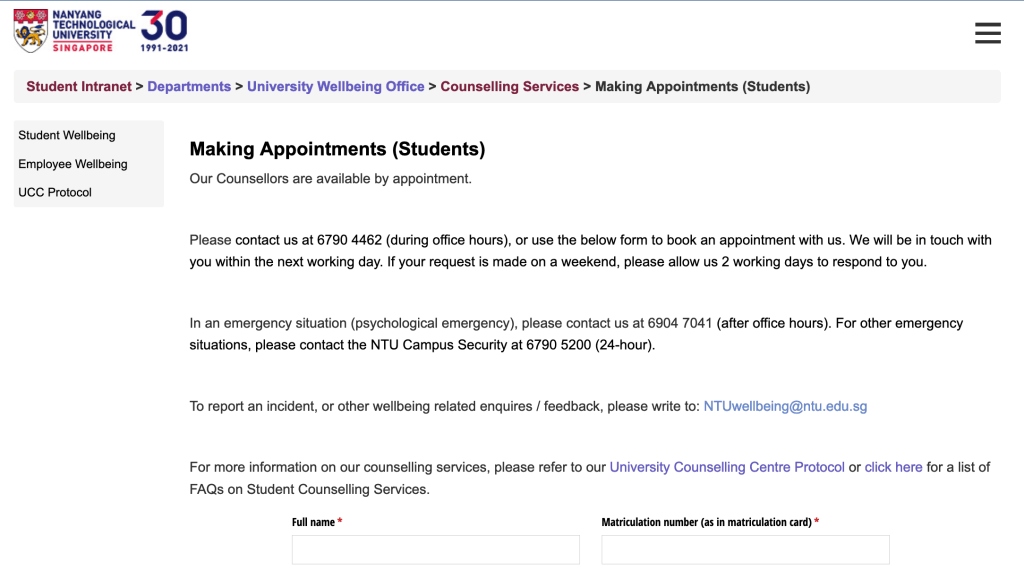
The appointment request form is on this page (login credentials required), but you can email the UCC at ucc-students@ntu.edu.sg or call 67904462. Getting to the request page is NOT an intuitive process (take note NTU); from a Google Search of “NTU counselling”, you need a minimum of four clicks on the correct links to get there.
The specific order is Student Intranet > Student Wellbeing (under Student Services) > Counselling > Making Appointments (Students) (under Student Wellbeing) – like how many Student Wellbeings do I need to see before I get to my destination LMFAO.
The intake call
Surprise, surprise: the appointment booking form I filled was not, in fact, for the counselling appointment. It was for an intake call. They contacted me through my email to arrange a call, and after some back and forth, we agreed on a timing. Anyway, they forgot to call me at the stipulated timing on the day itself, and I had to write in after a 15-min period of radio silence to remind them.

The intake call is a means of gathering initial information about the client through a series of questions (for the nitty-gritty, read here). The lines of enquiry that stood out to me were:
Naturally, I wanted to see the counsellor ASAP, but they informed me that the next appointment wasn’t available until a month later. I remember responding: the semester would have ended by that time – what would I have to talk about then? Can’t be helped, the caller essentially replied. It was crunch time for them because everyone gets stressed around the exam/assignment period. So, ironically, the time when students are most vulnerable is precisely when they are least likely to get opportune help because the centre can’t cope with the demand.
OK, well, whatever. I booked the appointment for the following month and promptly forgot about it. Later, I had to postpone it for another week because I had an urgent deadline that cropped up, which was a hassle. The other thing about UCC’s booking system is that it is internally and manually managed. There is no convenient online portal that you can log onto – like that of polyclinics – to book or reschedule appointments. You have to write/call in to deconflict and haggle for the timing that works best for you AND them.
[3] FINALLY, THE ACTUAL COUNSELLING SESSION

Counsellors, therapists, and psychiatrists
Before we proceed, a note between the differences between a counsellor and (psycho)therapist because there is a common misconception that they are the same. If you’re wondering where clinical psychologists are, they fall under the umbrella of therapists. Finally, neither counsellors nor therapists are psychiatrists, who are specialised medical doctors and the only ones that can prescribe medication for mental disorders. (Confused? This resource may help clarify.)
Therapists undergo more specialised training focusing on diagnosis and treatment, and minimally require a Master’s to practise professionally. Counselling does not require a Master’s, though there is a certification requirement of a few hundred hours of supervised training. The above does not mean one profession is better than the other – it just means they address different needs of the client. A counsellor is well-equipped to handle immediate problems causing distress and is a resource bank of coping strategies that the client can draw upon during trying times.
Think of counsellors as the “first line of defence”. If your symptoms are severe such that a counsellor’s assistance is insufficient, your case will be escalated to a psychologist or psychiatrist for further attention. But for many, seeing a counsellor will be enough. I think of counsellors as similar to GPs. We all get sick once in a while, and so seeking regular check-ups is a good habit to cultivate. But sometimes we have severe or recurring symptoms beyond their expertise, and that’s when they refer you to a specialist.
Nice to e-meet you
I opted for an online call because I didn’t want to travel down to Pulau NTU. Ah, the joys of technology! My counsellor was randomly assigned to me – I didn’t get to choose. I won’t disclose her name for privacy reasons, but she was sweet and approachable. And a great listener.
We started in an open-ended fashion, where she invited me to share what I’ve been up to and any challenges that I’d been facing recently. I’m a great rambler (ideal client type), so I wasted no time and jumped straight into rattling off all my problems. Throughout my monologues, she remained highly engaged, interjecting appropriately during my pauses.

When I shared my chronic belief of never being good enough, she gently guided me to elaborate and interrogate the causes of this belief. Examples:
As I attempted to answer these questions, I found myself exploring dusty places in my mind. I realised I possessed thought and action patterns that I had simply accepted as normal and automatically used without noticing their impact on me through the years. It was a pleasant surprise when her questions decentred me, throwing me off my usual line of self-talk, and pointed me in new directions to explore. It was exciting.
What I really liked was the new perspective that she offered to the things I took for granted. It’s easy to believe that we know everything about ourselves – after all, we live with the voices in our heads 24/7. And I’d already had extensive conversations with my loved ones and mentors before about the struggles I faced. While they are indubitably a valuable source of social support, I stopped learning anything new about myself from those repeated conversations at some point. So, gaining an outsider’s perspective was illuminating.
Problem-focused coping is my passion
Before ending the session, she provided me with a few coping methods to try over a few weeks. She mainly proposed journaling with specific adjustments. I mentioned that I have a habit of reviewing my day in writing, so she commended me (LOL) and recommended further minutiae I could try. Namely:
You might think these sound commonsensical. I’d already learnt all of it before, and I know that these are helpful in theory. The thing is (again): it never occurred to me to practise doing these things. She reiterated that I don’t have to be ambitious or perfectionistic about this whole journaling endeavour: start small and build up slowly. The same goes for mental health, really – it’s a process.
Finally, we scheduled our second appointment for a month later, since one hour was grossly inadequate to work through two decades of self-doubt. Afterwards, she emailed me a cute diagram with tips on cognitive restructuring.

UNTIL THE NEXT APPOINTMENT…
In summary, I would rate my experience as:
I firmly believe that counselling is a resource that everyone deserves and should use to better their well-being. I say this based on my experience seeking counselling and as a psychology graduate. The good news is that there are now many free counselling services available (see the end of this post for a list of community resources), and one’s educational institution is a great place to start.
Ultimately, my hope is that seeing a counsellor can be as normalised as going to your GP for a physical ailment. Fortunately, with mental health awareness steadily increasing in Singapore, that doesn’t seem such a far-off goal now. That being said, there’s always room for improvement… but that’s a story for another time.
Wishing you all wealth and health and that you will meet the counsellor who helps you flourish and be your best self!

For more quality content like this, subscribe by entering your email under the “VIP Club” section on the right side of the page! Alternatively, contact me here or follow me @gwynethtyt on Instagram.
If my posts helped you and you’d like to show your appreciation, consider making a donation here! It keeps my blog running and my energies focused on writing quality content LOL. You’ll be contributing to my monthly donations to Share The Meal too.
Update (4/1/22): Dr Lim from the University Wellbeing Office commented on this post with further resources for NTU students!
Thank you for promoting and your championing of mental health and wellbeing for our youths. Regarding my suggestion to include a link for the students, you could consider this: https://ts.ntu.edu.sg/sites/intranet/student/dept/uwo/resources/Pages/default.aspx (NTU student intranet under UWO webpage). This page has different categories of self-help and will encourage exploration of the different resources and services available to the youths.
APPENDIX: USEFUL COMMUNITY RESOURCES
Fei Yue’s Online Counselling Service
ec2.sg
[Live chat] Mon-Fri: 10am-12pm; 2pm-5pm (Closed on Public Holidays)
e-Counselling Centre
Singapore Association for Mental Health (SAMH)
1800 283 7019; 6283 1576
Toll-Free Helpline from 9am-6pm on weekdays (except public holidays)
counselling@samhealth.org.sg
A helpline for all mental health-related matters
Community Health Assessment Team (CHAT)
https://www.chat.mentalhealth.sg/get-help/About_webCHAT/
6493 6500 / 01
chat@mentalhealth.sg
webCHAT operates from Tues to Sat, 1pm-8pm
Provides a confidential and personalised mental health check for young persons between 16 and 30 years old. CHAT is NOT a counselling or crisis service
Touch Community Services
1800 377 2252
Mon to Fri from 9am-6pm
TOUCHLine Youth Counselling Service
Care Corner
1800 3535 800
Daily from 10am-10pm (excluding public holidays)
Toll-free Mandarin Counselling Hotline
National Care Hotline
1800-202-6868
Provides emotional and psychological support to those affected by the COVID-19 pandemic
IMH Emergency Help Line (24h)
6389 2222
Urgent intervention for those experiencing acute difficulties in their mental health
Samaritans of Singapore (SOS) (24h)
1800 221 4444
pat@sos.org.sg
Facebook Messenger (6pm-6am on Mon to Thu and from 6pm-11:59pm on Fri)
A 24-hour suicide prevention helpline to provide emotional support for those in distress
Mental Health Services Resource Directory
*The above are unabashedly taken from a school email, no shame, thanks NTU
Update 20/7/22
I get a lot of questions from juniors in NTU, so I made this FAQ which should serve to answer most of your questions. I will continually update this list as new questions come along. If you have any questions, leave a comment below and I’ll get back to you!
How do I win the NTU STAR WARS?
Here’s what worked for me (I got virtually every mod I wanted as an undergraduate).
Prepping for War
The What War?
The Aftermath
Check out my guide to NTU Psych Modules here.
Other FAQs
What’s the average grade for module X / FYP?
Assume all modules, including FYP, follow the bell curve. This means that your performance is graded relative to how your cohort did, rather than the absolute score you got on your assignments/exams. Let’s say you got 40/50 for a recent test. It’s a 80%, but if the cohort average is 45/50 then you’re unlikely to be getting an A for that test.
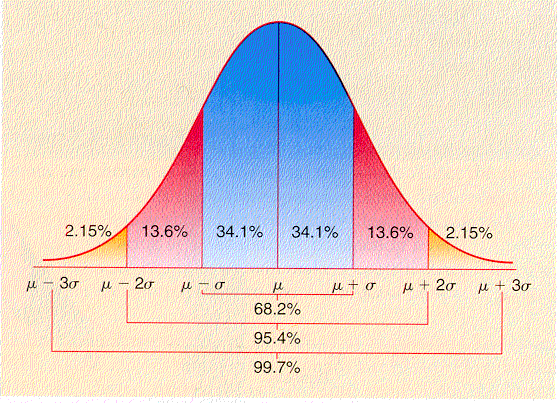
The next question you might have is: how many % of students get a certain grade? Well, nobody knows, because it is not disclosed for obvious reasons. My PERSONAL guess (so don’t quote me to the office) of the grade proportions are:
A further EXAMPLE to illustrate. Referring to the diagram above, most students will get a B+/B (the blue regions). A smaller proportion of students will get A- and B- (e.g. the red regions). The smallest proportion of students will get A/+ and below B- (yellow). So on and so forth. Again, this is only an example.
Suffice it to say: the average is a B+. You are most likely to get a B+. “But I am a genius and work really hard,” you lament. Sure – you’re still most likely to get a B+, based on the principle of regression to the mean. My estimate is a B+ because I notice most people around me in HASS graduating with a Distinction, which is a cGPA of 4.0-4.49. It may also be a B in certain courses. Finally, note that a minority of modules (smaller classes?) may be exempted from the bell curve. Nothing’s ever for certain in this murky bureaucracy.
There’s a variant of this question that I also get: is the bell curve steep? Huh? Bell curve differs meh? I don’t know. I assume all modules are curved in the same proportion. Surely there must be some guideline, or students in different schools would be graduating with different proportions of honours.
For more information, see this post written by the incumbent NUS President Prof Tan Eng Chye for an illustration of how the bell curve grading system works.
Is X course/module competitive? (Or: what’s the vibe of the course?)
Yes, it is. It is competitive. I mean, what answer were you expecting? Students fight tooth and nail every year to secure a spot in your course at NTU, NUS, and all the other universities. Why would you think that it would get easier after you’re admitted? But that doesn’t mean you have to be [only] a slave to the rat race. Make the best of your time by focusing on discovering yourself and pursuing what you love.
Do you have Past Year Papers to share?
Past year papers of all courses in NTU can be accessed here (under E-Resources). If it’s not available there, it doesn’t exist. To the NTU Psych students reading this: the Psychology programme does not provide PYPs. Thank you.
Are NTU and NUS different? Which one should I choose?
Nah, not to me. Tbh I bet people couldn’t tell the difference between a NTU and NUS student, ceteris paribus – they’re “functionally equivalent”. (Fun activity to try the next time you’re in a group interview – “Guess the Uni!”) The biggest inter-university difference comes with SMU imo, because students there are trained to make themselves heard. You might hear some casual comments like “NUS is more rah rah” or “NTU is more laidback” but dig a bit more and you’ll find that there are no specifics to these statements. The two universities are more similar than different. But which university do the really outstanding students pick, you ask? Neither – they’re overseas in the US or UK under government scholarships ASLDJSKFJS
Pick the course that you’re more interested in, not based on the abstract “culture” of the school. See my NTU vs NUS Psych post for a comparison of the two programmes.
Is Uni as stressful as poly / JC?
Uni is like Poly+. Same thing at a higher difficulty. More stressful, because the cohort has been further “pruned”. To underestimate the poly students in uni is to make a mistake. We’re very good at what we do, or we wouldn’t be here, because the bar is higher for us.
I feel like JC is a long-distance marathon while Uni is closer to a series of sprints. I think the stakes are higher for the A levels because you basically only have one chance to make it or break it. In Uni you arguably have multiple chances, and the system is a lot more flexible than people give it credit for (e.g. S/U, dabao, 1st sem invulnerability). Not sure about the stress, but JC students are free to leave their comments below.
Update 20/7/22

Hello to all my fans. This post is a comprehensive review of modules I have taken in NTU. For each I briefly discuss the lecturer’s style, content, assessments, and personal tips if any. Ctrl-F is your friend here – enter either the year/semester (e.g. Y1S1), course code (e.g. HP1000), module name (e.g. Introduction to Psychology) to jump to the relevant section directly. I also indicate the type of module (Core/Major-PE/Ger-Core/Ger-PE/UE) and number of AUs. All the psych mods are presented first, followed by the GER-PEs/UEs/BDEs.
Background: I majored in Psychology with a 2nd Major in Sociology. That’s a normal workload for psychology + 35AUs in sociology courses substituted from my UEs.
Disclaimer: Module syllabus differs by year and is especially contingent on the lecturer so what you read here may not be what you get. My module trajectory is not a guideline – I just did whatever I wanted. It is your responsibility to do your due diligence. Just because I said a module was easier for me doesn’t mean it’s easy to score because of how the bell curve works, and just because I said something was hard doesn’t mean I didn’t do well. I discourage selecting modules based on how easy they seem; I recommend selecting topics that interest you.
PSA: You can find most course syllabi at this page (under the courses block).
If my posts helped you and you’d like to show your appreciation, you can buy me a coffee! It keeps my blog running and my energies focused on writing LOL. You will contribute to my monthly subscriptions to Share The Meal.
Select page 2 below to continue.
Part 2 of teamwork, or lack thereof
I was interviewed by a therapist a few months back for some program. (Not for therapy, but I’ll get there.) She was a genteel lady who spoke as if soothing a newborn, yet I could sense iron will beneath that demeanour. And that intimidated me. I felt that she could see the weaknesses of my being: when her gaze penetrated me, I found myself wringing my hands under the table.
We started with the typical questions. Tell me one interesting fact about yourself. How did you become interested in psychology? What are your career goals? The two other interviewees flanking me answered with practised ease: well, I’ve always been interested in counselling…
Everything was manageable up to the pièce de résistance. Having sat silently beside her until then, her assistant peered at his notes as he recited the question.
I'm sure all of you have had to work in teams in the course of your study. Can you share one instance where you had a teammate who did not participate as much as you would have liked, and what you did in response?
Unsurprisingly, nobody had issues answering. We shared our misadventures with our own flair. I started with an academic definition of social loafing, which her assistant noted with some alarm; someone detailed a more placative approach, and the other had a heartwarming ending to their story. But the details were irrelevant: deconstructed, our stories were identical. There is a slacker, there is retaliation, and perhaps reconciliation.
I thought the interview would end following our earnest sharing. But I was wrong. She leaned forward, her body language incongruent with the killer blow she was about to deliver.
What are your thoughts about… showing compassion to these people?
Just like that, I was ensnared.
My mind was racing. I’d never encountered a question like that before. Whilst I spluttered trying to parse together a coherent response in real-time, my psyche was going through a saga of civil war. Tons of if-then sequences, buts, and rebuttals to those buts battled each other.
Should slackers be shown compassion? Do they deserve compassion? Who’s to say who deserves what? Isn’t it right to show compassion to all, for better or for worse? Everyone’s bound to make mistakes, and the least we could do is be understanding, right? Isn’t that what I’d want from others – empathy in difficult times? But what about situations where someone leeches off the team the whole term with a shitty work ethic? And what if it happens most of the time? What about the others left shouldering the burden of work then?
What about me?
My first instinct was to reject the notion of compassion. Being primed with the thought of slackers already brought forth ugly memories from the recesses of my mind. To further expect me to swallow that resentment and extend loving acceptance to those who brought me suffering? If received offhandedly, the question could even be construed as an insult to those who actually put in effort (or, if I dare say, one could “take umbrage” at the statement). We bear the brunt of the work, they get the grade we worked for with minimal contribution, and we still have to extend compassion to them? Am I supposed to benevolently and passively endure as people take advantage of me for the rest of my life? To accept such an arrangement would be absurd. I can’t help but bitterly wonder if graders consider our feelings when we raise such instances of injustice only to hear “it’s just like that; get used to it”.
I should qualify my statements with a disclaimer that I don’t think of myself as The Most Valued Contributor Of All Time. I have done less than what I could potentially do, once in a while, albeit never regularly. Nevertheless, I continue to find myself appalled when I repeatedly encounter instances where people simply do not seem to care. They’re not even pretending to try. And others become notorious for making loafing a habit and their defining characteristic. I may not have the complete picture – thing is, nobody ever does – but I sure as hell can tell when you’re making an effort.
I’d be happy to extend compassion to everyone if it meant that loafers would actually start pulling their weight in projects, except I don’t recall that working out. Pragmatically speaking, compassion is a lofty ideal only attainable to the enlightened who have unlimited patience and time. And in this pressure cooker of a society, we have neither to spare. I have neither to spare.
Why then, indeed, should we show slackers compassion?
I guess that her counterpoint was designed to be discovered within that internal tirade. Her argument was that with sufficient support and unconditional positive regard, anyone could be motivated to contribute. Keywords: anyone, unconditional. I must admit that this optimistic view doesn’t sit well with my assumptions of human nature, which tend to lean toward the direction of self-centredness. But that could very well be a distortion manifesting from my personal insecurities. If there’s anything I’ve learnt from group work, it’s that our expectations of others are projections of our expectations of ourselves. I demand from others as much as I demand from myself, and I inevitably find myself disappointed because I am chasing unattainable perfection. And expecting others to act in the way we want is maladaptive at worst and naive at best.
It’s easy to attribute this dysfunction to the environment. We exist in a system that pits people against each other, and where the default mode of exchange is transactional rather than relational. My corresponding preoccupation with equal contributions bleeds into everything I think about and do when it comes to work. And my self-centredness hurt me and the people around me in the process. I’d immediately dismissed compassion as a fruitless endeavour on the basis that it wasn’t tangibly productive because I think only in terms of results when it comes to this issue. In this view, people are only worth as much as they can contribute to the outcome – precisely what she was attempting to challenge when she presented us with that thorny question.
Of course, resentment at inequitable contributions is instinctive and natural. But we can choose to rise above those. At least theoretically. And it’s not a have to, as she reiterated – nobody is obligated to show compassion to another. But perhaps we would be better off doing so. In extending compassion to others, we could be doing the same for ourselves – something we often neglect in the pursuit of conventional success. In fact, we probably need this compassion more than ever during these difficult times. Still, I believe we can further advance the conversation by considering other layers of the issue, including distributive justice, and I look forward to encountering more nuanced takes in the future.
 baby g’s diary