The post that started it all. Reading this again makes me laugh because it demonstrates my point that people fundamentally don’t change. I mean, look at these iconic quotes from 2019 me:
“I enjoy oversharing about my life to the discomfort of others, though I should really know better. Either way, you’ll get my irrelevant opinions on all sorts of issues.”
“If you think I don’t have any [haters], you’d be surprised — I am so popular it pains me. I can’t even sin in good conscience anymore.”
This post was the first example of what I would become most well-known for among my juniors — reviews and advice relating to my academic pursuits. And my wit, of course.
One of my purer self-expressions at the time related to the paradox of online authenticity — a recurring issue in my life. The dilemma in summary: being “real” online necessitates sharing negative experiences and potentially controversial opinions because that’s real life. However, doing so could lead to adverse consequences, mainly: (1) it might not be good for your reputation in a hypercurated online environment and (2) your disclosure could be weaponised against you.
(1) is more rooted in insecurity than anything else, but (2) is a real concern. Someone reported me to my superiors when I was a student leader because I allegedly made an inflammatory comment online.
The only thing I learned from that affair then, unfortunately for the instigator, is that some people have such uninteresting lives that they can only spend it attempting (and failing) to drag others down. But I’ll admit that the experience helped me learn to criticise in a way that convinces audiences while the targets can’t do jackshit to me. (-:
I only resolved the dilemma after going through therapy: now, I share whatever I want without concern for others’ opinions. The value that I create and the way I treat others is testament enough to my character. If you can’t see it, that’s on you and not me x
2020: the liberal feminist (ironic) era [16 posts]
Self-explanatory. Interesting in the sense that men do not only represent an outlet of emotional and sexual fulfilment for me (god, if only I could choose otherwise), but because the concept of manhood defined my psychic development as a woman. Freud would be proud.
A chauvinist triggered me to write this. The post is noteworthy because it demonstrated my propensity for conflict and polemics. I’m more selective with my battles now because I’m better able to distinguish what’s worth my time.
But my desire and ability to put men in their place will never die.
Trivia: named after a popular shoujo manga I read when I was younger.
This is the post I am most well-known for. I wrote it because it is what I would have wanted to read as a junior. The support I received motivated me to keep writing; it might be part of the reason I am still posting today.
This post marked a breakthrough for me because it was the first time I actively sought help for my depressive symptoms. It was formative in terms of my journey as a mental health advocate.
Trivia: did you guys know I got into trouble for this series (the mental health logs), because someone didn’t like what I said and reported it to someone with authority over me? I got away again, of course (see the pattern here?), because 1) I can and 2) people are delusional to think that they can police my non-political opinions in our fair and free society.
I have had a long troubled history of insomnia since I was an adolescent (it’s gotten a lot better in 2024, though). I paid doctors hundreds of dollars to confirm what I already knew. Speaking from experience: if you have a sleep issue, also get your mental health checked out — the two are inextricable from one another.
More political commentary. The feelings I experienced when I posted this and when I saw the response to it solidified my commitment to write until I die.
Being single and encountering a bunch of men made me have Many Thoughts about the nature of love, dating, and marriage. So where better to organise all these thoughts creatively than here?
I would like to thank the men who inspired me because, hell, I was compulsively putting out banger after banger LOL. Sublimation is real, and I have lived it.
Embarked on this because I love self-improvement projects and gamifying my life. It’s not working out great because I clearly have impulsivity issues, but I’d be damned if I wasn’t having fun.
Another banger of a series (a little bit of disclosure: I was lovesick. I might still be. But I wouldn’t worry, because it’ll all work out in the end.)
That was a sweet trip down memory lane. Happy 5th birthday, my darling blog! I love you.
I drink a lot of milk tea. When I say “a lot”, I mean that across the 108 days that I’ve tracked my beverage intake so far, I drank milk tea on 57 of those days. Yes, diabetes is hurtling towards me at lightspeed (I have a will in my blog drafts). Anyway,
LATER: Will make an excel sheet to organise the list below.
Rating system:
1/5 = disgusting, didn’t finish 2/5 = blargh will not drink again, struggled to finish 3/5 = OK, fine, might not buy again 4/5 = mm mm good will keep it on my roster 5/5 = all-time fav, unforgettable, fantastic, scrumptious, magnificent, top-tier,
Standard order/quirks:
70% sugar, less pearl, normal ice.
If no black/golden pearl, no topping (white pearl does NOT cut it!)
I drink only milk tea, specifically jasmine/green milk tea. I stand by the belief that a milk tea brand can be judged exclusively by how good its green milk tea is. I will die on this (diabetic) hill.
I like sweet, flowery, and milky stuff.
If it has peach, I am already there.
Now for the brands, arranged in some general order of preference. Limited Edition = LTD
Chagee (now Amps Tea, and then Chagee again, it’s all over the place) – their drinks make me wanna dance like it’s Saturday night. They don’t have black/golden pearls, but I love their teas as much without.
Osmanthus Oolong Latte: 4/5 – I could drink a litre of this and still beg for more
White Peach Oolong Latte: 5/5 – I could hook this up directly to my body like an IV drip and still beg for more
Jasmine Green Tea Latte: 4/5 – one of the better jasmine milk teas on this entire list, sweet and flowery
Seasons Oolong Tea Latte: 3/5 – decent but pales in comparison to the others from this brand
Camelia Latte: to try – my friend recommended it
Nuobei Tea – the Sinicised version of Chagee/Amps Tea, if that was possible
Peach Oolong Tea Latte: 5/5
Jasmine Green Tea Latte: 5/5
Green Grape-Lychee Green Tea: 4/5
No. 17 tea – makes diabetes seem like an afterthought
Jade Green Milk Tea: 5/5 – when I tried this I knew that no matter where this brand goes I will follow like a devoted dog crawling on the floor, begging, whining
Snow Peach Oolong Milk Tea: 4/5 – AUGH (trembling) so good
Snow Peach Oolong Latte: 4/5 – love this, but realised jade green milk tea was superior (and milkier, despite this being a milk latte)
Peach Yakult Green Tea: 3/5 – fixed sugar level, too sweet, and that’s coming from ME
Peach Milk Cap: 3/5 – eh not as good as the others
Roasted Brown Sugar Pearl Milk Tea: 3/5 – ok ok only I am at a loss for words because it really isn’t all that. If I wanted a good brown sugar milk tea I still think of Tiger Sugar (where are you baby)
Koi – the longest-standing pioneer. 50% is often better with their LTD/experimental drinks
Green Milk Tea: 4/5 – can’t go wrong with this OG King, but loses out to No. 17 / Amps’s equivalents overall
Peach Green Milk Tea: 4/5 – 50% is perfect
Honey Milk Tea: 3/5 – decent alternative for people who want something in between green milk tea and “traditional” milk tea, basically, people who cannot make up their mind
Vanilla (Green) Milk Tea: 4/5 – tastes like (yummy) flowers will get this once in a while for kicks
Vanilla Four Seasons Milk Tea: 4/5 – dials back the flowery for the tea. I recommend getting one vanilla GMT and FSMT with your friend and sharing it. Milk tea together just tastes better!
Peach Four Seasons Milk Tea (LTD): 3/5 – too sweet(!), strange
Peach Oolong Milk Tea (LTD): 2/5 – another peach but somehow I don’t like it… everything tastes wrong in an artificial way
Lychee Milk Tea (LTD): 3/5 – fragrant but too sweet; can’t taste the tea
Peanut Butter Milk Tea (LTD): rare 1/5 – what were they thinking
My brother, the peanut butter connoisseur: “The peanut butter is Skippy but mixed with milk tea tastes like Shitty” he’s right
Mango Four Seasons Milk Tea (LTD), 50%: 3/5 – the verdict that my friend and I submit is that Koi wants to be experimental, but they’re better off sticking to the classics. This one tastes like mango sago, but where is the tea? Also, we got 50% but it was sweeter than my 100% sugar White Peach Oolong Latte from Amps. How do they determine their sugar levels? My gut feeling about men is more accurate.
Yakult Green Tea: 4/5 – if I was on a milk ban, this would be a good alternative
Lychee Black Tea (LTD): 3/5 – Again, I only drank this because I was on a milk tea ban. It will not happen again. But it was alright.
3Seasonstea
Peach Oolong Milk Tea: 5/5 – Sumptuous stuff — I was drinking it exclusively for weeks at one point while hammering out my thesis. Their sugar is light but lingers on the tongue (a sweetener, maybe?) My custom order, breaking from the usual: more sugar, milk cap/foam, crystal jelly instead of black pearl.
LiHo – I’d say I’m too good for them, but I drank it weekly at school anyway
Jasmine Light Milk Tea Cloud(LTD?): 4/5 – I actually LOVE the cloud concept and there’s this wonderful lingering taste but WHY IS IT NOT SWEET??? I ASKED FOR A 100%!!! Still think about this one sometimes though.
Gardenia Light Milk Tea Cloud (LTD?): 4/5 – I ASKED FOR A 100% AND I HAD TO ASK FOR MORE!!! I HAD TO ASK FOR MORE!!! Would drink again with extra sugar though.
Green Milk Tea: 3/5 – Not that great, but it’s the only drink I’ll accept pudding topping for
Money Money Light Milk Tea Cloud (LTD?): 4/5 – Glutinous rice-based. Not bad at all my friend treated me to this and then I downed 75% of it (we were supposed to share) sorry HW hope you like the necklace though ❤
AtTea – naming a whole milk tea brand after yourself is such a power move
Jasmine Milk Tea: 3.5/5 – lovely in a subtle way, but not enough to become a regular rotation
Pink Meteor 945 (50%): 3/5 – My friend got this, of course — I’m not that adventurous. Has pomegranate and guava in it? A nice drink to share, but not to drink alone.
iTea – your friendly neighbourhood bbt store
Green Milk Tea: 4/5 – light on tea but great on milky taste + bonus point for their insane value of $2.50 (free pearls!!!). Literally the only thing I drink at iTea like I have FILLED their loyalty cards with this alone
PlayMade — strong USP with their pearls, but their tea quality is unremarkable
Osmanthus Oolong Latte (w Cactus Pearl): 3.5/5 – my guilty pleasure, but starting to pale in comparison with the other brands
White Grape Milk Tea (w White Grape Pearl) (LTD): 4/5 – a big dopamine hit. The white grape pearls are a BOP. Better at 50%; it’s saccharine sweet
White Peach Oolong Milk Tea (w White Peach Pearl) (LTD): 3/5 – taste encapsulates my evaluation of PlayMade – I’m excited about what it could be until I actually try it…
Each A Cup – your friendly neighbourhood bbt store, II
Jasmine Milk Tea: 4/5 – This one tastes like meeting an old friend… time passes, you meet new people, and you forget about them gradually, but when you encounter them again, you remember why you loved them
Gong Cha — credits to this for being the only brand where you can taste some semblance of actual tea in their milk teas
Pearl Milk Tea: 3/5 – my daddy’s favourite. You can actually taste the tea in this one!
Peach Oolong Milk Tea: 4/5 – honestly, not bad at all. It’s milky, sweet, and has the aftertaste of tea.
Chi Cha San Chen — interestingly, low on the list (I’m not a tea purist)
Osmanthus Oolong Tea + Mousse/Cream, 100%: 3/5 – nothing wrong with it, there’s just better (milk) teas out there
Osmanthus Oolong Tea + Mango: 3/5 – I feel like you could order this from your Kopitiam aunty and she would grin and say “ok 美女” and it would cost $2? LOL
Osmanthus Oolong Tea + Passionfruit (50%): 3/5 – as sweet as the mango version because of the syrup they use. Review same as above
HeyTea — the closest thing to milk teas from Shanghai (those are really good btw)
Pure Aqua Green Jasmine Milk Tea (DISCONTINUED): 5/5 – absolute perfection. I remember the first time I drank this — I was irreversibly altered. They literally lost a customer (me) for discontinuing this. I strolled into an outlet one fine day, delirious with anticipation. I nearly screamed when they told me it was gone, and I walked out. I have never bought from them again. Let me know when they put it back on the menu, though.
Milksha (COLLAPSED) — goodbye
Wheat Milk Tea: 2/5 — YUCKS!! That is all
Green Milk Latte: 3/5 — Ehhh this score was foreshadowing that it would close down
I recently read Atomic Habits and wrote a summarised version of each chapter for my own reference. But I went beyond to include my own tables and exercises based on James’s suggestions. And thus the Summary/Action Guide to Atomic Habits was born. I’m sharing it here in the hopes that others will find it useful.
This is part 2/2 of the book summary. Read part 1 here if you haven’t already!
Mandatory recommendation to support James Clear by buying his book. While I think my guide is fantastic, it can never beat learning from the author himself.
THE 3RD LAW: MAKE IT EASY
CHAPTER 11: WALK SLOWLY, BUT NEVER BACKWARD
Motion vs action
Motion: planning and strategising and learning “how to”, but without doing.
Action: actually doing.
Examples
Motion: outlining ideas for 10 blog posts (haha!)
Action: actually sitting down to write a post
It’s easy to fall into the trap where you’re in motion convincing yourself you’re making progress. But motion in itself does not produce any outcome. Only actual action will get the results we’re looking to achieve.
Takeaway: Start practicing your habits immediately instead of spending all the time planning and delaying!
Habits form based on frequency of repetition, not time
Repetition leads to change at the neuronal level.
After enough repetitions, habits move from effortful practise to become automatic
Automaticity occurs when we no longer need to think about the steps involved
The key to developing a habit is that you take the actions you need to make progress and do it frequently.
We can practice our habits by making them easy (next chapter).
Exercise 11.1: Taking action
Write down one habit action you’ve been meaning to do
List 1 “motion” and “action” aspect.
How can you take action today to start the activity?
I’m probably late to the game but I recently read Atomic Habits and found it a game-changer for my own life! Due to the sheer volume of tips and content covered, I found myself writing a summarised version of each chapter after reading. But I went beyond to include my own tables and exercises based on James’s suggestions. And thus the Action Guide to Atomic Habits was born.
I’d like to share it here in the hopes that others will find it useful!
Mandatory recommendation to support James Clear by buying his book. While I think my modified guide is fantastic, it can never beat learning from the author himself.
JAMES COMMANDS YOU
Before we begin, my review of Atomic Habits: 5/5 stars. This book marked a paradigm shift for me. It is also well-integrated with psychological principles, so bonus points! I also love that there are many action pointers interspersed throughout the book, though I would have appreciated it even more if he straight up had “exercises”. But it’s alright because I’ve created them – problem solved.
*This post is the first of two. It covers the first 10 chapters in the book (of 17), because writing a summary takes time. Also, because the content covered can be dense, don’t expect to be able to finish the summary/exercises in one sitting. Yes – you know what that means! Bookmark this page, subscribe to me for updates, and send love if you enjoyed it!
USING THIS GUIDE
For starters, I recommend selecting one habit – and only one – that you hope to build and focusing on it via the exercises in this guide. The habit I’ve been working on is reading academic journal articles every day. Well then, without further ado…
Mental health in youths is the In Thing now. There’s been a proliferation of ground-up and top-down initiatives targeting this issue in the past year, with even the Singapore government publicly committing to progressive improvements (albeit not reforms). This leads us to the questions: what resources are available, and are they adequate?
For me, there was one FREE resource under my nose I’d neglected for the longest time: the school counsellor. Yes – after more than four years in university and pursuing two psychology (!) degrees, I finally reached out to the NTU University Counselling Centre(UCC). This post will describe my experience seeking counselling services from the NTU UCC.
Sections to be covered (Ctrl-F to skip to a section directly, e.g. [1]):
[1] Why people don’t always seek help [2] Booking the appointment + waiting time [3] The actual counselling session
Even though I visited a university counsellor, I expect the overall experience to be generalisable, so youths of other ages and institutions may still find this post applicable. Students not from NTU/uni may skip [2], though I’d still recommend you read everything.
My goal here is to encourage help-seeking on my readers’ part: if you feel like you’re facing difficulties with your mental health in any way, go to a professional if you can. Don’t wait until your stresses boil over and you find yourself in a state of burnout (speaking from experience).
[1] THE PREAMBLE: WHY PEOPLE DON’T ALWAYS SEEK HELP
Considering I’m a psychology graduate, it’s ironic how I’ve never seen a counsellor. I mean, I’ve studied under clinical practitioners. Hell, I took a counselling module once, where my counselling skills were assessed. (Minor flex: I was the “top performer” in the cohort for that module. But look at where I am now. So.) Either way, I’ve never been a client.
That’s not to say I never considered the prospect of seeking help – I just never got around to doing so.
The point is: there’s a gap between intention and action that many of us find ourselves stuck in. You know (from the indelicate “oh mental health is superrrr important and we shouldn’t neglect it” narrative that we’re bombarded by) that seeking help is good, but… you just can’t seem to bring yourself through the steps to get there.
Granted, not everyone has the energy or time to seek professional help. There exists a multitude of (valid) reasons people don’t. Here are mine in the past that I cycled through at my convenience:
I am busy / I have too much work / I don’t have time / it’s too much of a hassle
It might not help me / I could just talk to my friends or family
It’s too expensive* (high-SES private therapists can go up to $180/h)
*So I found a free service. Baby steps, my friends.
Tl;dr: in deciding to seek help, you must believe that the value you’re receiving is worth the investment you’re making. In describing my experience with counselling below, I hope to demonstrate the value that counselling can bring. It will not solve all your problems – but it might get you closer to addressing them.
[2] BOOKING THE APPOINTMENT + WAITING TIME
Send help, am suffering
What prompted me to request an appointment was a stressful episode midway in the semester. Long story short, I felt that I wasn’t living up to my unattainable standards and doing terribly compared to my peers. A common experience, I guess, but with sufficient intensity to shut me down for three consecutive days – a significant amount of time when you’re running on weekly deadlines. Then, I saw an email advising students to seek help at the UCC if they needed it. LOL. This whole scenario reads like a comedy advertisement.
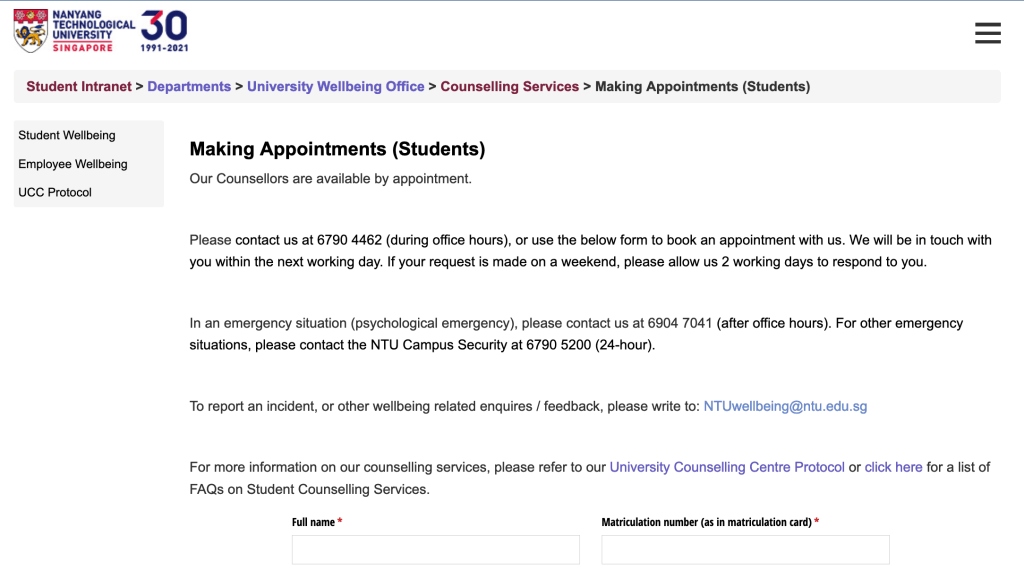
The appointment request form is on this page (login credentials required), but you can email the UCC at ucc-students@ntu.edu.sg or call 67904462. Getting to the request page is NOT an intuitive process (take note NTU); from a Google Search of “NTU counselling”, you need a minimum of four clicks on the correct links to get there.
The specific order is Student Intranet > Student Wellbeing (under Student Services) > Counselling > Making Appointments (Students) (under Student Wellbeing) – like how many Student Wellbeings do I need to see before I get to my destination LMFAO.
hello sgsecure? i am insecure
The intake call
Surprise, surprise: the appointment booking form I filled was not, in fact, for the counselling appointment. It was for an intake call. They contacted me through my email to arrange a call, and after some back and forth, we agreed on a timing. Anyway, they forgot to call me at the stipulated timing on the day itself, and I had to write in after a 15-min period of radio silence to remind them.
The intake call is a means of gathering initial information about the client through a series of questions (for the nitty-gritty, read here). The lines of enquiry that stood out to me were:
Any current issues/life transitions/symptoms experienced in the past month
My reason for seeking counselling; what I expect to get out of counselling
Any intentions for self-harm? (They were particularly meticulous about this)
Existing sources of social support I could draw upon
Naturally, I wanted to see the counsellor ASAP, but they informed me that the next appointment wasn’t available until a month later. I remember responding: the semester would have ended by that time – what would I have to talk about then? Can’t be helped, the caller essentially replied. It was crunch time for them because everyone gets stressed around the exam/assignment period. So, ironically, the time when students are most vulnerable is precisely when they are least likely to get opportune help because the centre can’t cope with the demand.
OK, well, whatever. I booked the appointment for the following month and promptly forgot about it. Later, I had to postpone it for another week because I had an urgent deadline that cropped up, which was a hassle. The other thing about UCC’s booking system is that it is internally and manually managed. There is no convenient online portal that you can log onto – like that of polyclinics – to book or reschedule appointments. You have to write/call in to deconflict and haggle for the timing that works best for you AND them.
[3] FINALLY, THE ACTUAL COUNSELLING SESSION
24 for me but same same
Counsellors, therapists, and psychiatrists
Before we proceed, a note between the differences between a counsellor and (psycho)therapist because there is a common misconception that they are the same. If you’re wondering where clinical psychologists are, they fall under the umbrella of therapists. Finally, neither counsellors nor therapists are psychiatrists, who are specialised medical doctors and the only ones that can prescribe medication for mental disorders. (Confused? This resource may help clarify.)
Therapists undergo more specialised training focusing on diagnosis and treatment, and minimally require a Master’s to practise professionally. Counselling does not require a Master’s, though there is a certification requirement of a few hundred hours of supervised training. The above does not mean one profession is better than the other – it just means they address different needs of the client. A counsellor is well-equipped to handle immediate problems causing distress and is a resource bank of coping strategies that the client can draw upon during trying times.
Think of counsellors as the “first line of defence”. If your symptoms are severe such that a counsellor’s assistance is insufficient, your case will be escalated to a psychologist or psychiatrist for further attention. But for many, seeing a counsellor will be enough. I think of counsellors as similar to GPs. We all get sick once in a while, and so seeking regular check-ups is a good habit to cultivate. But sometimes we have severe or recurring symptoms beyond their expertise, and that’s when they refer you to a specialist.
Nice to e-meet you
I opted for an online call because I didn’t want to travel down to Pulau NTU. Ah, the joys of technology! My counsellor was randomly assigned to me – I didn’t get to choose. I won’t disclose her name for privacy reasons, but she was sweet and approachable. And a great listener.
We started in an open-ended fashion, where she invited me to share what I’ve been up to and any challenges that I’d been facing recently. I’m a great rambler (ideal client type), so I wasted no time and jumped straight into rattling off all my problems. Throughout my monologues, she remained highly engaged, interjecting appropriately during my pauses.
When I shared my chronic belief of never being good enough, she gently guided me to elaborate and interrogate the causes of this belief. Examples:
When did I start feeling this way?
Is it really feasible to be the best at something (all the time)?
How do I deal with situations when I do not meet my expectations?
What is my relationship with myself?
As I attempted to answer these questions, I found myself exploring dusty places in my mind. I realised I possessed thought and action patterns that I had simply accepted as normal and automatically used without noticing their impact on me through the years. It was a pleasant surprise when her questions decentred me, throwing me off my usual line of self-talk, and pointed me in new directions to explore. It was exciting.
What I really liked was the new perspective that she offered to the things I took for granted. It’s easy to believe that we know everything about ourselves – after all, we live with the voices in our heads 24/7. And I’d already had extensive conversations with my loved ones and mentors before about the struggles I faced. While they are indubitably a valuable source of social support, I stopped learning anything new about myself from those repeated conversations at some point. So, gaining an outsider’s perspective was illuminating.
Problem-focused coping is my passion
Before ending the session, she provided me with a few coping methods to try over a few weeks. She mainly proposed journaling with specific adjustments. I mentioned that I have a habit of reviewing my day in writing, so she commended me (LOL) and recommended further minutiae I could try. Namely:
Write down the events of the day. Next, identify and label the emotions I experienced – positive or negative. Then validate them: was it reasonable to feel this way, given the circumstances? Would others have felt the same in similar situations?
If there are negative thoughts, create a separate column to reframe them: rewrite them as valuable takeaways to learn from.
Write one positive thing about myself every day (basically gratitude journaling), e.g. “I am proud of myself for powering through the day!”
You might think these sound commonsensical. I’d already learnt all of it before, and I know that these are helpful in theory. The thing is (again): it never occurred to me to practise doing these things. She reiterated that I don’t have to be ambitious or perfectionistic about this whole journaling endeavour: start small and build up slowly. The same goes for mental health, really – it’s a process.
Finally, we scheduled our second appointment for a month later, since one hour was grossly inadequate to work through two decades of self-doubt. Afterwards, she emailed me a cute diagram with tips on cognitive restructuring.
i will NOT break down today
UNTIL THE NEXT APPOINTMENT…
In summary, I would rate my experience as:
Appointment process: 2.5/5, as mediocre as me, needs improvement
Counselling experience: 5/5, exceeded expectations, would recommend to all
I firmly believe that counselling is a resource that everyone deserves and should use to better their well-being. I say this based on my experience seeking counselling and as a psychology graduate. The good news is that there are now many free counselling services available (see the end of this post for a list of community resources), and one’s educational institution is a great place to start.
Ultimately, my hope is that seeing a counsellor can be as normalised as going to your GP for a physical ailment. Fortunately, with mental health awareness steadily increasing in Singapore, that doesn’t seem such a far-off goal now. That being said, there’s always room for improvement… but that’s a story for another time.
Wishing you all wealth and health and that you will meet the counsellor who helps you flourish and be your best self!
For more quality content like this, subscribe by entering your email under the “VIP Club” section on the right side of the page! Alternatively, contact me hereor follow me @gwynethtyt on Instagram.
If my posts helped you and you’d like to show your appreciation, consider making a donation here! It keeps my blog running and my energies focused on writing quality content LOL. You’ll be contributing to my monthly donations to Share The Meal too.
Update (4/1/22): Dr Lim from the University Wellbeing Office commented on this post with further resources for NTU students!
Thank you for promoting and your championing of mental health and wellbeing for our youths. Regarding my suggestion to include a link for the students, you could consider this: https://ts.ntu.edu.sg/sites/intranet/student/dept/uwo/resources/Pages/default.aspx (NTU student intranet under UWO webpage). This page has different categories of self-help and will encourage exploration of the different resources and services available to the youths.
APPENDIX: USEFUL COMMUNITY RESOURCES
Fei Yue’s Online Counselling Service ec2.sg [Live chat] Mon-Fri: 10am-12pm; 2pm-5pm (Closed on Public Holidays) e-Counselling Centre
Singapore Association for Mental Health (SAMH) 1800 283 7019; 6283 1576 Toll-Free Helpline from 9am-6pm on weekdays (except public holidays) counselling@samhealth.org.sg A helpline for all mental health-related matters
Community Health Assessment Team (CHAT) https://www.chat.mentalhealth.sg/get-help/About_webCHAT/ 6493 6500 / 01 chat@mentalhealth.sg webCHAT operates from Tues to Sat, 1pm-8pm Provides a confidential and personalised mental health check for young persons between 16 and 30 years old. CHAT is NOT a counselling or crisis service
Touch Community Services 1800 377 2252 Mon to Fri from 9am-6pm TOUCHLine Youth Counselling Service
Care Corner 1800 3535 800 Daily from 10am-10pm (excluding public holidays) Toll-free Mandarin Counselling Hotline
National Care Hotline 1800-202-6868 Provides emotional and psychological support to those affected by the COVID-19 pandemic
IMH Emergency Help Line (24h) 6389 2222 Urgent intervention for those experiencing acute difficulties in their mental health
Samaritans of Singapore (SOS) (24h) 1800 221 4444 pat@sos.org.sg Facebook Messenger (6pm-6am on Mon to Thu and from 6pm-11:59pm on Fri) A 24-hour suicide prevention helpline to provide emotional support for those in distress
I read The Art of Thinking Clearly by Rolf Dobelli a while back. It already is a summarised version of 99 common thinking errors, but I took it upon myself to simplify it even further. So here we are. I haven’t completed it, though, so we’re only up to 30 for now.
Survivorship bias: success cases are over-represented, leading us to overestimate our chances of success
Swimmer’s body illusion: selection factors are confused with results
Clustering illusion: tendency to perceive patterns where there are none
Social proof: predisposition to follow others’ behaviours, esp. in uncertain situations. Combat with being skeptical and challenging norms
Sunk cost fallacy: reluctance to abandon an undertaking due to incurred costs, though that has no relevance to future outcomes (irrational). Consider only the latter
Reciprocity bias: social predisposition to respond to actions in a similar manner (e.g. kind behaviour is returned, so is hostility)
Confirmation bias: we disproportionately focus on evidence that confirms prior beliefs and disregard contradicting information. Seek out disconfirming evidence and clarify milestones to ensure we do not overlook failures.
Authority bias: information with authority is perceived as more credible/influential
Contrast effect: the effect of an object is enhanced/diminished when perceived in relation to another, though it should have no bearing (beware discounts, cheap add-ons, beauty standards).
Availability heuristic: evaluation of a concept is determined by how readily examples come to mind, which distorts actual risks and decisions made. Make effort to consider relevant but less accessible information, e.g. alternative views.
Narrative bias: illusion of causality; tendency to connect disjointed, random occurrences into a cohesive, controlled narrative (stories). Consider omitted elements (via negativa) and be wary if the bias encourages risky decisions.
Hindsight bias: hindsight is 20/20; we modify our cognitions after an event such that the event seemed inevitable and logical, although we are poor forecasters in reality
Overconfidence effect: person’s subjective confidence in his/her judgements is reliably greater than objective accuracy of those judgements – even pessimists.
Chaffeur knowledge: vs. real knowledge – people who have invested time and energy to genuinely understand a topic. Chaffeurs merely repeat it without real understanding. Know your circle of competence and recognise when you fall outside.
Illusion of control: tendency for people to overestimate their ability to control events
Incentive super-response tendency: people respond to incentives by changing their behaviour (e.g. if you pay per hour, people prolong their work). Reward both intent and result, and watch out for ways people may exploit the system.
Regression to mean: the natural tendency for phenomena to even out towards the average. If an extreme event happens, it is likely to return to the average in time (think normal distribution).
Outcome bias: tendency to evaluate a decision based on its outcome (good/bad) rather than the decision-making process. This is an error because no decision-maker in the past ever knows for sure how the risk will turn out. To avoid the influence of outcome bias, one should evaluate a decision by ignoring information collected after the fact and instead focus on the quality of the factors at play.
Paradox of choice: more choices decreases quality of decision-making, and leads to lower satisfaction. Set a list of criteria and stick to them; recognise that perfection is unattainable; and learn to love what you choose.
Liking bias: the more we like someone, the more likely we are to trust and help that person. Influenced by 1) attractiveness, 2) similarity to us, and 3) they like us too. To maximise this benefit: send people compliments and make them think you like them.
Endowment effect: people’s willingness to pay for a new object is typically lower than the amount they are willing to accept to give up the object. e.g. people lowball for textbooks on Carousell but sell it at high prices. Related to loss aversion. Related to mere ownership effect – owning an item makes one evaluate it more positively. Endowment effect applies even to near-ownership circumstances. Don’t cling to things and consider whether the relationship you have to those items really matter.
Groupthink: phenomenon where desire for harmony in an ingroup leads to dysfunctional decision-making processes and irrationality. Symptoms include: illusion of invulnerability, illusion of unanimity, pressures toward conformity.Question tacit assumptions and always appoint a devil’s advocate to break consensus.
Neglect of probability: we respond well to the magnitude of an event, but lack intuitive grasp of its likelihood (probability). Zero-risk bias: we prefer 0% risk even when the alternative may have better outcomes. When faced with emotional topics or serious threats, we respond more poorly to risk reduction stats.
Scarcity error: tendency to place higher value on an object that is scarce and lower value on those that are in abundance. The more difficult an item is to acquire, the more value that item is perceived to be. Arises from social proof and commitment. Reactance: when we are deprived of an object, we deem it more attractive. To counteract, assess products solely based on their qualities. And remember that most things will come back – like sales.
Base-rate neglect: when people are given generic information (e.g. statistics) and then specific information (e.g. anecdotes), the mind tends to focus on the latter. Disregard of fundamental distribution levels. Specificvariant of extension neglect – cognitive bias whereby people ignore size of the set during an evaluation in which the size of the set is logically relevant, e.g. ignoring sample size and variability.Watch out for anecdotal information.
Gamblers’ fallacy: the erroneous belief that if a particular event happens more often than normal in the past, it will “balance out” by occurring less in the future. This is problematic if the events are statistically independent, e.g. a dice roll. What happened in the past is unrelated to the future.
Anchoring bias: cognitive bias whereby an individual relies too heavily on an initial piece of information offered (the “anchor”) to make subsequent judgements. Once this initial value is considered, subsequent negotiations and decisions will align towards it while dissimilar values are discarded. The more uncertain the value of something, the more susceptible people are to anchors. Use anchors to elevate your value, but also be wary of them when it comes to sales.
Induction problem: inductive thinking is the tendency to draw universal generalisations from specific observations. However, these generalised certainties are always provisional – think Black Swan event.
Loss aversion (Daniel Kahneman): people fear loss much more than they value gain, and are much more motivated to avoid loss even when this comes at the expense of potential gain. Exploit this when advertising by appealing to how a product may help you avoid losses/disadvantages.
Social loafing: the tendency for individual effort to depreciate when in a team setting. Groups’ total productivity is less than the sum of its individual members working separately. Increases proportionally with group size, due to diffusion of accountability and deindividuation. Combat this by making individual contributions visible (measurement), and motivation. Related to risky shift.
I am currently offering psychology tuition for any education level. Register your interest here (no obligations!)
I first received the invitation to join the NTU URECA programme in August 2018. It was an exciting time. Early on in the game, all the possibilities seemed so alive. So I jumped on the bandwagon and went crashing into a wall at full speed. Wait, what?
Excuse me. Let’s try again. In this post, I will recap my URECA journey over the past year for your benefit and mine. Mandatory disclaimer: I did a project relating to the social sciences, so the research process may vary with other disciplines.
Yes that’s me and my beautiful friend Cal.
Background
All good research papers must begin with a succinct and relevant background of the topic. The current piece is no exception. URECA is an acronym, standing for Undergraduate Research Experience on CAmpus.It’s a derivative of the word “eureka”, which implies a moment of insight where a solution to a complex problem is spontaneously realised. This all sounds great on paper, but I will inform you now that the reality is nothing like that. There are no sudden moments of miraculous magic, at least not without the preparation. There is only pain, and in it some potential for growth, if you make the best out of it.
i‘m only putting pics bc i know people get intimidated by huge chunks of text.
Registering for your project
If you are interested in joining the programme, there are two ways to go about it. Both of them involve attaching yourself to a research project. The email that the office sent delineates three options, but two are essentially the same thing.
You pick a project that is already available on the portal.
You propose your own.
The first one is straightforward enough. Half the work is done for you. The seeds of the idea have already been sown by the professor and their team – all you have to do is to bring it to fruition. Plus, some projects sound like they promise a lot of fun. (“Psychophysical investigation on association between tactile softness perception and onomatopia”? Count me in!) Looking at the projects available this cycle, I am reminded of how the research space is bursting with creativity.
You don’t have to limit yourself to your own major either – you can choose to work with professors from other disciplines. Ah, now is a good time to mention: you might be interested in working with them, but they must want to work with you too. Professors are popular and they know it. They revel in it. And if they have to pick the best student to work with, they will. So prepare your résumé and a convincing argument why they should pick you over the others; you never know when you might need it. As far as I know, it is customary to meet the professor in person to express your interest and get the ball rolling (for some of my friends, it was the one and only time they saw the professor in the flesh LOL).
Anyway, me being the masochist that I am, I opted for the second option. I wanted to do something related to Psychology, but I wasn’t particularly inclined towards any existing project either. And every moment I hesitated, professors and projects were being snapped up left and right. My strategy: I identified a list of professors whose areas of interest overlapped with mine, and sent them customised emails. Customised emails = not merely replacing their names, but a brief comment on their field of specialisation and how my potential project aligned with their work.
sticks and stones may break my bones…
Prof Catherine was the professor whose work (and later on, personality) intrigued me most. Yes, disclaimer: I am her fan and I will spare no effort to put her on a pedestal from here onwards. I am kidding, but I am really not. She had no projects registered on the portal – I found her through the staff directory. She benevolently stated in our first meeting that she would be Very Busy (she still is) and due to that I might suffer (I did, a lot), but she was otherwise willing to give the collaboration a shot. It’s hilarious thinking about this now because my ideas got so butchered in the process of development that I wonder if she knew what she was saying yes to in the first place. But I am happy that it worked out with her, and I have #noragrets.
Idea development
Another pivotal part of all good research is a fresh idea. As I have mentioned, if you have opted for Option 1 (selecting an existing project), this should be relatively easier because the foundation is already laid out for you. Still, this doesn’t mean you have a license to relax. Expect to do a lot of reading and critical thinking during this period, where you need to pick out relevant literature that supports your project’s thesis. On top of that, you need to innovate by coming up with your own unique selling point of your project that makes it worth caring for. Sorry kids – plagiarism and social loafing ain’t gettin’ you through this one.
Fortunately, the URECA office offers a few workshops to help you through this process. There are some useful tips to be gleaned from those sessions. (There are also compulsory quizzes.) I get the impression that some students look upon them as a chore rather than an opportunity to benefit. Ultimately though, it’s your project, and whatever you make of the experience is what you’ll get.
For Option 2 (proposing your own project), it’s the same thing, but on harder difficulty. I took a good few months before finally settling on a central idea, and that was after redoing the whole thing at least three times. It’s not like erasing a few lines and rewriting it – more like throwing the whole whiteboard out, markers and all, and replacing it with a new set. In the meantime, I had to deal with being interrogated by my astute Prof C every other week. She caught all my presuppositions, prejudices, and paradoxes in my proposals and reflected them to me. And where I could not account for them, I had to go back and think about it until I could. There was no escape. (There is no escape from mediocrity and misery. If you can accept that, I am sure you can accept anything.)
Data collection
I underestimated the potency of the data collection process. The actual “collection” per se is time-consuming, but it’s hardly the most taxing part. It’s the preparatory work: the justification of questions, supervisor comments, the ethics committee’s approval, participant recruitment and management, booking of rooms, financial reimbursement… merely typing this makes me shiver. It is not as intellectually challenging as the idea development stage, but it is extremely tedious. Start as early as possible. Even though I started the preparatory work in March, by the time I was officially allowed to begin data collection, the exam period was already setting in. As such, my potential pool of participants was reduced (screams in small sample size).
I could afford to have 160 participants, so I had to exhaust every resource I had to get as close to that number as possible (or risk the wrath of my Prof!). Thankfully, my course department was supportive and accommodated my requests for reaching out to the participant pool. Other than that, it was posting on social media (fyi: there’s a Telegram Channel called NTU Paid Studies/Surveys for this purpose) and begging my friends.
My means of obtaining data was an online survey. However, to replicate “laboratory conditions”, my participants had to make the trip down to the computer lab and complete the survey under my Watchful Eye. Upon receiving their registration deets (slyreply.com is popularly used in my discipline), I sent multiple personalised reminders (including specific time and location) on the advice of my all-knowing Prof. You can imagine the chaos that come from dealing with humans, who are inherently fickle. Some didn’t read the instructions and registered when they did not meet the eligibility criteria. Others registered a second time after not showing up for the first appointment and ultimately still did not come (why??? WHY???). But most were polite and came on time, though I would have been even more grateful if they had not mowed through my painstakingly-crafted survey in the span of a few minutes.
Data analysis
This is arguably the part where I struggled the most. At the same time, I learned a lot. While the data can be anything you make of it, you need to know what to do in the first place! There’s not much to talk about here, except that it involved yet more meetings (à la Coffee Confrontations) and actual revision. I had to scour through my archives to find my statistics notes from the previous semester, so that I could identify the limits of what I previously learnt and by extension what I was expected to know (not that it mattered, because I knew nothing). If you’ve noticed thus far, URECA is basically an opportunity to apply the material you’ve learnt in university, with some scaffolding from your professor. I ran so many SPSS tests I started dreaming about them at one point.
Prof held my hand through my suffering. I am still grateful. I remember one of our final meetings where we were deciding whether to investigate a marginally significant 3-way interaction effect. She took 30 minutes to illustrate in detail what tests I would be expected to run. At the end of it she looked at my face of despair, deadpan, and we collectively decided we would be strict about the cut-off p value after all.
Report writing
Not only do you get to improve your knowledge relating to your topic, your report writing skills will be sharpened too (I sound like an advertisement – I should be paid for this LOL). Remember those academic writing modules that we were made to take? I hope you paid attention, because those actually come into good use here. You’re given only 12 pages so every sentence counts. At least, my Prof was exacting in her expectations that there were no loose ends and all threads were tied up neatly. While my end-product was by no means spectacular or perfect, I attribute its relatively decent quality to her attention to detail. (Check out my final report here). In short, if you want to create something you’ll be proud of, set standards for yourself and be sure to communicate your expectations with your supervisor.
Other notable events
There are some events that I did not cover above. I probably don’t remember all of them but here are a few major ones to look out for.
ICUR-URECA (International Conference of Undergraduate Research). Optional. You get to watch the presentations from the best of the previous batch of NTU-URECA students, as well as students from other universities. It was intriguing enough for me, though it did not inspire any ideas on my part. If your project is eventually good enough, you may be selected to participate yourself. (2021 update: I submitted my FYP-URECA project to this conference, and was waitlisted. HAHAHAHAHHAHAHAHHA)
Poster Presentation. Optional. You summarise your project into the size of an A1/2 board and present to judges and interested passersby. They get to vote on their favourite poster for each category. It’s fun doing with friends. (Trivia: that’s where the video at the top of this page came from.)
QnA– our favourite thing
1. Is it worth it?
This is such a loaded question. But for my fans I will deliver.
It’s worth it if:
You intend to pursue a career related to academia, or a post-graduate degree.
You have some interest in research and you’re looking to test the waters before committing. In that case, think of it like a hands-on internship project. One where you don’t get paid, that is.
You are particularly passionate about a specific topic in your discipline (e.g. social psychology, quantum mechanics??) and you want to use this opportunity to expand your knowledge base or plan ahead. FYP-URECA is this initiative where you basically do a sequel to your original URECA project with the same professor, but this time you mark it as a FYP. This obviously suggests a great deal of dedication to a single topic. (2021 update: this paid off for me! I qualified for FYP-URECA because of this foundation I had set two years back).
You are emotionally and physically ready to invest a substantial portion of your time developing and cultivating an idea that may not pay off in the end (I would know).
You enjoy the camaraderie of suffering with your peers.
Having a slight tinge of masochistic tendencies in your blood also helps, because you’re going to need it when you inevitably get bashed by your professor. They can’t help it – it’s an occupational hazard, dealing with naive students. I can’t count how many times my mind felt like it was on the verge of imploding because my professor decided to ask me if I had learnt 6D multimatrix regression in stats class or something.
It’s probably not so worth it if:
You are unlikely to end up in academia
You just want to make your resume look nicer (there’s no point really – most of the research comes back with null results and gets buried somewhere in the void of space). I guess it can be a good conversation starter though. “Hey, I conducted my own student research project. I got none of the results I expected, but at least I tried.” Sounds about right to me.
You’re doing it for the AUs. It’s not worth it. You’ll need a lot more than that to get through it.
You are currently overcommitted. There’s only so much one can give. If your will collapses, so does everything else. Be ready to sacrifice something in return for a good piece of research, whether it be your sanity, your sleep, your co-curricular activities, or those nights out with your friends. My informal guideline is that you should have no more than 3 major commitments including this one (leadership positions and academics included). And that’s already a lot to handle.
2. What’s the workload?
If you are consistent with your effort and pace yourself, it’s actually not much. I could get things done the night before early on, though as the project progressed I had to start earlier in the time leading up to my meetings with my professor. Since the final product should not exceed 12 pages, it is comparable to the length of a group assignment. Considering you are given one year to do it, it’s manageable. At the time I was doing it, I was pursuing a 2nd Major, had co-curricular activities, and went on summer exchange too.
3. Should a person going on semester exchange take it up?
I would say no. You miss out on valuable f2f time with your professor, and that’s where you get the most out of meetings. Texts and emails can’t replicate the, should I say, eureka feeling. LOOOOOOOL. Plus, who wants to spend their exchange worrying about deadlines on a research project? If possible, I recommend you schedule URECA for one year and exchange in the next or before.
Truth is, I’m not sure if this is even allowed. Please write in to the office to ask; they are always there to entertain you. Prof Siva is very nice – I talked to him on the phone once. Feelsgoodman!
4. Pass/fail or graded?
Pass/Fail. 4AUs. You may be able to get pass with merit (or some kind of special award) though. I was awarded the title of “NTU President Research Scholar” on the basis of outstanding achievement, though I have no clue how common it is. They don’t give stipends anymore, beginning from my batch. I was registered in Sem 2 (HE9015 Undergraduate Research) but the entire duration of the project was one academic year, or two semesters.
#Protips for Pros
Communicate with your professor (or your PhD student-in-charge, lel). I always set deadlines in advance and there was rarely, if ever, a period of time where we both did not know what was happening. Perhaps that was because I could always feel her disapproving spirit loom over my being, but whatever goes.
Take advantage of the opportunities the URECA body offers. This means participating in the workshops, poster presentations, conferences, blah. You may not win, but you will learn either way. Not only was I pushed out of my comfort zone, I also learnt to identify the people around me who actually cared for the things I was passionate about. (There were not many.)
Plan ahead. While I did not rush to finish my work, I missed the deadline to submit it to an international body (Global Undergraduate Awards Programme). While I wouldn’t have won anyway, I feel bad that I didn’t manage to enter at all. If I had completed it just slightly earlier, I might have made it. So don’t estimate to complete your work on time, but complete it earlier. There are a lot of stages to research, as I listed through this post, so having a sense of the big picture really helps. I thought once I had gotten past the literature review phase everything would go easy but no-o-o. There is still data collection, and data analysis, and report writing, all of which were challenging in their own right.
Every professor has their own style and quirks. If you do not know what they’re like beforehand, you can only pray and roll with it. Being adaptable goes a long way here. Asking your seniors about your professors’ personalities as a precautionary measure is also wise. I am lucky that I met a nurturing one who was willing to make time to see me regularly, but this is not universally applicable.
Make your own notes of the dates and pointers provided by the URECA office. The office (or just Prof Siva, the Director?) is generally quite thorough in its instructions provided over the course of the programme, but the email content can be all over the place.
Mandatory self-plug
I mean, since I’ve written so much, I should share about my URECA project too. Let me pluck it out of the dust. Okay. I just tried to break down my thesis and hypotheses, but I gave up. So I will just put the entire paper up for view here. Like I said, it’s not an excellent paper by any means, but I’m nevertheless happy that it’s here. It’s tangible proof that I tried. And I will remember the memories that came with it. I also want to thank my loved ones, in particular V, L, and J, for being there for me.
If anyone is reading this, I hope this article helped you to know more about URECA and possibly contribute to your decision on whether to take it up or not. I’d be happy if you could share it with your friends who are in a similar situation too! 🙂 If you have any questions, feel free to contact me and I’d be happy to help.
Jul 2021 update: I’ll be writing about my FYP-URECA experience sometime, so stay tuned. You can subscribe to this blog by entering your email on the right side of the page. Or follow me at @gwynethtyt on Instagram for live updates and clownery.
Updates 20/7/22:
I am currently offering psychology tuition for any education level. Register your interest here (no obligations!)
















 baby g’s diary