Confessions of an ex-NTUSU Exco

I was part of the NTU Students’ Union 28th Executive Committee in AY2018/19 as the Corporate Communications Executive (Relations). I am here to share my story.

OK, now that I’ve got your attention, this post is not about any particular individual or even a set of people. It is about the NTU Students’ Union as an institution and mode of government.

I will not name anyone in this post because I know my peers would rather not be entangled in this matter, not to mention that they have moved on with their lives anyway. (Crucially, I am not interested in being SLAPPed with a lawsuit.) I’m only here because I’ve been in NTU for longer than most people I know – first as an undergraduate and now as a graduate student.

This post is a singular reflection of my experience with the Students’ Union: what I thought it was, what it really was then, what it is now, and what it could be.

Therefore, a confession of sorts, though I have nothing to be ashamed of, as you will see.

What the Students’ Union was to Me, Part 1: The Introduction

I was peripherally involved with Union activities in Year 1. I was a member-minion of the Open House Committee, and my task was to secure partnerships with external organisations. The Open House work was basic, but I enjoyed seeing the event coalesce via that invisible thread of camaraderie interlacing it. Through that opportunity, I met others, some of whom would eventually become my teammates in the 28th NTUSU Executive Committee (henceforth SU/Union and Exco).

When asked to consider running as an SU Exco member in Year 2, I was starry-eyed at the prospect. And why wouldn’t I be? It promised to be an avenue for me to create change as I envisioned it. And I had dreams: I wanted to revitalise the floundering Union magazine, U-Insight, and transform it into an avenue where students could express themselves. I wanted to improve the communication channels between SU and the student body, mainly so that student feedback, previously scattered across sources, could be consolidated into a single place to amplify its voice.

Here’s a part of my presentation script that I used in the 28th Council Election Rally (2018) in standing for the role of Relations Executive. If you’re wondering about its authenticity, note its dated nature – for example, the Nanyang Chronicle was quietly discontinued after 2019. Yes, I am old. Yes, I called it Nanyang Chron.

  • I will now elaborate on my aims and goals should I be elected to this role. First, I want to expand and distinguish U-Insight. It was moved online fully since last year and now has its own unique platform, rather than being integrated on the NTUSU website, but it’s still relatively rudimentary. Currently, it has 11 posts over 5 months, mostly focusing on events and new initiatives that NTUSU pushed out in the previous academic year. As you can see from the picture, it has a grand total of 2 tabs or sections. So what I want to do is expand what the editorial has to offer in a direction that distinguishes us from the other editorials/magazines in NTU, such as Hey! Magazine and Nanyang Chronicle. My vision for the magazine is a platform that represents the voice of the students – on top of sharing news about policies and events, we also make students feel like they have a part to play in the growth of this editorial. Currently, what I am looking at is including more sections in the editorial, and some that our student-members can contribute directly to. This may include opinion pieces, Q&As, interviews, and so on. I will work closely with my committee to achieve these goals. If possible, we may even look towards collaboration with other student-run editorials like Nanyang Chron.
  • Feedback is one of the most important things for me, and as such will be a priority. I understand that we currently have a feedback link that is attached to all the EDMs [electronic direct mailer, i.e. fancy way of saying emails] blasted by the SU. There is another link that is pasted on a few bus stop posters asking students to provide feedback, but that link does not work. What I want to do is clean up and simplify the feedback process by standardising it, as well as putting this link up on more platforms. To achieve this, my proposed committee includes the position of online engagement officer, whom I will work with to collect feedback across a variety of platforms and analyse it.

I had dreams, and I wanted to achieve them. The position of Relations Executive offered me just that; it gave me power – the ability to influence events in the direction of my will.

And who wouldn’t want that?

So off I went to the elections, full of hope and ambition.

What the Students’ Union was to Me, Part 2: The Election

Let me explain how the Union (Executive Committee) electoral process works. Again. Because I’ve done this before, but let me do it again.

The SU Executive Committee is not elected by the students. The Union Council is elected by the students. The Executive Committee is elected by the Council.

Some context is necessary.

Anyone who glances through the NTUSU website might think the Council is the Executive Committee. It is not.

The Council is composed of:

  • The Executive Committee
  • The Academic Constituent Clubs (a fancy way of saying “school clubs”) – e.g. School of Social Sciences Club, Biological Sciences Club. All students are part of the club whose name matches their school.
  • The Non-Academic Constituent Clubs (i.e. the Big Three Clubs that seem to pervade every aspect of CCA life) – WSC, Sports Club, CAC. All students are members of ALL NACCs (bet you didn’t know that! And that’s why you can vote in their elections, even if you don’t participate in their activities or volunteer).

The power distribution within the NTUSU Council has baffled me, though certainly, I had no interest in pursuing the matter given that the arrangement benefited my position. How I understood it during my time was (might be inaccurate):

  • The Council, as a totality, is concerned with all student members. They discuss things sporadically. The duration between successive meetings can span up to months.
  • ACCs and NACCs are more concerned with things happening within their student sections. They primarily run events for their own members.
  • Exco is concerned with all “26,000 undergraduate students of NTU” and counting. They implement the decisions of the Council, kind of. They organise events for and represent everyone. They are the closest point of contact to the NTU management.

(If you’re wondering about the postgraduate students, they’re covered by another group entirely irrelevant to this discussion – the Graduate Students’ Association [GSA]. There are also the non-constituent clubs, which are the smaller clubs catering to more specific interests.)

When I write about it that way, there seems to be an overlap between Council and Exco. Hmm. The Council makes some decisions, but the Exco makes others, though the Exco is responsible for most of the legwork. Another interesting factoid: the current Constitution says that the Council “has the power to” exercise control over the Executive Committee. I am not sure how it works in practice.

I digress. Back to the electoral process.

Again: The SU Executive Committee is not elected by the students. The Union Council is elected by the students. The Executive Committee is elected by the Council.

There are two “levels” of elections happening here.

  • The first election, at the NACC/ACC level. Students vote here for the Committee Members of their NACC/ACC Club. This is what you vote for on Union Day. The President of the ACCs at this level – and only the President, not other committee members – becomes a Council Member. For NACCs, two (President and VP/Hon Gen) become Council Members.
  • The second election, at the council level. Council members, empowered by students as representatives of their clubs, vote here to decide which specific council members become members of the Executive Committee.

In other words, students do not elect anyone in the Executive Committee. The Presidents of their Clubs do.

A more concrete example to illustrate – myself. Students elected me as the Union Representative of the School of Social Sciences, and I became a Council Member. (That, or at least a temporary member who could stand for elections in the Council. The definition of a Union Representative is wonky.) Then, I was voted in by the 28th Council Members to become a member of the Executive Committee. If by any chance the Union Rep is not elected due to lack of confidence or a contesting candidate winning, they are required to resign from the Council basically immediately. In case I get questions on this, yes, my role was uncontested. (But I’m sure you’d vote for me even if it was contested. :-))

I noticed a lot of fanfare on the ground over students being unable to directly elect the Exco. Note that this election process is neither unfair nor problematic per se. The Prime Minister of Singapore is chosen similarly. The Prime Minister is defined as the leader of the Parliament, and the leader is decided through a “consensus among peers” involved. The voting public has limited influence over the final decision of who is selected as the PM – though, of course, it can have its preferences, and its opinions are sought by the government. A Mothership video explains it better than me here (unfortunately).

By the way, I can’t find the past Students’ Union Council Rally meeting minutes. The election archives (which I had to google to find and which doesn’t seem directly accessible from the main NTUSU website) only have the results of the ACC/NACC-level elections. If anyone can find the past Council meeting minutes, please leave a comment below, thanks. It is 5:51 a.m., and I am not in the headspace to search for gold in the desert.

What the Students’ Union really was: The Exco and its Jurisdiction

I learned following my successful election that there were limits to my power. To give some perspective, I guess my role at that time is the equivalent of the current Public Relations Executive in AY2022/23. I had to report to my Vice-President, who was accountable for my actions; they had to report to the President, who was accountable for our actions. The President, in turn, was accountable to stakeholders with various interests.

I don’t want or need to elaborate on how the Union is aligned vis-à-vis the university management regarding decision-making. I am sure there are plenty of posts out there that can paint a picture for you. I will say that the Union is dedicated to protecting the peace of the status quo. This is hardly surprising; it would be surprising if it were anything else.

My role was mainly limited to communicator ex post facto rather than decision-maker, given the limits of my power. So I could consolidate feedback and I could attempt to persuade, but I had no say in the final decisions made.

One of my first projects was consolidating feedback via Union channels. As I promised in my rally, mind you! The hot topic that year was the issue of being unable to see the results of your S/Ued options, unlike NUS’s practice.

Ultimately, this was the end result we communicated to students. Relevant extract copied below.

Context: the bolded sentence is a question asked by a student we received via our newly released feedback channel. We gathered recurring themes and officially responded to them via our editorial website, U-Insight (responses in point form below the question).

Why can’t we see our results before choosing to S/U it? What has NTUSU done regarding this issue? – MECH/4

  • The University Management’s stance is that the S/U option is part of the broad level efforts undertaken by the University to nurture a holistic learning environment that puts less emphasis on grades and focuses more on learning and exploring courses beyond their core disciplinary studies. The University Management believes that the current S/U declaration period up to two working days after the last exam paper of the semester gives students sufficient time to weigh their choices of either opting for grade or S/U notation, rather than as a means to pull up their GPA […]
  • In AY14/15, after hearing from students, NTUSU successfully pushed for the S/U option to be available after exams, when it was previously available only before exams. NTUSU is constantly engaging both students and the management on this matter.

Note how the response is phrased. I leave the interpretation up to you, but I can tell you I oversaw its creation. By the way, the last sentence is true, even as it is broad. The point here is that students are given access to the outcomes of discussions involving the Students’ Union. As for the process, which is fundamental to participatory decision-making… that’s up to you to decide.

What the Students’ Union is, Now?

A few comments on the selection process based on my experience.

I was recruited due to my past experience as a member of a Union Committee before running for Executive. I believe this is a reasonable expectation to have for someone who is expected to represent the interests of students; aside from a desire to serve, it helps to have prior experience. But beyond demonstrating ability through your previous work, it is because you have made connections through your shared experiences.

“Connections” sounds like a dirty word, huh? But is it really? We know elected positions in the Council and across clubs, halls, and societies are almost always uncontested. It is the rule, not the exception. People ask why, but there really is no question. The simple answer is that succession planning occurs. Imagine you are a leader of some club or society. You would hope to leave it in good hands. You are now faced with a decision. Who do you pick to succeed you?

We can argue that the system is flawed if, and only if,

(1) Students are not given an equal opportunity to run for these positions, AND/OR

(2) Students who do apply are not evaluated fairly.

It is hard to argue (2) because most positions are uncontested. So, we focus on (1).

Now for the million-dollar question: did (1) happen with the transition of power from the previous Union Executive Committee to the current one?

I don’t know. Neither do I want to make any claim with absolute certainty.

What we can do is to look at the information we’ve been presented with, and you can decide for yourself.

What the Students’ Union Could Be?

Before evaluating what we have, consider this fascinating observation of mine.

The circle is closed, yes, but it is not impenetrable.

In the same Union Rally I attended to be elected, another position in the Exco was contested. Two people ran for it. One of them was unexpected. The unexpected one was dazzling in their purity, and I say that in the most respectful way possible. They had seen the club elections notice, and with pure hope, they had run for Union Rep, got elected by their students, and decided to run for the Exco with whatever they knew. Of course, the other candidate had done the same, but with a longer preparation runway. Only one of them was elected that night. Guess who won? You’d be surprised.

In the latest AY2023 Union Rally, the role of President was contested by the Union Rep of the Welfare Services Club. However, it seems that a technicality did not allow them to rally before the incumbent President was elected. Hmm… (It’s all reported on Soapbox – not my words!)

These two examples are few and far between. Still, they are sufficient to establish that theoretically nothing stops students from running for elections, whether as Union Rep at the club level or Exco members at the Council level. Theoretically. Please do not take this to mean that I am defending the current state of affairs.

The next question is: assuming students care enough to run (high bar in itself btw), do they know enough to run? If they do not know enough, can we argue that this results in unequal access?

Information Asymmetry, Example 1

Let’s backtrack into the election process again.

I knew I had to be elected into the SSS Club as Union Rep to become an Exco member later. I knew this because I was familiar with the election procedure. And I knew this because I knew someone who knew this. Of course.

I suspect that many students are not aware of this requirement.

The above does not mean that students are not allowed to run in club elections. In my case, the SSS Club elections in my time were open to all, and people were free to run for whatever positions they desired (- I think!). There was at least an email informing people that applications were open. There was an open “candidate evaluation process” which consisted of them pasting applicants’ entry forms onto big boards displayed in the foyer for passersby to gawk at. Was mine there too? I can’t remember – it’s been years. The devil may be in the details, but I don’t remember anything amiss.

But that’s missing the point.

Information Asymmetry, Example 2

Another thing I noticed is that the NTUSU Instagram page (managed by the Exco only, the Communications department in particular) does not list the names of the Union Representatives contesting for Exco positions. I chalked it up to lack of transparency initially, but on second thought, it makes sense in a pedantic way. The Union Reps have yet to officially hold any positions in the Council/Exco. So, there is technically no need to declare your interest in a specific Exco position until you get to the Council Rally, which is a closed-door event anyway. (This feels like the kind of argument phrasing that got the current SU PR department in hot soup.)

To be even more pedantic, one could argue that students have access to information regarding who their Union Reps are – you can find out via the results release of the elected positions via the ACC/NACC club documents. They’re just not widely publicised, so it takes a lot of effort to find out.

I repeat: information asymmetry.

Anyhoo, if we’re focusing on improvement, I would love to see more details of Union Reps interested in Exco positions being released by NTUSU moving forward. After all, if someone is going to represent my interest and that of 26,000 others, I feel like they deserve a certain level of public scrutiny and evaluation. Let me hear your pitch! Let me see your résumé!

To summarise, one thing is clear: there is a gap between the current communication of the SU’s election/decision-making procedures and students’ understanding of it.

The equation is simple: if students don’t know what to do or how to do it, they cannot do it.

I would say both the Union and the students share a responsibility on this matter – the former for conveying information, and the latter for seeking information. But suppose I am right in assuming that a severe information asymmetry is present at the moment. In that case, the onus is on the SU (led by the Exco) to resolve it. (This post is an attempt to rebalance this asymmetry, but I am old and retired!)

Conclusion: For Students, by a Student

Institutions – especially established ones – always tend towards inertia. There is little incentive to change what works if it has been working fine for the people who benefit most. But at some point, we will be knocked off our feet and then forced to recalibrate – who is this system benefiting? And if there is a discrepancy between what was promised and what is, how do we fix it? I can’t offer anything else more feasible, but I am genuinely encouraged to see that more students are challenging what we’re used to in hopes of something better. It may seem disingenuous for me to say this as someone who was part of “the establishment”, but after all… the goal of the Students’ Union was always to represent students’ interests, right?

If you’ve read this far – thanks, even if you skimmed everything. Here, I just want to share something personal. I didn’t know if I should post this or even start writing this. But acting almost on compulsion, I sat down at 2am in front of my laptop and started typing anyway. It is now 7:46am. I could not stop once I started. I guess I’ve wanted to say something for a long time, and after a long while, the time has finally come. Whatever it is, I hope students can continue to speak up on what matters to them.

P/S: If you think I’m doing this for attention – well, maybe. I could have posted this anonymously, but with the level of detail I went into, it was bound to be a matter of time before I was doxxed anyway. If there’s something in it for me (aside from more readers <3), I believe this post captures the transparency I wanted to achieve in my time in the NTUSU. Regardless, I hope there’s something that you can take away from this.

And those conclusions are for you to hold and act on, not me.

Final disclaimer: I tried my best to be accurate, but let me know if anything is false. I will revise my post, where reasonable, with credits to you. (Please don’t sue me.)

If you’re interested in something similar I wrote before, read this. It’s basically a precursor to this post.

Exclusive section for blog readers only, haha~

Just some additional sharing on a personal note. I was inspired to write this post by Lee Kuan Yew. Yes, you read that right. I was watching one of his speeches from the CNA Special “Lee Kuan Yew: In His Own Words” – specifically, his speech at the Swearing-in Ceremony on 13 September 1988.

In this speech, he delineates three criteria for evaluating political leaders. It struck a chord with me, which moved me to write this post. It’s cheesy but it’s true.

I am unsure if I can quote him here on this blog due to copyright concerns, so I will link the YouTube video with the timestamp instead for your leisure viewing (28:53-29:25). Watch with captions!

Alternatively, you can also find his full speech via this document publicly available for viewing (see page 2).


5 tips to succeed in university

Note: I specify university, but the content applies to any student actually (e.g. poly, JC, IB, even sec school).

Welcome to university! What awaits you ahead is a life-defining period of exploration. Play your cards right, and uni can be fulfilling and a powerful launchpad to where you want to go.

So let’s dive into the tips from university seniors to set you off right. They’re based on the lived experiences of my friends and me, who have survived (and hopefully thrived) in uni. This post covers broad principles that will move you forward as long as you consistently work at them.

1. PLAN AHEAD, AGGRESSIVELY

I blitzed through my first two years of uni with only a rough idea of what was happening. I thought it would be fun to “take things as they come”. The spontaneity was thrilling… the mental meltdowns every semester were not.

But once I got into the habit of planning ahead, it was as if I’d never lived before. Finally, I no longer felt like a clown on a unicycle with seven plates of responsibilities balanced on a stick.

But I digress. Using a planner served two functions:

  • It focused my energies on specific goals to guide me where I wanted to go
  • It helped me to schedule critical tasks and make them a habit

Why does planning ahead make you more effective? Because you’re eliminating the troublesome need to make decisions throughout the day. You don’t have to think about what to do or where to go; you just have to follow the plan you made earlier.

With the conserved mental energy, you’re free to devote yourself to higher-order, effortful tasks, like studying or working on your passion projects. And this logic can be generalised to a longer timeframe – weeks, months, and even years. 

or you could just spend that extra time sleeping like me.

In fact, I recommend drawing up a grand plan for the entire duration of your study. And I have a guide just for this purpose:

  1. Start by deciding what you wish to achieve and when you want to do those things. For example, in planning your academics, begin by reviewing your course’s recommended study plan to figure out what’s expected.
  2. Then draw up a timeline that includes these elements of what and when so you have a big picture view of your plans. This is not as daunting as it sounds – simply start with a few rough boxes and fit details in there, and you’ll find that the rest naturally comes along. You can use any medium that works for you, such as Word/Excel, or the classic pen-and-paper.

Of course, as events roll around, contingencies will force you to readjust. But you should have an “ideal plan” to follow in good weather conditions. The plan specifies what is fundamentally important to you, so you don’t get distracted by the nonessentials.

The planner that I use and swear by is called the Self Journal. Each is designed to be used for exactly 13 weeks. At the start, you specify 3 goals for yourself, and the journal helps you create milestones and daily actions to achieve those goals. Daily and weekly planning pages are included, so you can plan down to 30-minute blocks. Finally, every section allows you to reflect on what you’ve achieved and what to do to improve.

(If you’re wondering why 3 months in particular: it’s because it’s long enough for you to achieve something sizeable but short enough to motivate you to work towards your goals.)

I was so committed to this series I ordered a year’s worth directly from the publisher and had the journals delivered internationally via a third-party courier when Amazon didn’t carry it. But the good news is that it’s back on Amazon (Singapore) now.

2. DEVELOP A GROWTH MINDSET

Now that you’ve set the stage with a solid plan, it’s time to reframe your mindset in a way that best helps you to grow. And that begins by changing the way you think about effort and achievement.

Before I elaborate, let’s find out how you think presently. Take a few seconds to answer the following questions with this scale (1 = strongly disagree, 2 = disagree, 3 = agree, 4 = strongly agree). (Source)

  • Your intelligence is something very basic about you that you can’t change very much.
  • Truly smart people do not need to try hard.
  • Only a few people will be truly good at sports, you have to be born with the ability.
  • The harder you work at something, the better you will be.

The last statement is reverse-coded, so subtract your answer from 4, e.g. if you answered “agree” (3) to it, your score is 4-3=1. Then, add that number to your scores from the first three questions.

me counting my score

Developmental psychologist Dr Carol Dweck identified two broad perspectives that people have towards achievement in her groundbreaking research:

  • The fixed mindset (total score 1-6): the belief that intelligence and ability are generally fixed and not modifiable through effort and practice. Your performance reflects your innate abilities.
  • The growth mindset (total score 7-12): the belief that intelligence and ability can be changed through effort and practice. Your performance is dependent on how much effort you invested.

Research has repeatedly shown that effort, rather than innate ability, makes the difference in performance. In addition, people with growth mindsets work harder in the face of challenges and persist longer than their fixed-thinking counterparts. Tl;dr: adopting the growth mindset will get you further. Instead of focusing on outcomes, focus on the process and how far you’ve come.

If you find yourself trying but not improving in an area, the reason has more to do with an inefficient strategy than an innate lack of ability. Before concluding that you’re just “not made for this”, try a different approach. For example, if cramming doesn’t work for you, revise your work over regular time intervals instead.

With effort and a good strategy, success will inevitably reach you!

3. DO IT NOW

Related to how you think is how you do. Get over the idea that you need to be good at something before you begin doing it. Doing anything, even imperfectly, is better than doing nothing. 

The best way to improve is not through preparation but through practice. Like me, you can read all the self-help books in the world and plan for all it’s worth, but if you don’t do, you won’t improve. (That being said, check out my Atomic Habits Action Guide, where I summarise key points and added my own exercises to prompt action.)

To be honest, I still struggle with the above. I sat on this blog post for a year because I kept putting it off, waiting for the perfect ideas to strike. But there are no perfect ideas; it was more important that I got to writing. After all, the only person who will critique your ideas against your potential ideas is yourself. Who else would know?

So don’t wait – if you have an idea or a wish that you’ve had for a long time, start it now. Every day that passes is a missed opportunity to gain experience or the compounding effect that comes with time. 

me psyching myself up with this before every major blog post ngl

And keep at it because it takes time before you see the results; you have to be patient. For example, I recently started my mini-business selling candy. In trying to grow my page, I realised that engagement is crucial, but I need to put in the work by posting more. It can be discouraging when I get low views, but I trust that it will pay off if I keep at it. (If this post helped you, please consider getting some candy for yourself or your friends! I guarantee you’ll love them.)

Everyone has ideas. What differentiates successful people is that when they have ideas, they take action to make those ideas a reality. You can be one of them as long as you start.

Start a project? Learn a new skill? Join a club? Do it today!

4. NETWORK, NETWORK, NETWORK 🎶

Everyone knows this but far fewer get to exploit it to their advantage. I’ll be honest, I don’t think it’s something you can ever master. But like everything else, it is a skill that can be developed with practice. The biggest challenge is when you start out – conquering your mental blocks in initiating relationships or following up with contacts to create new opportunities.

When I feel self-conscious about making the first move, I repeat the mantra: everyone is too preoccupied with themselves to judge you. Besides, what do others’ opinions matter if you are growing and not hurting anyone?

Yes, you could come off as instrumental if you only approach others when you want something from them. Ideally, you should bring something to the table that benefits the other party. Not every exchange has to be transactional. Developing active listening skills and being genuinely interested in others’ lives will do wonders. When others feel heard and appreciated, a world of possibilities opens.

my friend community (i am the second from the left)

Finding your community – others with similar goals and dreams to you – is what changes the game. When you reflect on your university experience later, you’ll realise the people made the difference. All your memories will be defined and coloured by who you created them with.

So how do you find your community? An easy way to do this is to join clubs and groups that spark your interest. The more events you attend, the more you’ll get acquainted with others, and eventually, you’ll make a few friends that you can count on. Or you could simply initiate a conversation with your tablemate in class.

+

Thanks for reading! I’ll be posting more content soon, e.g. how to study effectively, read/write research papers, and more. So if you enjoyed reading this, be sure to subscribe at the bottom of this post!

Please also comment below if you have anything to share or ideas for new blog posts.

For other essential posts on this blog, click here. Top posts include:

  • How to Win the NTU Star Wars
  • Gwyn’s Guide to NTU Psych Mods
  • My URECA experience and review

All about NTU Psychology

Updated 20/7/22

Hello everyone and welcome to the world of Psychology! This post is written for poly/JC students considering a future with NTU Psychology. The sheer amount of online information can be daunting, so I have kept it to the essentials. I hope that it will be useful to you in making an informed decision.

All links open in new tabs.

Contents

[1] Curriculum: Overview, course structure, modules, lesson format
[2] Academic supplements: internships, research opportunities
[3] Work/future prospects: pay, career pathways
[4] Admission information: IGP for JC/poly
[5] Why NTU psychology: comparing NUS and NTU + some considerations 
[6] Scholarships available

For a future post: how to maximise chances of admission + student life

A bit about me for context

I graduated from the NTU Psychology programme in 2021 with Honours, Highest Distinction. I’m pursuing a Master’s degree in NTU now, researching social psychology. In addition, I’m the incumbent President of the Singapore Psychological Society (Youth Wing), which you should follow for more psychology opportunities! Oh and I also studied psych in poly.

In short, I literally have no identity besides “I do psych UwU”, but in exchange, I think about it ALL the time and that means I can deliver quality information to you, my dear reader.

How better than to start with some common misconceptions? Let’s see:

Common misconceptions

  • Psychology students can read minds or are more well-tuned to others’ emotions. Unfortunately, neither are true – though the second is a skill that can be developed with training based on psychological principles.
  • All psychologists deal with mental health. Not at all – clinical psychology is a popular discipline, yes, but it’s only one out of like, fifty (50) fields available. I’m serious.
    • Related misconception: psychology is a back-up plan for becoming a medical doctor (psychiatry). Let me put it out there now that there is virtually zero chance one can become a medical doctor with a psychology degree. The ONLY exception (available to the 1%) is if you go to graduate medical school.
    • You can become another type of doctor though (PsyD, PhD).
  • Psychology is easy because it’s commonsense knowledge. Yes, everyone has a natural tendency to try to understand other people, but here’s two things for your consideration: 1) you’re often wrong and 2) you don’t know that you’re often wrong. Psychology is also not easy because: STATISTICS IS COMPULSORY!!!
  • A degree in psychology means you are a psychologist upon graduation. Nope, you’ll need to pursue further studies – usually a Master’s degree.

These are not to scare you, merely to illustrate the realities of what it’s like to study psychology in Singapore. If you are willing to accept the above, it marks a great start for your journey ahead!  

Essential information

The full name of the NTU Psych degree as of 2022 is a BSocSci(Hons) in Psychology – short for Bachelor of Social Sciences. It used to be the Bachelor of Arts, and I believe the nomenclature change marks a transition to recognising it as more of a “science”. Some folks make a distinction between BA, BSc, and BSocSci, but imo it doesn’t matter.

What’s important is this – all students that enroll in NTU Psych are guaranteed an Honours degree. That means all students do a 4-year programme, since a conventional undergrad degree is typically 3 years. In comparison, an Honours is optional for NUS FASS.

To fulfill the honours requirements in Year 4, you will write a 10,000-word research paper (aka the fearsome Final Year Project) or take 2 additional higher-level modules in its place.

[1] Curriculum – click here for the full curriculum document.

Students take three types of modules in NTU:

  1. Specific stuff related to your degree (Major Requirements)
  2. General knowledge you need for the world (Interdisciplinary Collaborative Cores)
  3. The “have fun and S/U it” (Broadening and Deepening Electives)

For simplicity’s sake, we’ll only look at the first. Suffice it to say that the interdisciplinary cores will provide a good foundation. You will learn both skills (e.g. writing, critical thinking) and an appreciation of big trends in the world today (e.g. sustainability, big data). As for the broadening and deepening electives (every time I see this phrase I wanna laugh lol), use them as an opportunity to explore without fear of jeopardising your GPA. 

The modules that you take for psychology are split into two main types – the major-cores and major-electives. You will be clearing the 9 major-cores in the first two years, which are compulsory modules that the entire cohort has to take. These serve the function of exposing you to the diverse fields within psychology – e.g. social, biological, cognitive psychology – which can be poles apart in the methods and theories that they use. They’re all introductory-level modules, so don’t worry if you don’t have a H2 from JC.  

You will also be introduced to statistics from your very first semester. Even though students are only required to take two statistics modules (there are more, but they’re optional), you’ll realise that the subject matter bleeds into everything else. For example, to evaluate a journal article, you need to know what the numbers mean. Some students erroneously believe “oh since my future career goal is to become a therapist [for example], it’s not that important”. But without the numbers, we’re not a science at all. Either way, no matter how much mental gymnastics or procrastination you put yourself through, it will find its way back to you. So, you might as well tackle it head-on and set aside a lot of time to practice.

Most of the major-cores are lecture and exam-based. Lectures are usually 3 hours in a large lecture theatre or possibly online with COVID. Alternatively, it will be 2-hour lectures and 1-hour tutorials with more room for discussion. There is a heavy focus on content absorption and regurgitation. You will be expected to read a lot, from textbooks to journal articles. Some assignments will require you to write essays, where you will have to synthesise and evaluate the literature. There may also be presentations and posters to deliver. Nonetheless, the weightage of your grade is primarily determined by exams. Most of the exams are a combination of MCQs and short-answer questions.

Moving on to the major-electives. NTU Psychology offers over 50 (!) electives, though not all are available every semester. You won’t be taking all of them, of course. That’s why they’re called electives – because you get to choose. You won’t be taking them until earliest Y2S2, though it never hurts to plan ahead. 

Here are some examples of electives I’ve taken:

  • HP3002 Positive Psychology
  • HP3402 Social Cognition (fun fact: I’m the tutorial assistant for this now)
  • HP3708 Biopsychosocial Criminology
  • HP4104 Evidence-based Practice in Clinical Psychology

You might note a few things from the above. First, the topics are rather niche. You can think of them as “offshoots” of the core modules. They are also more integrative, e.g. social cognition blends social and cognitive psychology. Second, there are level 3000 and 4000 modules. Level 4000 modules are the most specialised, with a focus on the state of the art and application. Classes are smaller, with less lecturing and more student discussion. At this level, we move away from exams towards applying the knowledge to create new ideas and products. These are the modules that will stretch you the most. The instructors of those modules range from experts to superstars, who often have fanbases (LOL).

Single majors can expect to have a workload of about 15-18 AUs per semester, which is about 5-6 modules including the miscellaneous ones. This means you will be taking about 3-4 psych modules every semester. Double majors do a bit more, and 2nd majors are stressed a bit more because they have fewer modules they can S/U. Each module may further split into a number of quizzes, ranging anywhere from 2 to 5 (bless these students). The lesson is clear: consistent work is the only way to survive and thrive.

A brief note regarding the Final Year Project (FYP) that students will take in Year 4. I quote from the website:

The objective of the Graduation Project/FYP is to expose students to the elements that are inherent in independent research work in psychology. With the guidance of an advisor, the student will learn to identify a research issue in an area of psychology, conduct empirical, meta-analytical (use of secondary data), or library research, and write up a research report of about 9,000 to 10,000 words

“Empirical” just means “run your own study”, meta-analytical just means “take a bunch of existing studies and run analyses on them”, and library research means “literature review”. All worthwhile and fun. FYP is compulsory for GPAs >=3.9/5, optional for 3.75-3.89, and disallowed for those below 3.75. The third group will take two 4000-level modules in its place. You’ll graduate with an Honours regardless of whether you do your FYP, though it’s required for the award of Distinction and above.

You don’t have to worry about the FYP because it’s so far away. But if you need to ease your kiasuism, what you can do is to take your first semesters to find out more about the professors. Learn about their personalities, their work, their interests, and decide if you’re aligned with those aspects. If you have an idea of who/what you like early on, you can also volunteer as a research assistant at their labs to get a headstart. More on that below.

At some point, every student probably goes through the phase of “this was not what I was expecting”. If you want a clearer idea of what to expect, check out my guide to NTU Psych modules, where I cover the content, assessments, and personal tips for all modules I took.

[2] Academic Supplements

Research opportunities are useful if you are gearing for a career that is research-oriented. Internships offer an avenue to demonstrate your aptitude and interest in a field of work.

Research Opportunities

Research Assistantships (RAs): a university has two functions – to educate and to churn out research. Professors are conducting new research studies all the time, and many have “labs” – workgroups of students running projects spearheaded by the professor (known as the Principal Investigator). Students can volunteer (i.e. unpaid labour) to join labs to assist with these projects and learn about the research process. Early on, you’ll be assigned more menial tasks like coding responses, running studies and data cleaning, but as you gain more experience, you’ll ideally be empowered to contribute more. You might even land a co-author spot eventually!

The demand for manpower is ever-present, but so is the supply. Thus, you’ll have to be proactive in seeking out your professors and be able to articulate clearly why you have chosen their lab over others. The good news is you don’t have to limit yourself to the professors that have taught you – you could even go beyond the department if you wanted.

URECA: An acronym for “Undergraduate Research Experience on CAmpus”, this is an optional programme that allows students to conduct their own research project with a supervisor of their choice. It is available from Year 2 onwards for all students with a GPA of over 4.0. It’s 4AUs, which is the equivalent of a 4000-level module. In other words, it’s like a mini-FYP. The good news is that it’s pass/fail, allowing a rare opportunity for students to freely pursue their interests without having to worry about their GPAs. How your experience will play out is heavily dependent on your supervisor’s workstyle and preferences (this is a rule you should remember as you go along), but in general, all students are expected to submit a 5,000-word research paper as the final deliverable. They will also be credited as the first author alongside their supervisor. You probably will not end up with a ground-breaking discovery, but it’s an excellent foray into the world of research.

For more information, I wrote a review of my URECA experience here.

Internships

I only took one internship in poly – right before I graduated. Since I knew I wanted to pursue further studies early on, I wasn’t too worried about whether I had an internship or not. The pressure to obtain an internship under one’s belt can be daunting, though. In my conversations with friends, the stresses of applying for internships was a frequent topic.

There is no restriction on where and what kind of internships you can apply for. Additionally, the School of Social Sciences (of which the Psych department is under) offers the Professional Attachment Programme (HPAP) that students at the end of Year 3 can take. Students will receive 5AUs (pass/fail) in exchange upon completing 10 weeks of internship. The organisation in which you intern at must be approved by the Career and Attachment Office (CAO), though.

Juniors often ask me where to find internships. Honestly, I’m not very sure in light of my limited experience in this area. Three avenues I can suggest:

  • Ask your professors
  • Use platforms such as LinkedIn
  • Do your own research

Just because a job is not listed doesn’t mean it’s not there. One of my friends shared that she had landed an internship by proactively reaching out to companies that interested her even when they did not indicate that they were hiring talent. I was so impressed. I just applied for mine because I saw that they were recruiting via school email.

At the end of the day, before jumping into any research opportunities or internships, start by asking yourself: what value am I looking for out of this, and is it what I really need? Or am I merely doing it for the sake of having something on my résumé? Don’t just do it because you’re FOMO. Remember that every choice you make entails an opportunity cost. 

[3] Work/future prospects – ah yes the million-dollar question

Pay: An average fresh grad from NTU Psych can expect to earn in the range of $3000-3500.

Sectors (that I’ve seen my friends enter): civil service, private sector (HR, banks), research, marketing, clinics

  • To reiterate: to become a full-fledged psychologist, you need a postgraduate degree. It is not a negotiable, and takes years of investment and commitment. 

Key skills gained: critical thinking, writing, translating research, data analysis, interpersonal skills, possibly advocacy (HAHAHA)

[4] Admission Information

Indicative Grade Profile AY21/22 for Psychology

A levels

  • 10th percentile: AAC/B
  • 90th percentile: AAA/A

Polytechnic

  • 10th percentile: 3.72
  • 90th percentile: 3.92

[5] Scholarships

There are many scholarships for freshmen that NTU offers.

I might do another post on how to improve your chances at getting a scholarship/maximise your chances of getting into the programme based on my experiences of receiving the Nanyang Scholarship and NTU Research Scholarship, so feel free to give a like, leave a comment under this post, or even support me if you want to make it happen!

[6] Why NTU Psychology?

I cover various reasons why in my post comparing NTU and NUS Psychology, written with the input of my friends in the two programmes. That being said, I recognise that there are other universities in Singapore offering psychology, and they too are valid choices.

Some major concerns might be:

  • The major declaration system: NUS FASS allows you to change your major to something else, NTU doesn’t; you’re in for psych all the way
  • The module balloting system: NTU is fastest fingers, NUS is bidding
  • The S/U system: NUS allows seeing your grades before S/U, and NTU students have been up in arms for years about this, but it didn’t matter much to me
  • The location and living arrangements: NTU has first 2 years guaranteed hall, and I think NUS doesn’t have this

Student life

I originally wanted to include my experiences with hall living, overseas exchange, and student clubs in this post but in the interest of time I think I’ll save it for another post. Again, let me know if you’re interested by liking, commenting, or just reaching out!

Feel free to AMA by leaving a comment here or on the Reddit post I’ll probably be linking this to.

Final credits

This post and its format was inspired by the following “All about [Course]” series of posts which I am grateful for: law, nursing.

Resources and relevant posts

If you want to show some love, you can buy me a coffee at ko-fi.com/gwynethtyt. You don’t have to, but it’d make my day.

Follow for more psych opps: Singapore Psychological Society (Youth Wing) | NTU Psychology Society

More on NTU life: Guide to STAR Wars and other FAQs

How to Win the NTU Star Wars… and other FAQs

Update 20/7/22


I get a lot of questions from juniors in NTU, so I made this FAQ which should serve to answer most of your questions. I will continually update this list as new questions come along. If you have any questions, leave a comment below and I’ll get back to you!

How do I win the NTU STAR WARS?

Here’s what worked for me (I got virtually every mod I wanted as an undergraduate).

Prepping for War

  • Split your modules into three plans.
    • The first two plans will ONLY have your cores and major electives. GER-Cores come under here too.
    • The first is your plan A, and you should populate it with your first-choice modules. Make sure they do not clash and that you do not have more AUs than you should have (people who hoard modules are trash). If you want to maximise your chances of getting the mods you want, consider selecting those with less popular tutorial timeslots. At least you’re in the module – you can swap indexes later.
    • The second is plan B, which contains the modules that you’re willing to settle for – there should be no overlaps with A. Plan B’s actually optional, because even if you lose the first round, you can play the waiting game to get all the modules you want eventually.
    • The third plan, the “essential afterthought”, consists of everything else – GER-PEs, UEs, or ICCs/BDEs as they now call it. Speed does not matter for these modules because ballotting, so just take your time to rank and submit after you’ve recovered from the initial shock of submitting Plan 1 and 2.
  • Use time.is – the STARS system is well-aligned with it.
  • In your free time or let’s say about 20-30 minutes before the actual war, practice holding the button from around XX:XX:55 onwards and release just as the clock turns to XX:XX:00. The system will indicate to you the time – if you’re in the “next minute”, you’ve succeeded. Practice releasing as early as possible while not being too early, because a mistake later during the actual bidding will cost you.
  • Sit really close to your Wi-Fi source, or use a desktop PC (those ethernet-wired ones). It worked for me, especially with the latter, but it might be a placebo effect.
  • Load up the page about 10 minutes before the actual timing and keep loading your modules in intervals of 30s. I am paranoid so I was loading every 15s LOL. This is so the page doesn’t expire by the time you submit your mods.
  • I read online that some people use two devices i.e. a computer and their phone to bid at the same time. I think that is hilariously dramatic and I did not need to do that, but whatever works amirite?

The What War?

  • When you submit Plan 1/2, another page will launch asking you to rank the modules. You do not need to rank the modules. Just locate and select the button at the bottom to submit.
  • The page may freeze. DO NOT close it. That’s what I did once when I panicked and I lost big time. Just wait, even though your heart wants to jump out of your chest and your mind is SPINNING.
  • … [processing] …
  • If you win, congratulations! No further action is required on your part. Do your little victory dance, submit Plan 3, and text your friends.
  • If/when you lose, DO NOT PANIC. Do NOT launch your email application in a fruitless attempt to complain to your school office – they will not be able to do anything for you at this point.
    • Speaking of which, keep an eye out for emails from your admin. They will usually be around to resolve any cohort issues (but not your individual ones, so don’t waste their time).
    • More slots for your modules are likely to be released periodically through the remainder of the day. Some say it is 5-10pm, but check back every 15 minutes anyway. It’s not as if you’ll be able to focus on anything else.
    • If you have a group chat with your coursemates, start posting your deets to exchange mods. First-come-first-serve!

The Aftermath

  • Contrary to popular opinion(?), THIS is actually the stage where I got most of the modules I wanted.
  • Sometimes I wrote to the office and pulled the 2nd major/exchange card (scientia potentia est, ladies and gentlemen).
  • Most other times I simply waited for the add/drop period and camped religiously at the STARS planner page. I would check back every 30 minutes or so waiting for people to drop the modules through the first and second week (esp. following the first lessons). I checked during class, outside class, when I woke up, before I slept. I usually got my modules by the end of the first week. Yeah so kinda anticlimactically, for me it was really just patience and persistence that sealed the deal.
  • I know some students write directly to professors, but it depends on the prof’s personality. I never used this method because I didn’t want to inconvenience others (the admin who has to accommodate extra slots, and the other students and professor who may have to bear the brunt of an overloaded class) and I don’t like it.
  • Even if you don’t get the modules you want, try something else and you might find yourself in for a surprise! I do have modules I regret taking (everyone does), and I can’t help but wonder what if I experimented and found something else in the process? You never know.
  • Be kind to your fellow peers and help them out. You never know if they might return the favour. People are more prone to helping friends when it comes to this kind of thing like swapping modules and all.

Check out my guide to NTU Psych Modules here.

Other FAQs

What’s the average grade for module X / FYP?

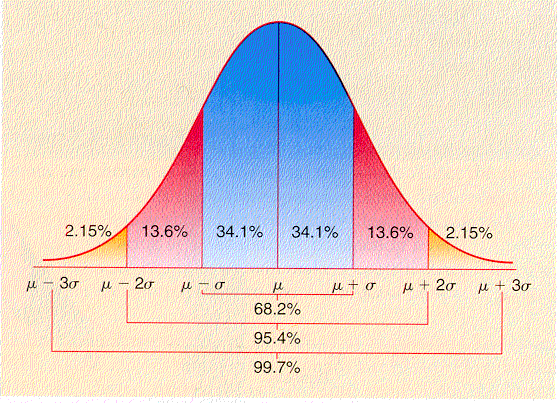
Assume all modules, including FYP, follow the bell curve. This means that your performance is graded relative to how your cohort did, rather than the absolute score you got on your assignments/exams. Let’s say you got 40/50 for a recent test. It’s a 80%, but if the cohort average is 45/50 then you’re unlikely to be getting an A for that test.

This image has an empty alt attribute; its file name is normal_curve-1ftn8yh.gif
pictured: a representation of the normal distribution, or the “bell curve”.

The next question you might have is: how many % of students get a certain grade? Well, nobody knows, because it is not disclosed for obvious reasons. My PERSONAL guess (so don’t quote me to the office) of the grade proportions are:

  • 15-20% of students will get any A (A+/A/A-).
  • 70-75% will get any B (B+/B/B-).
  • 10% get C and below or dabao.

A further EXAMPLE to illustrate. Referring to the diagram above, most students will get a B+/B (the blue regions). A smaller proportion of students will get A- and B- (e.g. the red regions). The smallest proportion of students will get A/+ and below B- (yellow). So on and so forth. Again, this is only an example.

Suffice it to say: the average is a B+. You are most likely to get a B+. “But I am a genius and work really hard,” you lament. Sure – you’re still most likely to get a B+, based on the principle of regression to the mean. My estimate is a B+ because I notice most people around me in HASS graduating with a Distinction, which is a cGPA of 4.0-4.49. It may also be a B in certain courses. Finally, note that a minority of modules (smaller classes?) may be exempted from the bell curve. Nothing’s ever for certain in this murky bureaucracy.

There’s a variant of this question that I also get: is the bell curve steep? Huh? Bell curve differs meh? I don’t know. I assume all modules are curved in the same proportion. Surely there must be some guideline, or students in different schools would be graduating with different proportions of honours.

For more information, see this post written by the incumbent NUS President Prof Tan Eng Chye for an illustration of how the bell curve grading system works.

Is X course/module competitive? (Or: what’s the vibe of the course?)

Yes, it is. It is competitive. I mean, what answer were you expecting? Students fight tooth and nail every year to secure a spot in your course at NTU, NUS, and all the other universities. Why would you think that it would get easier after you’re admitted? But that doesn’t mean you have to be [only] a slave to the rat race. Make the best of your time by focusing on discovering yourself and pursuing what you love.

Do you have Past Year Papers to share?

Past year papers of all courses in NTU can be accessed here (under E-Resources). If it’s not available there, it doesn’t exist. To the NTU Psych students reading this: the Psychology programme does not provide PYPs. Thank you.

Are NTU and NUS different? Which one should I choose?

Nah, not to me. Tbh I bet people couldn’t tell the difference between a NTU and NUS student, ceteris paribus – they’re “functionally equivalent”. (Fun activity to try the next time you’re in a group interview – “Guess the Uni!”) The biggest inter-university difference comes with SMU imo, because students there are trained to make themselves heard. You might hear some casual comments like “NUS is more rah rah” or “NTU is more laidback” but dig a bit more and you’ll find that there are no specifics to these statements. The two universities are more similar than different. But which university do the really outstanding students pick, you ask? Neither – they’re overseas in the US or UK under government scholarships ASLDJSKFJS

Pick the course that you’re more interested in, not based on the abstract “culture” of the school. See my NTU vs NUS Psych post for a comparison of the two programmes.

Is Uni as stressful as poly / JC?

Uni is like Poly+. Same thing at a higher difficulty. More stressful, because the cohort has been further “pruned”. To underestimate the poly students in uni is to make a mistake. We’re very good at what we do, or we wouldn’t be here, because the bar is higher for us.

I feel like JC is a long-distance marathon while Uni is closer to a series of sprints. I think the stakes are higher for the A levels because you basically only have one chance to make it or break it. In Uni you arguably have multiple chances, and the system is a lot more flexible than people give it credit for (e.g. S/U, dabao, 1st sem invulnerability). Not sure about the stress, but JC students are free to leave their comments below.


Update 20/7/22

reflections of a “student leader”

Just around this time in 2018 I was eagerly awaiting Union Day. For many of us, it’s an otherwise ordinary day with a minor perk: classes, by law, are not allowed to be conducted between 10:30am-2:30pm. For me it was a day of reckoning, where my fate as a “student leader” lay in the hands of my peers. In the month leading up to the big day, I had applied for the role of Union Representative (now “Union Executive Committee Representative”) in SSS Club, and had my plans all laid out for a corresponding role in the NTUSU Exco as Corporate Communications Executive (Relations). On Union Day, undergraduates are empowered with the ability to vote and elect a handful of representatives to their school Club, as well as the Big 3 (CAC, SC, WSC). And I was one of those hopeful applicants, filled with dreams and grand visions of a building a better place for students.

look at this sellout!

Fast forward two years and here I am – no longer a student leader of NTU, but a student who can say she’s had the experience of being one. Still, I remain invested in the election affair every year not only because it is an event of personal significance, but also that many of my friends have opted to contest for various positions in the clubs/societies they identify with. But enough about me – this piece wasn’t written for me, but for NTU students.

I aim to answer two questions, broadly:

  1. What is the significance of the student leader?
  2. More importantly: why should you care?

I will juxtapose two perspectives: as a leader from my experience in my junior years, and as an observer watching from the crowd following “retirement”.

The contested role of the “student leader”

What do you think about when you hear the phrase “student leader”? Responses range from the apathetic/nonchalant to mild approval to aggressive frustration. The last one is typically the most salient, perhaps because of the negativity bias. (In other words, we are more likely to recall unfavourable information, and we are tea-loving drama hoes).

There is a murkiness that surrounds the exact responsibilities of student leaders, though I will endeavour to state that this is largely deliberate – this is so that leaders can absorb a range of functions without being unnecessarily restricted. But while its abstract nature offers freedom, it also means little guidance and the leader is left to concretise it themselves. In my role as CCE(R), my overarching aim was to “bridge the gap between students and administration”. That could be anything. I opted to build U-Insight and U-Feedback, since they were the main channels of communication. But if there is not enough key initiatives or functions achieved that distinguish the role, then it is easy for onlookers to claim that the leader is not doing enough, or even that the role is redundant. They’re not necessarily wrong.

I’ve observed a disjuncture between the perceptions of students “on the ground” vs. student leaders on the issue of what they actually do. As a leader, it’s easy to list out all the things that I did – craft and disseminate timely information, manage social media channels, provide copywriting for all publicity materials, respond to students’ concerns… the list goes on. On the other hand, ask any cynic what they think student leaders do and you might get a diametrically opposed view.

this is not uncommon to see. it is not exclusive to the SU.

A compilation of some strong criticisms of the so-called student leader. I address all below:

  • Selfish; only out for ourselves and our resumes, without real intention to benefit the student community.
  • The image of the porcelain doll is apt here: filled with an air of unwarranted self-importance, yet not serving any real purpose other than to look pretty.
  • Limited in power, yet corrupted by power. (Make up your mind!)

I personally believe there is a positive correlation between individuals driven by power/achievement and the likelihood of taking up leadership positions. But this does not necessarily mean they will be selfish. The ability to make a change is imbued with power, yet this proposition attracts different kinds of people. Some are motivated by a real desire to do good, and I also know of others whose ego is wildly out of proportion to their capability. It is unfair to make broad generalisations of the entire character of a group based on a few eye-catching examples. The best way to know is to judge for yourself, and this is not via hearsay. It is about hearing from the candidates themselves. I elaborate on this later.

Another common accusation is that clubs and societies are merely extensions of the administration/upper management. Here is where I recall an article I read in a module on organisational structure (HS2005) by Kanter (1994). It addresses issues of power. I took it the same semester I was in the Students’ Union, and thus found it particularly relevant. Kanter proposes that there are three sources of power in any organisation, and I attempt to contextualise them here.

Power

First is lines of supply – the more capacity a leader has to bring in new resources such as money and materials, the more powerful. It is important to establish here that virtually all events are funded by the school/SAO. Thus, proposals by student organisations are subject to multiple layers of approval and careful consideration of costs and benefits. This means that bargaining power is relatively limited, especially if it is not in line with the consensus from management.

Next we have lines of information – knowing current affairs and relevant news. The club has a bit more power here if they can manage to conduct surveys that assess members’ opinions, which they can then use to strengthen their claims to the administration. However, due to the inherently hierarchal structure of the system, information on school policies is often ambiguous or not conveyed to student leaders altogether. The opacity of the decision-making process at the highest levels of NTU is common knowledge – only when decisions have been confirmed are they announced to students. While there is an effort to include representatives in this process, this is not always a guaranteed. Furthermore, the rapidly-changing nature of key events such as Covid-19 means that things are constantly in flux. When students write in asking for certainty in uncertain situations, there are a very limited range of responses student leaders can pursue. It takes time to clarify.

Last we have lines of support – the power to call for extraordinary, innovative, but risky events without having to worry about resistance. This is arguably the most complicated. A bureaucratic structure is naturally predisposed – by design – to maintain the status quo as far as possible. The life cycle of any ambitious uprising against the current order is like that of a bug’s – short and usually quashed before it can grow into anything bigger. Irreversible upheavals are anathema to the existing order. Even at the policymaking level, many initiatives may be delayed with the rationale that “more research is required to avoid unforeseen consequences”. And that is rational to say considering any change has implications on up to 24,000 undergraduates at an institutional level. But that is not to say extraordinary things can’t be achieved. I don’t believe that the history of NTU has ever seen a fully S/U-able semester until last year. And that was achieved because students were able to collectively galvanise their interests, providing the sufficient momentum for student clubs to campaign for changes. However, it comes with great difficulty, and you need the right time, place, and people.

Agency

One note to make is that our system of (school) governance is not universally applicable to other cultures. When I was in McGill University I saw critical reports on existing practices all the time. But that’s not how it works here. It seems like a very cop-out answer but I believe it is best understood within the broader climate of Singapore’s political ideology.

Student leaders, by virtue of their position, are agents created to perpetuate the existing order. This is not their fault. They still do their best with the resources and constraints they have. There is a lot going on behind the scenes that members sometimes take for granted. Those “welfare pack” events every year that some mockingly disparage even as the same people readily join the thousand-strong queue for them? They take months of planning and logistics. Not to mention that there are tons of other activities occurring across the year. And even event-running is pivotal to maintaining school culture. We take student activities for granted until they disappear.

Leaders as just “overhyped event planners”? I recall the time my colleague showing me a 50-page document reviewing a school policy based on a large-scale survey that he had teamed up with another colleague to implement (hi A if you’re reading this, pat on the back for you). I would have disseminated it but got shot down before I could. His partner (also A, love y’all fairies) worked himself half to death over policies relating to student life, personally tailoring thoughtful 300-word responses to students who were flagging issues they faced. He finally saw his ideas come to success after months of back and forth, but was it worth it? Either way, I know he did his best.

The student not immersed in this reality only has a partial view into what leaders actually do – but that’s not their fault. The student-member doesn’t see what’s going on, because they don’t have access to this privileged information. I argue that this is due to the limitations on the part of clubs (and perhaps by default the system as whole) in measures to ensure accountability and transparency.

Accountability and transparency

I had the pleasure of attending the SSS Union Rally last Friday via Zoom. I noted a discrepancy in the recruitment emails and final rally line-up sent earlier that week by the club, and thus I sought to clarify the matter as a Concerned and Invested Member. Unfortunately, I picked an inappropriate time to do so, during the transition between two candidates — the Returning Officer appeared visibly thrown off by my question. Seemingly offended by my indiscretion, he first spluttered that I should have “done my research beforehand based on the information available” (but I did, or I wouldn’t have a question to ask in the first place…). He then proceeded to inform me chidingly that it was rude and unbecoming to unmute and show my face in a rally(!) without seeking permission to do so.

Throughout this lecture, he did not answer my question nor seek to clarify what I meant. He did say it could be asked at the end of the rally “when the questions are open to the floor”, but I left because I have better things to do than sit in for another three hours. Still, don’t take my word for it – verify it with the recording of the rally! If they make it publicly accessible, that is. (Maybe if a Student Advisor was present, there might have been a better outcome to this? Hahaha!) Of course, there are many potential innocuous explanations for the discrepancy. The club is welcome to respond to my question and I will revise my account where necessary.

every voice, always heard.

Every year leaders face the same problems and ask the same questions — how do we increase student engagement, and actually make changes that benefit the members’ welfare. These are questions with no answers and no end: we can only inch forward slowly in trying to discover what works and what doesn’t. One way to start is to increase transparency and accountability of all processes, and not ignore students’ concerns. If the students know what is going on then they can be invested in it. But this is, of course, not as easy as it sounds.

Before Covid-19 happened, there would be a period of time where applicants’ details were publicly displayed at the foyer for students to peruse. Inconsistencies, if found, could be raised to the election committee, and disqualifications could ensue if they were found to be legitimate. For example, I believe there is a rule whereby you cannot have a fellow candidate endorse you (you need a supporter and seconder for your application). Maybe in the transition online, this process was omitted. I didn’t know who my representatives were until two nights before the rally.

I have good faith that the student leaders did their best for SSS Club during their term. They organised a few events, e.g. a welfare-themed one. In response to students’ concerns on the newly implemented S/U option, they provided relevant clarification on questions raised by students. They created a new social media page @sss.academics to address academic concerns. There are a lot of background processes running at any given point, and we should give them credit for what they have achieved.

I believe that the onus is on student clubs to make information about club proceedings and updates easily accessible to their members. That means that relevant documents should be stored in an online location that is retrievable at a click and not hidden in some dusty treasure chest. In my opinion, reports, constitutions, or meeting minutes should be sent without question upon request – and the member shouldn’t even have to ask for it to be privately sent in the first place. It should be a given that it is publicly available. Fun Accountability Test: send an email to any club asking for their constitution and assess the response you get. I will qualify this by saying that clubs often have to strike a fine balance by deciding what is shared and what is not, because you don’t want to risk inundating your members with information to excess and driving them away or detracting from other relevant matters. Presidents should also regularly conduct reviews to ascertain if certain positions are doing too much or too little.

Walkovers

A final phenomenon to tickle your interest is the overwhelming tendency towards walkovers in school elections. This means that only one person is running for one position. But did you know that all roles, as long as you meet the prerequisites, are open for contest? Some societies do engage in deconflicting strategies to maximise student fit but a position doesn’t “close” even if there are no vacancies – nobody is guaranteed a position until they are officially voted in on Union Day / Annual General Meeting. So watch out when you receive a recruitment email where certain positions are omitted. Oftentimes you can still apply for those omitted from the list – and you should raise alarm if you receive a suspicious, deflecting, response. The reservation of roles is not allowed. But nobody is handing you anything on a silver plate – you want it, you should be prepared for it. Anyway, walkovers are the norm, and contests are the exception. This creates a troubling situation sometimes when onlookers perceive leaders as incompetent (but there is no better choice). Yes, if there was a better choice they wouldn’t win… but where are the contestants?

Okay, so what?

The takeaway for students is: if you’re frustrated at the current state of affairs, demand accountability. Make your opinions heard, and stand for constructive change. Even if you think student leaders suck, being one is better than being a sitting duck lamenting that nothing is happening. In case anyone takes my words out of context: I have NEVER once blamed students for any of this. I have made it clear that it is a STRUCTURAL issue. But you have the POWER to change it.

Vote. Know who the people representing you are. Ask questions (at the right time, I guess). Save the receipts. Demand accountability. Attend your AGMs and rallies and ask your questions and find out what events are relevant for you. It’s not as if you have anything to lose. Watch out for leaders who present with an arsenal of lofty, abstract ideals (hot air) but have no concrete plans to back it up. If they say they want to “improve the welfare of students”, ask them what examples of initiatives they have in mind and how they will implement them. Don’t be afraid to vote against people that you feel don’t reflect your ideology or are ill-equipped. Again: your vote counts. It will tomorrow. It always will.

Wow, you’ve made it!

Special section for Psychology students only. Come for AGM tomorrow! (See @ntupsychsoc on Telegram.) I wish to promote my friend Tarif who is running for president in PsychSoc this year. He is an outstanding student who excels academically and socially. As a former student leader, whatever that means, he has my stamp of utmost confidence. But decide for yourself! Tune in to PsychSoc AGM tomorrow (Tues, 15/9) 6:45pm on Zoom to hear more about his plans and ideas. (He has concrete plans!) And of course, vote – your opinion matters. Note that you need to be registered as a member to attend the event.

he’s on the left.

Update for my tea-loving drama hoes

Woke up this morning to this:

nice new vision
look ma, now i can ask questions on the spot

Coincidence? Whatever it is, remember to vote and question.

my NTU URECA experience: a review

Updates 20/7/22:


I first received the invitation to join the NTU URECA programme in August 2018. It was an exciting time. Early on in the game, all the possibilities seemed so alive. So I jumped on the bandwagon and went crashing into a wall at full speed. Wait, what?

Excuse me. Let’s try again. In this post, I will recap my URECA journey over the past year for your benefit and mine. Mandatory disclaimer: I did a project relating to the social sciences, so the research process may vary with other disciplines.

Yes that’s me and my beautiful friend Cal.

Background

All good research papers must begin with a succinct and relevant background of the topic. The current piece is no exception. URECA is an acronym, standing for Undergraduate Research Experience on CAmpus. It’s a derivative of the word “eureka”, which implies a moment of insight where a solution to a complex problem is spontaneously realised. This all sounds great on paper, but I will inform you now that the reality is nothing like that. There are no sudden moments of miraculous magic, at least not without the preparation. There is only pain, and in it some potential for growth, if you make the best out of it.

i‘m only putting pics bc i know people get intimidated by huge chunks of text.

Registering for your project

If you are interested in joining the programme, there are two ways to go about it. Both of them involve attaching yourself to a research project. The email that the office sent delineates three options, but two are essentially the same thing.

  1. You pick a project that is already available on the portal.
  2. You propose your own.

The first one is straightforward enough. Half the work is done for you. The seeds of the idea have already been sown by the professor and their team – all you have to do is to bring it to fruition. Plus, some projects sound like they promise a lot of fun. (“Psychophysical investigation on association between tactile softness perception and onomatopia”? Count me in!) Looking at the projects available this cycle, I am reminded of how the research space is bursting with creativity.

You don’t have to limit yourself to your own major either – you can choose to work with professors from other disciplines. Ah, now is a good time to mention: you might be interested in working with them, but they must want to work with you too. Professors are popular and they know it. They revel in it. And if they have to pick the best student to work with, they will. So prepare your résumé and a convincing argument why they should pick you over the others; you never know when you might need it. As far as I know, it is customary to meet the professor in person to express your interest and get the ball rolling (for some of my friends, it was the one and only time they saw the professor in the flesh LOL).

Anyway, me being the masochist that I am, I opted for the second option. I wanted to do something related to Psychology, but I wasn’t particularly inclined towards any existing project either. And every moment I hesitated, professors and projects were being snapped up left and right. My strategy: I identified a list of professors whose areas of interest overlapped with mine, and sent them customised emails. Customised emails = not merely replacing their names, but a brief comment on their field of specialisation and how my potential project aligned with their work.

sticks and stones may break my bones…

Prof Catherine was the professor whose work (and later on, personality) intrigued me most. Yes, disclaimer: I am her fan and I will spare no effort to put her on a pedestal from here onwards. I am kidding, but I am really not. She had no projects registered on the portal – I found her through the staff directory. She benevolently stated in our first meeting that she would be Very Busy (she still is) and due to that I might suffer (I did, a lot), but she was otherwise willing to give the collaboration a shot. It’s hilarious thinking about this now because my ideas got so butchered in the process of development that I wonder if she knew what she was saying yes to in the first place. But I am happy that it worked out with her, and I have #noragrets.

Idea development

Another pivotal part of all good research is a fresh idea. As I have mentioned, if you have opted for Option 1 (selecting an existing project), this should be relatively easier because the foundation is already laid out for you. Still, this doesn’t mean you have a license to relax. Expect to do a lot of reading and critical thinking during this period, where you need to pick out relevant literature that supports your project’s thesis. On top of that, you need to innovate by coming up with your own unique selling point of your project that makes it worth caring for. Sorry kids – plagiarism and social loafing ain’t gettin’ you through this one.

Fortunately, the URECA office offers a few workshops to help you through this process. There are some useful tips to be gleaned from those sessions. (There are also compulsory quizzes.) I get the impression that some students look upon them as a chore rather than an opportunity to benefit. Ultimately though, it’s your project, and whatever you make of the experience is what you’ll get.

For Option 2 (proposing your own project), it’s the same thing, but on harder difficulty. I took a good few months before finally settling on a central idea, and that was after redoing the whole thing at least three times. It’s not like erasing a few lines and rewriting it – more like throwing the whole whiteboard out, markers and all, and replacing it with a new set. In the meantime, I had to deal with being interrogated by my astute Prof C every other week. She caught all my presuppositions, prejudices, and paradoxes in my proposals and reflected them to me. And where I could not account for them, I had to go back and think about it until I could. There was no escape. (There is no escape from mediocrity and misery. If you can accept that, I am sure you can accept anything.)

Data collection

I underestimated the potency of the data collection process. The actual “collection” per se is time-consuming, but it’s hardly the most taxing part. It’s the preparatory work: the justification of questions, supervisor comments, the ethics committee’s approval, participant recruitment and management, booking of rooms, financial reimbursement… merely typing this makes me shiver. It is not as intellectually challenging as the idea development stage, but it is extremely tedious. Start as early as possible. Even though I started the preparatory work in March, by the time I was officially allowed to begin data collection, the exam period was already setting in. As such, my potential pool of participants was reduced (screams in small sample size).

I could afford to have 160 participants, so I had to exhaust every resource I had to get as close to that number as possible (or risk the wrath of my Prof!). Thankfully, my course department was supportive and accommodated my requests for reaching out to the participant pool. Other than that, it was posting on social media (fyi: there’s a Telegram Channel called NTU Paid Studies/Surveys for this purpose) and begging my friends.

My means of obtaining data was an online survey. However, to replicate “laboratory conditions”, my participants had to make the trip down to the computer lab and complete the survey under my Watchful Eye. Upon receiving their registration deets (slyreply.com is popularly used in my discipline), I sent multiple personalised reminders (including specific time and location) on the advice of my all-knowing Prof. You can imagine the chaos that come from dealing with humans, who are inherently fickle. Some didn’t read the instructions and registered when they did not meet the eligibility criteria. Others registered a second time after not showing up for the first appointment and ultimately still did not come (why??? WHY???). But most were polite and came on time, though I would have been even more grateful if they had not mowed through my painstakingly-crafted survey in the span of a few minutes.

Data analysis

This is arguably the part where I struggled the most. At the same time, I learned a lot. While the data can be anything you make of it, you need to know what to do in the first place! There’s not much to talk about here, except that it involved yet more meetings (à la Coffee Confrontations) and actual revision. I had to scour through my archives to find my statistics notes from the previous semester, so that I could identify the limits of what I previously learnt and by extension what I was expected to know (not that it mattered, because I knew nothing). If you’ve noticed thus far, URECA is basically an opportunity to apply the material you’ve learnt in university, with some scaffolding from your professor. I ran so many SPSS tests I started dreaming about them at one point.

Prof held my hand through my suffering. I am still grateful. I remember one of our final meetings where we were deciding whether to investigate a marginally significant 3-way interaction effect. She took 30 minutes to illustrate in detail what tests I would be expected to run. At the end of it she looked at my face of despair, deadpan, and we collectively decided we would be strict about the cut-off p value after all.

Report writing

Not only do you get to improve your knowledge relating to your topic, your report writing skills will be sharpened too (I sound like an advertisement – I should be paid for this LOL). Remember those academic writing modules that we were made to take? I hope you paid attention, because those actually come into good use here. You’re given only 12 pages so every sentence counts. At least, my Prof was exacting in her expectations that there were no loose ends and all threads were tied up neatly. While my end-product was by no means spectacular or perfect, I attribute its relatively decent quality to her attention to detail. (Check out my final report here). In short, if you want to create something you’ll be proud of, set standards for yourself and be sure to communicate your expectations with your supervisor.

Other notable events

There are some events that I did not cover above. I probably don’t remember all of them but here are a few major ones to look out for.

  • ICUR-URECA (International Conference of Undergraduate Research). Optional. You get to watch the presentations from the best of the previous batch of NTU-URECA students, as well as students from other universities. It was intriguing enough for me, though it did not inspire any ideas on my part. If your project is eventually good enough, you may be selected to participate yourself. (2021 update: I submitted my FYP-URECA project to this conference, and was waitlisted. HAHAHAHAHHAHAHAHHA)
  • Poster Presentation. Optional. You summarise your project into the size of an A1/2 board and present to judges and interested passersby. They get to vote on their favourite poster for each category. It’s fun doing with friends. (Trivia: that’s where the video at the top of this page came from.)

QnA – our favourite thing

1. Is it worth it?

This is such a loaded question. But for my fans I will deliver.

It’s worth it if:

  • You intend to pursue a career related to academia, or a post-graduate degree.
  • You have some interest in research and you’re looking to test the waters before committing. In that case, think of it like a hands-on internship project. One where you don’t get paid, that is.
  • You are particularly passionate about a specific topic in your discipline (e.g. social psychology, quantum mechanics??) and you want to use this opportunity to expand your knowledge base or plan ahead. FYP-URECA is this initiative where you basically do a sequel to your original URECA project with the same professor, but this time you mark it as a FYP. This obviously suggests a great deal of dedication to a single topic. (2021 update: this paid off for me! I qualified for FYP-URECA because of this foundation I had set two years back).
  • You are emotionally and physically ready to invest a substantial portion of your time developing and cultivating an idea that may not pay off in the end (I would know).
  • You enjoy the camaraderie of suffering with your peers.
  • Having a slight tinge of masochistic tendencies in your blood also helps, because you’re going to need it when you inevitably get bashed by your professor. They can’t help it – it’s an occupational hazard, dealing with naive students. I can’t count how many times my mind felt like it was on the verge of imploding because my professor decided to ask me if I had learnt 6D multimatrix regression in stats class or something.

It’s probably not so worth it if:

  • You are unlikely to end up in academia
  • You just want to make your resume look nicer (there’s no point really – most of the research comes back with null results and gets buried somewhere in the void of space). I guess it can be a good conversation starter though. “Hey, I conducted my own student research project. I got none of the results I expected, but at least I tried.” Sounds about right to me.
  • You’re doing it for the AUs. It’s not worth it. You’ll need a lot more than that to get through it.
  • You are currently overcommitted. There’s only so much one can give. If your will collapses, so does everything else. Be ready to sacrifice something in return for a good piece of research, whether it be your sanity, your sleep, your co-curricular activities, or those nights out with your friends. My informal guideline is that you should have no more than 3 major commitments including this one (leadership positions and academics included). And that’s already a lot to handle.

2. What’s the workload?

  • If you are consistent with your effort and pace yourself, it’s actually not much. I could get things done the night before early on, though as the project progressed I had to start earlier in the time leading up to my meetings with my professor. Since the final product should not exceed 12 pages, it is comparable to the length of a group assignment. Considering you are given one year to do it, it’s manageable. At the time I was doing it, I was pursuing a 2nd Major, had co-curricular activities, and went on summer exchange too.

3. Should a person going on semester exchange take it up?

  • I would say no. You miss out on valuable f2f time with your professor, and that’s where you get the most out of meetings. Texts and emails can’t replicate the, should I say, eureka feeling. LOOOOOOOL. Plus, who wants to spend their exchange worrying about deadlines on a research project? If possible, I recommend you schedule URECA for one year and exchange in the next or before.
  • Truth is, I’m not sure if this is even allowed. Please write in to the office to ask; they are always there to entertain you. Prof Siva is very nice – I talked to him on the phone once. Feelsgoodman!

4. Pass/fail or graded?

  • Pass/Fail. 4AUs. You may be able to get pass with merit (or some kind of special award) though. I was awarded the title of “NTU President Research Scholar” on the basis of outstanding achievement, though I have no clue how common it is. They don’t give stipends anymore, beginning from my batch. I was registered in Sem 2 (HE9015 Undergraduate Research) but the entire duration of the project was one academic year, or two semesters.

#Protips for Pros

  • Communicate with your professor (or your PhD student-in-charge, lel). I always set deadlines in advance and there was rarely, if ever, a period of time where we both did not know what was happening. Perhaps that was because I could always feel her disapproving spirit loom over my being, but whatever goes.
  • Take advantage of the opportunities the URECA body offers. This means participating in the workshops, poster presentations, conferences, blah. You may not win, but you will learn either way. Not only was I pushed out of my comfort zone, I also learnt to identify the people around me who actually cared for the things I was passionate about. (There were not many.)
  • Plan ahead. While I did not rush to finish my work, I missed the deadline to submit it to an international body (Global Undergraduate Awards Programme). While I wouldn’t have won anyway, I feel bad that I didn’t manage to enter at all. If I had completed it just slightly earlier, I might have made it. So don’t estimate to complete your work on time, but complete it earlier. There are a lot of stages to research, as I listed through this post, so having a sense of the big picture really helps. I thought once I had gotten past the literature review phase everything would go easy but no-o-o. There is still data collection, and data analysis, and report writing, all of which were challenging in their own right.
  • Every professor has their own style and quirks. If you do not know what they’re like beforehand, you can only pray and roll with it. Being adaptable goes a long way here. Asking your seniors about your professors’ personalities as a precautionary measure is also wise. I am lucky that I met a nurturing one who was willing to make time to see me regularly, but this is not universally applicable.
  • Make your own notes of the dates and pointers provided by the URECA office. The office (or just Prof Siva, the Director?) is generally quite thorough in its instructions provided over the course of the programme, but the email content can be all over the place.

Mandatory self-plug

I mean, since I’ve written so much, I should share about my URECA project too. Let me pluck it out of the dust. Okay. I just tried to break down my thesis and hypotheses, but I gave up. So I will just put the entire paper up for view here. Like I said, it’s not an excellent paper by any means, but I’m nevertheless happy that it’s here. It’s tangible proof that I tried. And I will remember the memories that came with it. I also want to thank my loved ones, in particular V, L, and J, for being there for me.

If anyone is reading this, I hope this article helped you to know more about URECA and possibly contribute to your decision on whether to take it up or not. I’d be happy if you could share it with your friends who are in a similar situation too! 🙂 If you have any questions, feel free to contact me and I’d be happy to help.

Jul 2021 update: I’ll be writing about my FYP-URECA experience sometime, so stay tuned. You can subscribe to this blog by entering your email on the right side of the page. Or follow me at @gwynethtyt on Instagram for live updates and clownery.


Updates 20/7/22:

until then losers!

hello, losers

That’s right. After an interminable period (frankly, I can’t recall how long) of me yapping about creating a new blog for all my fans, it’s here. You may look forward to my official Youtube channel in another four years.

Why should you care? I mean… you don’t. And you won’t. It doesn’t matter. I am sitting alone, just as you probably are. Sometimes I dream about dying alone. That’s fine too. It’s okay to let the existential angst inundate your being once in a while. But if you enjoy ruminating about insignificant Everyday Things or you ever feel up for a mini-debate, you’re always welcome – even if you’re one of my haters! (If you think I don’t have any, you’d be surprised – I am so popular it pains me. I can’t even sin in good conscience anymore.)

Topics that may or may not be covered for the next two years or so include university life, human dynamics, sins, with a generous portion of psychology magic dust sprinkled on top of it all. As you may already know, I enjoy oversharing about my life to the discomfort of others, though I should really know better. Either way, you’ll get my irrelevant opinions on all sorts of issues. You are cordially invited to join me and weigh in if you have any points to advance the conversation.

Recently I was encouraged (pressured) to develop this ability that is called self-censorship. Personally, I think that it is a tragedy, and it says a lot about me being unable to stand up to the forces (expectations) that weigh down on me. But a lady’s gotta survive in this world, and that means: no expletives, and no inflammatory opinions that might offend others’ sensibilities (which I agree is perfectly legitimate, though the extent to what is offensive is really relative). Hopefully this means I will be using eloquent and rational arguments, rather than just angry ranting, to express my opinions. I mean, the last time I said that men annoyed me I was reported for it (LOOOOOOOOOL). Maybe I deserved it? But I’m a reformed woman now. You know it. Anyway, I expect the same from all my fans (i.e. you guys).

Finally, feel free to correct me if I make any grammatical errors, if you want to. It’ll boost your ego, make you feel superior for a while (I guess), and help me to improve. Or critique my ideas. I don’t know. Actually, I don’t know if I want to be criticised at all. My fragile self-esteem might crumble. In fact, why am I even thinking so far? What if nobody even reads this? It’ll be the ultimate #sadcringe. Oh man.

Let me know if there’s anything you want me to write about, and I’ll credit you for it if it’s a novel idea. Not that you care, but yeah! xoxo