gwyn’s theory of interpersonal interest, #1

In this series: #1 | #1.5

I was recently invited to give a TED talk (where TED stands for Topical Extended Discussion here) by a clown. Of course, I have risen to the challenge.

I began with the intent to capture obsession but got sidetracked into operationalising interpersonal interest instead. Oh well, still a worthy contribution to society.

A brief primer on terms used in psychometrics (the art of measurement in psychology). Since I have repeated this to my students ad nauseam, I might as well lecture my fans too.

  • A concept/construct: the phenomenon you want to understand. Usually a “big idea” that needs further definition and explanation. In this case, interpersonal interest.
    • What does it mean to be interested in someone?
    • What are the characteristics that comprise interest? What are the central elements it must have, such that if they were not present, the concept would no longer be “interest”?
  • Operationalisation: to make a concept measurable. What are the observable signs of interest?
    • We must be able to see and measure these markers. For example, if thinking about someone is a sign of interest, we should be able to measure it somehow.

      • Example: count the number of times you think about that person in a day or the percentage of time you spend thinking about someone compared to others.
    • Things that are not measurable are psychometrically (and scientifically) worthless.
      • Example: the “energy vibrations” I send out to the universe when I am cursing men to dream about me. HAH

mrw I received this TED talk offer

Interpersonal interest: how much you’re interested in someone or vice versa. Contextualised to social media since that’s my panopticon playground and main site of research.

Now, the Checklist

Signs, in order of increasing intensity (0/absence = least interested, 5 = most interested). Checking off a sign higher on the list indicates that the lower signs have already been met.

  1. Watching your stories.
    • The more stories you watch and the more you regularly check for updates, the stronger the interest. (If your defense is “I’m just scrolling”… don’t you have better things to do?)
  2. Visiting your public platforms unprompted.
    • The preceding suggests they are taking the initiative to visit your profile (or blog, hehehe) without an external stimulus i.e. the action stems from an internal desire. Quite telling behaviour, if you ask me (I adore men who are obsessed with me).
    • Unprompted access to your profile is trickier to measure, but you can make logical deductions (my favourite activity). I wish I knew who read my blog, but it doesn’t matter because I delude myself into thinking that everyone reads it anyway. Delulu~ is the solulu~
  3. Texting.
    • Obviously. The more frequent and initiated, the stronger the interest.
    • A step up from the above because it means that at least one party has initiated contact, hence manifesting the interest. But see the section below on power asymmetry.
    • By the way, DMs on Instagram are like a 2.5. We’re not really friends until we have each other’s numbers (and I’m not just saying this because it means you can then PayNow me).
  4. Meeting in person.
    • Kind of an inevitability following 3 if the relationship is worth anything — see comments below.
  5. Putting aside your ego for them.
    • Best illustrated with a negative example — persistence in effort despite being rejected. Imagine one of your best friends said one day that they wanted to end the relationship. If you would fly down to their place and cry at their doorstep begging them to take you back, that’s a 5.
    • Because it means you’re down so bad you’d put your pride down for another shot, even when the odds are against you. The relinquishing of pride, given its fundamental importance to one’s self-esteem, is the greatest compliment you can confer upon another.
    • We love that; I do. I’ve done it before, and I’ll always have a soft spot for those who’ve tried it with me.

Some comments

  • Before you rate them, you must pre-categorise people into romantic OR platonic interest.
    • If you can’t decide, default to platonic (if you have to think twice, you don’t like them enough — don’t waste their time!)
    • Being interested platonically does not necessarily mean I am interested romantically (fine: the “friendzone”). BUT if I am interested romantically, I am probably also interested platonically. So romantic is a sub-category of platonic.
  • 3 (texting) and 4 (meeting in person) are the most intimately connected signs. The jump from 2 to 3 and 4 to 5 is comparatively large. Not that a relationship can’t be solid if it’s based entirely on text exchanges (the modern equivalent of a pen pal), but unless you have some extenuating circumstance (e.g. live on the other side of the world), there is no reason to not meet.
    • I detest 3.5 romantic prospects the most — those who linger in texting limbo but do not entertain further contact. They’re playing you, sis! You are a backup plan. DROP them like a hot potato, stat.
  • Only consider people 3 and above to be potential friends, 4 for lovers.
    • The 2s either have no courage or do not care enough about you to pursue a relationship. Neither is your problem. Your time should be spent cultivating 3s, 4s, and 5s.
    • They’ve said that they love you over text but can’t seem to find the time to meet? They are asking for a small loan of $20,000, too? They are a LOVE SCAMMER.
  • If you meet a 5 and you feel 5 towards them too — keep them in your life as far as possible.
mrw cornering people i like

On power asymmetries

And now, class, a fun activity:

  • Identify someone you’re interested in.
  • Rate your level of interest in them.
  • THEN, rate — based on their past behaviour — their level of interest in you. Only look at what they’ve done: do not assume, do not infer their intentions.

Use the following formula to determine the interest asymmetry score:
[their interest in me] – [my interest in them].

Examples (may or may not be taken from my past experience):

  • Someone acts like a 2 to me [their interest in me]. I act like a 0 to them [my interest in them]. 2 – 0 = +2.
  • Someone acts like a 0 to me. I act like a 5 to them. 0 – 5 = -5.

A positive score indicates that you have more power in deciding how the relationship will develop presently. A negative score indicates the power is in their favour. Higher scores = greater magnitude of asymmetry.

Any asymmetry calls for an attempt at rebalancing.

  • If you have more power (+): decide if their effort is worth matching.
    • If yes, match it.
    • If not, let them down easy. That’s the least you can do for them. (Except for players. Drag them to hell, babes.)
  • If you have less power (-): decide if they are worth your time and investment.
    • If yes and you want more, COMMUNICATE YOUR DESIRES.
    • If not, off you go for greener pastures, sweaty! We have no time for low-effort relationships.

That being said, you never know how someone might respond to you in the end. (People might really be watching my stories simply because they are interested in observing hypomania in the wild, or because I’m super hot, and NOT because I’m a complex person with deep feelings and thoughts and great music taste. Sigh)

And the scorecard now does not mean it will always be the same; people and contexts change. In particular, based on my past experience, the power dynamics in intense relationships (another favourite of mine) are always fluctuating. Is that stable? No. But is that fun? Absolutely.

Finally, we manifest that we will only settle for 5-5s.

Well, class is dismissed; I hope you enjoyed it. My DMs are always open to new ideas! x
kiss

gwyn’s lay theory of relationships, #3

in this series: #1 | #2 | #3 | #3.5

Humans commit to one another based on considerations of potential. They assess a prospect’s suitability and commit if they decide the arrangement is satisfactory.

Assortative mating comes into play here.

  • You date people you think are “in your league”, or if you’re lucky, you think are out of your league. Despite this, objectively speaking, if they like you back in the long run, they’re in your league (because they feel the same way about you — they think you’re good enough for them). So don’t be insecure about yourself, okay, babygirl? And watch out for lovers who regularly put you down — it’s not you, it’s them.
  • Ever heard of the ELO score on Tinder? That’s what’s operating here, except that Tinder is the World Wide Web (Offline).
  • Your ELO score comprises different dimensions: physical attractiveness/sex appeal, intelligence, wealth, health, humour, “personality”, etc. People differ in their preferences on those dimensions, although universal trends exist. Example:
but note many people don’t know what they really want, or lie to themselves. You and me included.
  • Naturally, idiosyncratic preferences exist. For example, I like simps. (Wait — who doesn’t?) Random disclosure from me because I love to overshare, and I want to remind everyone to know your worth: I permanently disqualified someone recently because he acted like he had no time for me. Huge landmine he stepped on. Well, so be it. You can play games with me… if you’re ready to lose. (Like, I said I would be okay if my partner had little time for me, but you can read my blog but not text me? Then you can stay a blog reader, thank yew.)
    • The preferences are gendered. Universal example: men prioritise physically attractive women; women prioritise high-status men. So, you are more likely to see a rich older man with a hot younger lady than the opposite.
    • The preferences are culturally influenced. Anecdotal example: sexual prowess does not rank highly for a lot of people in Singapore versus some other Western nation where hookup culture is more prevalent (I don’t even need to be specific; that’s how little sex we have. I must go.)
  • A relationship between two people who differ significantly on one dimension can still work out if that dimension is less important to the party who is higher on it. Hence, the “ugly funny guy gets the boring pretty girl” because looks > humour for him, humour > looks for her. You get the idea. On average, their ELO scores even out.
    • Lay theory prediction: the longer a relationship lasts, the more objectively similar the couple’s ELO scores are. A relationship with partners with discrepant scores is less likely to last, and the one with the higher score (delusional or not) tends to withdraw first. But even the delusional one will eventually be knocked back to reality through trial and error feedback — the only constant in life is the law of large numbers.
    • The best way to get an idea of your ELO score is to look at your long-term partner (or the kind of people you attract). If it still doesn’t add up… one of you has a self-esteem issue.

People commit based on potential. They stay committed for different reasons.

The investment model of relationships (Rusbult, 1980) predicts that commitment is determined by three factors. The more satisfied you are with the relationship and the more invested in it, the more likely you are to stay committed. The better you perceive your potential alternatives (other people in “your league”), the less likely you are to stay committed.

Some relevant concepts:

  • Sunk cost fallacy. An economist’s favourite. You’re unhappy in a relationship — but because you’ve invested so much into it, you might as well stay. Consider prospective and opportunity costs instead, which is what you lose by staying. Then again, I still can’t let go of my Sea Ltd stocks. So don’t let me tell you what to do.
  • People who claim they’re “dating down” are lying (and to themselves, too, if they lack self-awareness). You’re staying because you think you couldn’t get a superior alternative if you tried. If you genuinely believed you were dating down, your staying is irrational, meaning there is more to unpack there. Note that these evaluations are inherently subjective — just because you think you’re dating up or down doesn’t mean others will agree.
    • The lesson here (for me) is that if you want to assess your compatibility with your partner, don’t ask yourself. Ask your friends. Ask your parents. They might be biased, but they’re less biased than you.
  • The higher your ELO score, the better your quality of alternatives. That’s why hot guys can afford to play around. I’m just waiting for it to be acceptable for hot girls (joking — I don’t care).

Personal exposition (love and naïveté)

Men in Singapore are looking for stability. At least, an overwhelming number of men I’ve met are like this (same for women, where there is even less variation). My observation is definitely age-contingent, though. Guys are looking for girlfriends at 20 but wives at 30.

I was baffled for years about the preoccupation with stability, but I might be starting to see the light. Love’s great in itself, of course, but it is not enough in the great Pragmatic Nation of Singapore. People want love to lead to concrete outcomes, such as marriage, a BTO, and, most importantly, in the grand scheme of things (driven by a force beyond our control), children: the continuation of our species.

And why not, indeed?

Objectively speaking, the above are not inevitable outcomes of love. A counterpoint, however: maybe love — romantic love in particular — evolved to perfection precisely as an instrument to ensure these outcomes happen, over and over again, across humanity, and beyond time. That is, love was designed to lead to stability. Rather than being choices, as I hypothesised in post #1, they are merely two points on the same line headed in one direction. You either realise that love is to settle or stay naïve.

So, love is not enough.

Maybe I am naïve. I don’t really care. I’ll panic when I’m 30, I guess. Even if singlehood and living in a henhouse with my girls is my destiny, it’s not as if I’ll be loved any less. Put that on the record: it is what it is. Do what’s good for you.

Stay loved, and don’t fret, my darlings.

gwyn’s lay theory of relationships, #1

in this series: #1 | #2 | #3 | #3.5

I have a lay theory of partner selection preferences of males and females in heterosexual romantic relationships. Oh, hear me out — it’ll be a fun ride (perhaps even obvious in hindsight!)


First tenet: Men and women have different criteria for life partners.

Men settle for stability, and women settle for love.

Men are more rational and calculating: they choose to settle with women they intuit they can build families with. This is not necessarily the woman they love the most, although they will definitely try to convince themselves so.

Another way to put it is that they will eventually marry the women their mothers approve of more. As a man, you might scoff at the idea that your mother has any real influence in deciding who you marry, except she does — you just haven’t consciously come to terms with it.

The above is where the “girlfriend but not wife material” (GBNWM from now on) descriptor stems from — because men are better at separating love, sexual desire, and marriage. So, the woman who he loves, the woman who is attractive to him, and the woman who he marries can be three different women. Lucky him if they are the same woman, but they are often separate.

Women are more emotion-driven. They want to and are more likely to settle with men they love. This would suggest that love and marriage come together. And what about sexual desire? Ever heard the familiar story of girlfriends hurt by their boyfriend’s pornography/Insta hot girl pic consumption (let’s not pretend otherwise), while the boyfriend exasperatedly attempts to explain that “porn is just porn; it doesn’t mean I love you less”? Indeed, he does not love her less, but he does not understand that women conflate the three elements.

Of course, women seriously consider aspects like wealth and physicality, which are evolutionary signals for reproductive fitness. But give them a choice and they will let love lead the way.

In summary, men marry with their heads (yes, not the other head), and women marry with their hearts.

Art imitates life

We have discussed marriage. Now, let us discuss dating.

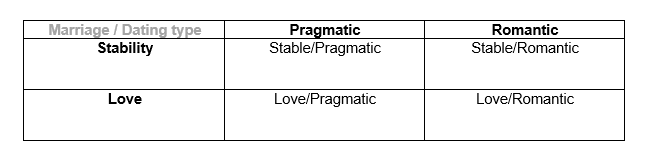
Second tenet: I further posit that people looking to date can be divided into two major types: people who date to date (the Romantics) and people who date to marry (the Pragmatics).

Your gender does not influence whether you are a Romantic or Pragmatic, unlike with marriage. Rather, your personality and past relationship experiences will determine your type. I will go as far as to predict that people who are high on openness to experience (a personality trait) are more likely to be Romantics.

Romantics say “I love them so much I can’t breathe; I have to be with them”.

Pragmatics say “I think they’re a great partner; I can see them in my future”.

There’s no right or wrong — it’s just a preference that has significant repercussions on who you meet and stay with, and how your relationships play out in the long-term. In general, Romantics are open to dating more people than Pragmatics, but they have shorter relationships.

(All of this is to say that you are not a “high-value person”, bless you, if you are selective in your choice of partners; you are probably just a typical Pragmatic, LOL. You should never be using that term unironically anyway.)

I did predict that men are more rational when it comes to marriage, but this does not necessarily mean they are more likely to be pragmatic when it comes to dating. For example, you may primarily date for love and discover a love that clutches at your heart and breaks you apart but still decide to marry someone stable in the end.

What’s interesting is that when the two tenets are combined, they result in unique patterns of partner-seeking behaviour in men and women.

Pragmatic men are the most selective, and Romantic women are the least selective.

Let’s say you are a typical Pragmatic man: you are looking for someone stable, and you are dating to marry. You will immediately disqualify GBNWMs because an uncontrollable woman might be sexual napalm as a girlfriend, but a liability as a wife. (I name this phenomenon “double jeopardy”, dedicated to crazy girls like me.) You will only date potential wives, which significantly restricts your selection pool.

Conversely, Pragmatic women might give chances to and later marry men who seem to not be husband material at first. Because — to use a cliché — love conquers all, and all can be forgiven. There might be no male equivalent for the GBNWM, actually — have you ever heard women describe a man like that?

Romantic men are kind of in-between in the sense that they might date for fun but not marry until they’re confident they’ve found the one.

Romantic women are just in trouble. HAHAHAHAH

Now we can make pairing predictions:

  • Pragmatics prefer fellow pragmatics. Pair two Pragmatics together and you are basically guaranteed a stable relationship. They’re that couple who has been together since the start of university (they met in some school camp), have gotten a BTO, and will be having their wedding this year.
  • Romantics care less about who they date. If paired with a Pragmatic, they may experience stress. If paired with a fellow Romantic, the relationship will be intense, but not necessarily stable, not that they mind.
  • The combination least likely to work out is between a Pragmatic man and a Romantic woman because their values differ the most. (Maybe I keep falling for Pragmatic men…)
the Pragmatic and the Romantic (I actually think Mario is a Romantic)

Third tenet: I expect that conservative men and women (compared to liberals) are more likely to be Pragmatic daters AND marry for stability. Conservatism involves upholding traditional standards in everyday life. Example: you believe that family is defined as the nuclear unit, men and women have different roles to play, etc.

The reason is that the more conservative you are, the more likely you are to adhere to gender stereotypes or the dominant trends you observe around you. And the Singapore Dream is stability across all facets of life. Singaporeans are generally quite conservative and risk-averse. Even marriages are tinged with transactionality nowadays (think BTO).

There’s nothing wrong with being conservative or liberal. It’s a preference. I’m not insinuating that those who lean conservative are mindless sheep. We make decisions that are aligned with our values. If you believe the status quo is fine, you would naturally act in a way that maintains it.


I might be completely wrong. These are all based on anecdotal observations limited to Singapore, and my friends have told me I tend to attract men who are bad for me (like attracts like, OK). You are welcome to DM me agitatedly proclaiming yourself as an exception, hah.

The final caveat is that these are generalisations, as theories must have — it does not mean all men and women act the same way. I am a Love/Romantic based on my theory though (of course). This means I date to date, and I will marry for love, consequences be damned.

Feel free to categorise yourself and let me know what you are. (If I am interested in you, I will ask you if I haven’t already guessed it).

Gwyn’s Typology of Love

Now for the cherry on top.

The research study: I ran an informal poll on Instagram to see if my hypotheses were supported. It’s not IRB-approved and might have involved coercion (I threatened my friends with the cold shoulder if they didn’t respond, hahahahaha).

It covers marriage preferences (first tenet) only. I will conduct another study for the types later, so stay tuned.

My aim is to demonstrate that in selecting a life partner:

  • Hypothesis 1: A higher percentage of men will pick stability > love.
  • Hypothesis 2: A higher percentage of women will pick love > stability.

Method:

  • Participants were shown the prompt “In selecting a life partner, is stability or love more important to you?”
  • They picked one of the two options provided — “stability” or “love” — and indicated their gender, male or female.

Sample characteristics: 21-30 years old, predominantly university-educated

Results:

  • Overall, both genders (N = 101)
    • Stability = 48 (47.5%)
    • Love = 53 (52.5%)
  • Men (n = 57)
    • Stability = 24 (42.1%)
    • Love = 33 (57.9%)
  • Women (n = 44)
    • Stability = 24 (54.5%)
    • Love = 20 (45.5%)

Summary of results

  • Hypothesis 1 not supported. Men prefer love over stability in their criterion for a life partner.
  • Hypothesis 2 not supported. Women prefer stability over love.
  • Of course note that I didn’t test for significance. But the differences seem big enough.

Discussion: Well, consider me shooketh. So I’m an anomaly? And my friends, too? This goes to show that one’s (my) view of the world can be surprisingly limited in the grand scheme of things. Or because I didn’t do my literature review before I generated my theory — it’s grounded science, baby!

Possible explanations of the findings from the literature:

  • Evolutionary theory suggests that men’s long-term mating strategies involve searching for women of “high reproductive value”, which is inferred via physical attractiveness and age. None of these are related to stability (Buss & Schmitt, 2019, pp. 88-89). (But they aren’t related to love either, which more men in the sample picked?)
  • Evolutionary theory again suggests that women’s long-term mating strategies involve searching for men who (1) can provide economic and status resources, (2) offer physical protection, and (3) are willing to commit (ibid., pp. 93-95). These all indicate stability.

Some potential alternative explanations must be considered:

  • Skewed sample characteristics: My followers tend to be liberal, so the effects would be weaker (or even inverted) compared to my predictions.
  • You guys are forecasting wrongly. HAHAHAHAHA. Let’s see why and to whom you all get married in the end — let me know! (wink)

Thank you to all of my 101 followers who participated. I hope you find the love you deserve.

Me and my future man who is rich, ambitious, protective, and committed