Another interesting thing is that a few similar questions were posted prior. All of them were fixated on women as the subject.
The answer distribution was interesting. It suggests that women do not give themselves completely to men until the latter have “proven their worth”, so to speak.
It made me wonder about my own answer. This post is my process of working it out.
Everyone deserves love — or so a humanistic therapist would say — although not everyone eventually deserves your love.
Not because reciprocity is expected, but because we have a finite capacity and must optimise where it goes. We must make calculated decisions about who we want to love and who we want to love more.
I wanted to believe I could love everyone the same, but I’m only human.
I was obsessed with you. I could beg you to pay attention to me and love me. But what for? I am chasing a mirage. You were never there; only my projected ideal of you was. Alone, I run, and alone, I am exhausted.
Or I could spend all that time that would have otherwise been spent pining on reconnecting with myself and the world. Even redirecting my focus to someone else would be a better idea — someone whose eyes will glow with affection when I am reflected in them and who has a fanatical, absolutist certainty about me. Repeat ad infinitum; such is the search for love.
If I think you’re worth it, of course, I would love you. But I cannot give endlessly without return.
Unrequited love is worthless — yes, not merely useless, worthless. Sure, feel your feelings and all — I understand — but all it ultimately is is a limbo that torments the indecisive. You must move forward. Either cross the suspension bridge to heaven and risk falling or leap straight into hell from where you stand. It will be terrifying for a while, but you will always land, which is a certainty you will never receive from the object of your affection.
The unknown is a critical variable in this. The law of probability is immutable — there is something better out there. Stay or leave for more.
With unrequited love, always leave. You owe it to yourself.
All that being said, would that have stopped me from loving you in the first place?
I bought you a gift before I realised that we had already met for the last time, a decision you made unilaterally for both of us and which I enforced. That’s okay; I’ll use it from now on. I will eventually forget it was ever for you: time is cruel to the ones who are loved but kind to the spurned.
So, my perhaps unexpected answer to the question (given the preamble) is: I will give you everything I have because I am, I was, ready to love you. I don’t believe in withholding love, though I do believe in withdrawing it upon reflection. If it’s not what you’re looking for, I will give it to someone else. I might break, but I will live, recover, and thrive in time.
The spiritual sequel to How to Lovebomb. Obviously, written as a joke — or is it? (cocks head)
The Thingamajig Strategy (by love bomber): (Accidentally) leave something smol behind at their place.
How/why it works (for the love bomber): A physical object reminds them of you. It creates an excuse to initiate contact, passing the responsibility to do so to them as in a delicate cha-cha routine.
Counterstrategy (for the lovebombed person): Throw the thing away — unless it’s a wallet. If so, retrieve the money and then throw it away. If they really needed it back, they’d ask. If they really wanted to see you again, they would initiate.
how you’ll sleep after getting rid of things that don’t spark you joy
TheCasper Strategy: Ghost them on chat but watch their stories obsessively. Don’t forget to like the stories where they’re super cute or you think allude to you.
How/why it works: Ghosting someone traps them in self-doubt preoccupied with what they did wrong, even though the problem stems from your inability to communicate like an adult. Kick them while they’re down by liking their stories on Instagram regularly, which bumps you to the top of the viewer list so they can’t ignore you even if they want to. It’s all power play, my friends, a perverse one once deconstructed.
(Effective for chronically online people who primarily rely on Instagram as a source of validation. But not effective for those who have a horde of fans to account to if they make questionable decisions.)
Counterstrategy: DON’T block them from watching your stories; no, enjoy the attention! DO block their stories from your feed, so you live in their mind collecting rent while you pay none. Then, go on to live your best life, whether you post about it online or not. Remember that YOU are the bourgeois and THEY are the proletariat.
this could be us but u ghosted me.
The ReincarnationStrategy: Reappear in their life by DMing them out of nowhere after a prolonged period of presumed death.
This strategy has two variations, each inversely proportional to the confidence or sympathy you wish to leverage. (Neither matters.)
Confidence route: provide no accompanying reason at all: simply audaciously announce that you desire to see them again.
Sympathy route: supplement the request with an explanation that you have been through some trööma that regrettably caused you to be unable to, again, communicate beyond the level of a three-year-old.
Pick the first variant if you’re insecure and the second if you’re manipulative. This strategy creates a virtuous loop with the ghosting one. You meet, die, reincarnate, and then die again! It’s an absolutely infallible combo. I recommend it 10/10 for clowns.
How/why it works: It throws the recipient off-guard by making them wonder if you have been thinking of them all this while. If they’re so over their head that they forget that you could have contacted them any time in between but chose not to until it was convenient for you (because they are ultimately a substitute), it could seem kind of romantic. In a world where we convince ourselves we don’t owe each other anything, it’s easy to confuse any casual act for affection. Lover beware!
Counterstrategy: Laugh in their face and move on. If you give in, oh well — we all have to binge on fast food occasionally because what is life without sin and a little indiscretion, even if you get a stomachache later. Just don’t make it a habit.
this photo isn’t even thematically related anymore. it’s just funny
The Promising Strategy: Make promises you have zero intentions of following through with.
Why/how it works: Empty promises lead to expectations, and the most powerful longing always concerns things that could have happened but never did. It’s inverted regret — a nostalgia for something that could’ve been, which could have been anything.
Counterstrategy: This one involves a radical change in your philosophy but will transform your life so drastically you’ll never look back. Hold on tight.
There are NO exceptions to this. NONE. Intentions mean absolute jackshit until they are realised. Whatever form they take on before realisation does not matter. It might as well not exist. It never existed. (TIL I’m materialistic without the -ic.)
If they believed you were worth it (immaterial), they would show you (material). If they claim to miss you (immaterial), they will meet you (material).
We can go further. A text telling you they miss you means nothing if they do not schedule a date to see you again. A kiss means nothing if the relationship is never defined (a “situationship”) and you are not cuffed — made “material” through accountability to others or bound by a physical contract.
We can argue that a text and a kiss are material since they occur in reality. But that is irrelevant because it is overshadowed by the immaterial intention behind the action that we project onto those we so desperately wish would love us.
The intention means nothing, even if they imply it, especially if you infer it.
Realise that we can never accurately capture the meaning of the present moment — the full picture only emerges in hindsight when the future has happened so that we can contextualise the past with it. You can immerse yourself in the now and feel it all, but that still doesn’t imbue it with any meaning outside your feelings. For an intention to be real, it must be manifested.
The past, present, and future cannot be considered separately in determining what is real and meaningful. Hell, even if it was real, it might not have meant anything. Maybe this is the logic that my pragmatic fans follow — did you really love them if you were never serious about them?
Naturally, you could argue that an intention could be real and meaningful, just that the person seems to be acting differently because you are mistaken about their intention. For example, if you’re only interested in sex, you only do booty calls. That’s perfectly congruent and reasonable if both parties are on board.
But the whole reason games exist is that people struggle to be upfront with what they want — worse if they do not know what they actually want. Then, everyone is in for a ride, and all intentions can go to die.
We can only establish if someone is sincere about you through the two elements of continuity and consistency. In other words, action and commitment, over and over, like the sea waves crashing into the shore for eternity, until death do us part.
—you will find someone who will love you, who sees you as a person, who is attracted to you; who will choose you, and continuously choose you.
my bestie (if everyone had a love like this there would be no divorces)
In short, words are just words (suddenly, I realise what my love language is not). You telling me I’m your favourite or that you respect me means nothing. I don’t care. You either prove it, or none of it matters — saying it is just performativity. You don’t have to say anything; I already know.
Intentions alone mean nothing. Promises mean nothing.
Perhaps even this blog post has meant nothing. But I hope it is at least marginally useful for my fans in helping them sieve out people who deserve them and people who don’t. God willing, considering how much time I’ve wasted on playing games, I might as well help people save some of theirs.
Know your worth, and the rest will follow. Whatever you give, you will receive in turn, good and bad.
– x, baby g, who loves you always (and has hopefully demonstrated it)
Bonus:
we accept the love we think we deserve.
my other bestie (quoting the Perks of Being a Wallflower)
I have a lay theory of partner selection preferences of males and females in heterosexual romantic relationships. Oh, hear me out — it’ll be a fun ride (perhaps even obvious in hindsight!)
First tenet: Men and women have different criteria for life partners.
Men settle for stability, and women settle for love.
Men are more rational and calculating: they choose to settle with women they intuit they can build families with. This is not necessarily the woman they love the most, although they will definitely try to convince themselves so.
Another way to put it is that they will eventually marry the women their mothers approve of more. As a man, you might scoff at the idea that your mother has any real influence in deciding who you marry, except she does — you just haven’t consciously come to terms with it.
The above is where the “girlfriend but not wife material” (GBNWM from now on) descriptor stems from — because men are better at separating love, sexual desire, and marriage. So, the woman who he loves, the woman who is attractive to him, and the woman who he marries can be three different women. Lucky him if they are the same woman, but they are often separate.
Women are more emotion-driven. They want to and are more likely to settle with men they love. This would suggest that love and marriage come together. And what about sexual desire? Ever heard the familiar story of girlfriends hurt by their boyfriend’s pornography/Insta hot girl pic consumption (let’s not pretend otherwise), while the boyfriend exasperatedly attempts to explain that “porn is just porn; it doesn’t mean I love you less”? Indeed, he does not love her less, but he does not understand that women conflate the three elements.
Of course, women seriously consider aspects like wealth and physicality, which are evolutionary signals for reproductive fitness. But give them a choice and they will let love lead the way.
In summary, men marry with their heads (yes, not the other head), and women marry with their hearts.
Art imitates life
We have discussed marriage. Now, let us discuss dating.
Second tenet: I further posit that people looking to date can be divided into two major types: people who date to date (the Romantics) and people who date to marry (the Pragmatics).
Your gender does not influence whether you are a Romantic or Pragmatic, unlike with marriage. Rather, your personality and past relationship experiences will determine your type. I will go as far as to predict that people who are high on openness to experience (a personality trait) are more likely to be Romantics.
Romantics say “I love them so much I can’t breathe; I have to be with them”.
Pragmatics say “I think they’re a great partner; I can see them in my future”.
There’s no right or wrong — it’s just a preference that has significant repercussions on who you meet and stay with, and how your relationships play out in the long-term. In general, Romantics are open to dating more people than Pragmatics, but they have shorter relationships.
(All of this is to say that you are not a “high-value person”, bless you, if you are selective in your choice of partners; you are probably just a typical Pragmatic, LOL. You should never be using that term unironically anyway.)
I did predict that men are more rational when it comes to marriage, but this does not necessarily mean they are more likely to be pragmatic when it comes to dating. For example, you may primarily date for love and discover a love that clutches at your heart and breaks you apart but still decide to marry someone stable in the end.
What’s interesting is that when the two tenets are combined, they result in unique patterns of partner-seeking behaviour in men and women.
Pragmatic men are the most selective, and Romantic women are the least selective.
Let’s say you are a typical Pragmatic man: you are looking for someone stable, and you are dating to marry. You will immediately disqualify GBNWMs because an uncontrollable woman might be sexual napalm as a girlfriend, but a liability as a wife. (I name this phenomenon “double jeopardy”, dedicated to crazy girls like me.) You will only date potential wives, which significantly restricts your selection pool.
Conversely, Pragmatic women might give chances to and later marry men who seem to not be husband material at first. Because — to use a cliché — love conquers all, and all can be forgiven. There might be no male equivalent for the GBNWM, actually — have you ever heard women describe a man like that?
Romantic men are kind of in-between in the sense that they might date for fun but not marry until they’re confident they’ve found the one.
Romantic women are just in trouble. HAHAHAHAH
Now we can make pairing predictions:
Pragmatics prefer fellow pragmatics. Pair two Pragmatics together and you are basically guaranteed a stable relationship. They’re that couple who has been together since the start of university (they met in some school camp), have gotten a BTO, and will be having their wedding this year.
Romantics care less about who they date. If paired with a Pragmatic, they may experience stress. If paired with a fellow Romantic, the relationship will be intense, but not necessarily stable, not that they mind.
The combination least likely to work out is between a Pragmatic man and a Romantic woman because their values differ the most. (Maybe I keep falling for Pragmatic men…)
the Pragmatic and the Romantic (I actually think Mario is a Romantic)
Third tenet: I expect that conservative men and women (compared to liberals) are more likely to be Pragmatic daters AND marry for stability. Conservatism involves upholding traditional standards in everyday life. Example: you believe that family is defined as the nuclear unit, men and women have different roles to play, etc.
The reason is that the more conservative you are, the more likely you are to adhere to gender stereotypes or the dominant trends you observe around you. And the Singapore Dream is stability across all facets of life. Singaporeans are generally quite conservative and risk-averse. Even marriages are tinged with transactionality nowadays (think BTO).
There’s nothing wrong with being conservative or liberal. It’s a preference. I’m not insinuating that those who lean conservative are mindless sheep. We make decisions that are aligned with our values. If you believe the status quo is fine, you would naturally act in a way that maintains it.
I might be completely wrong. These are all based on anecdotal observations limited to Singapore, and my friends have told me I tend to attract men who are bad for me (like attracts like, OK). You are welcome to DM me agitatedly proclaiming yourself as an exception, hah.
The final caveat is that these are generalisations, as theories must have — it does not mean all men and women act the same way. I am a Love/Romantic based on my theory though (of course). This means I date to date, and I will marry for love, consequences be damned.
Feel free to categorise yourself and let me know what you are. (If I am interested in you, I will ask you if I haven’t already guessed it).
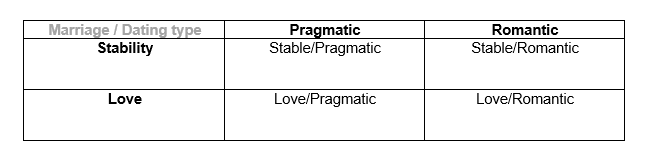
Gwyn’s Typology of Love
Now for the cherry on top.
The research study: I ran an informal poll on Instagram to see if my hypotheses were supported. It’s not IRB-approved and might have involved coercion (I threatened my friends with the cold shoulder if they didn’t respond, hahahahaha).
It covers marriage preferences (first tenet) only. I will conduct another study for the types later, so stay tuned.
My aim is to demonstrate that in selecting a life partner:
Hypothesis 1: A higher percentage of men will pick stability > love.
Hypothesis 2: A higher percentage of women will pick love > stability.
Method:
Participants were shown the prompt “In selecting a life partner, is stability or love more important to you?”
They picked one of the two options provided — “stability” or “love” — and indicated their gender, male or female.
Sample characteristics: 21-30 years old, predominantly university-educated
Results:
Overall, both genders (N = 101)
Stability = 48 (47.5%)
Love = 53 (52.5%)
Men (n = 57)
Stability = 24 (42.1%)
Love = 33 (57.9%)
Women (n = 44)
Stability = 24 (54.5%)
Love = 20 (45.5%)
Summary of results
Hypothesis 1 not supported. Men prefer love over stability in their criterion for a life partner.
Hypothesis 2 not supported. Women prefer stability over love.
Of course note that I didn’t test for significance. But the differences seem big enough.
Discussion: Well, consider me shooketh. So I’m an anomaly? And my friends, too? This goes to show that one’s (my) view of the world can be surprisingly limited in the grand scheme of things. Or because I didn’t do my literature review before I generated my theory — it’s grounded science, baby!
Possible explanations of the findings from the literature:
Evolutionary theory suggests that men’s long-term mating strategies involve searching for women of “high reproductive value”, which is inferred via physical attractiveness and age. None of these are related to stability (Buss & Schmitt, 2019, pp. 88-89). (But they aren’t related to love either, which more men in the sample picked?)
Evolutionary theory again suggests that women’s long-term mating strategies involve searching for men who (1) can provide economic and status resources, (2) offer physical protection, and (3) are willing to commit (ibid., pp. 93-95). These all indicate stability.
Some potential alternative explanations must be considered:
Skewed sample characteristics: My followers tend to be liberal, so the effects would be weaker (or even inverted) compared to my predictions.
You guys are forecasting wrongly. HAHAHAHAHA. Let’s see why and to whom you all get married in the end — let me know! (wink)
Thank you to all of my 101 followers who participated. I hope you find the love you deserve.
Me and my future man who is rich, ambitious, protective, and committed
I am turning 26 in two weeks. This piece attempts to reconcile the first phase of my life before I confront the vagaries of “real adulthood”. Singaporean-wise that means procuring a job and a house and getting married… all prospects that leave my bones trembling. But I digress.
I brazenly consider this as timeless advice from me to myself. I would tell this to my 20-year-old self, but I know my 30-year-old self would appreciate it (I’ll get back in 5 years on this). I hope anyone reading this enjoys it, too.
Organised in sections, pithy one-liners, and pointers for elaboration. Saved the best for last.
Accept that you will fail — all the time, without exception.
The things you are bad at, but more crucially, the things you are good at. Because making mistakes is one of the best ways to learn and improve.
You just have to keep trying and pick yourself up. Trying again (in a smarter way) is the only way you will get better.
Focus on your own progress.
IU wrote Palette at 25. I am writing this, HAHA. That’s okay. Everyone has their own value to contribute to the world. Even a small value may be significant (p < .05).
Don’t bother trying to emulate so-and-so successful person’s generic qualities. Focus on your spike – your unique combination of skills and interests that make you stand out.
Distinguish between what you’re doing because you want to and what you’re doing because you feel like you have to.
I used to think that my life was set and all I had to do was work towards a rigid set of predetermined goals. On reflection, it was because of my presumption that society thought it was good, so I assumed it would be good for me. It didn’t make me happy. It won’t make you happy either.
Reality is a mix of both. It is unrealistic to expect to pursue only what you are passionate about. There are oftentimes “have-tos” that seem like the best option for growth at the time, and it may not be what we love. But that’s fine as long as you recognise that and resist the allure of introjection, where you confuse others’ expectations for you with your own desires.
Relationships
Give because you want to and not because you expect something in return.
Consider any effort you put in for someone/something else as a gift from the goodness of your heart; don’t expect it back. If it does come back, treat it as a surprise.
I lived by this philosophy that everything is inherently transactional and people are only interested in others insofar as they are useful to one another. I still see evidence of that, but I have also realised that operating on an expect-returns basis is inane.
This includes lending anyone money: consider it gone by default and equivalent to the price of the relationship if it’s never repaid. Never give more to someone than you’re willing to lose, no matter how close they are, especially if they are close to you.
Treat a kind deed received as a pleasant surprise – a sign of good in the world. Just as you are willing to give for the sake of it, there will be someone out there who is the same. Cherish those people and those moments when it happens.
The inverse: you don’t have to give 100% to everyone or everything. Neither do you have to give if you don’t want to. And even if you’re willing to give someone everything, they might just call you silly. It is what it is.
Pick your battles wisely.
Don’t burn your bridges; you might need them later. That could mean holding your tongue and holding out for the future. Does that mean being two-faced? No — you can disagree with someone but maintain perfectly cordial relations with them and refrain from ad hominem attacks (you always can report facts about them… defamation suits don’t cover those).
And so what if we gossip about each other? Life is too short to waste on irrelevant people or haters. It is far easier to be a hater than a hated person because the latter requires you to achieve something that makes you powerful, relevant, and therefore threatening. You’re leagues ahead just by virtue of that fact. Let them talk the house down while you focus on doing your work. If they cared enough to do something, they would.
Don’t be a social justice warrior — don’t fight for people who don’t want to be fought for. At most, lay the groundwork and leave the action to them. But I would go as far as to say that that first step is not even worth your time. There are so many better ways you can spend it. Go pursue a passion project, or send your friends and family a loving text instead. Not everyone is worth it. If you feel that someone is still worth fighting for despite their evident reluctance to participate, perhaps you care about the cause more than the person. All of which suggests that your purpose is selfishly motivated. Having a personal agenda is fine, but leave others out of it.
If someone complains about X problem to you and you identify that something can be done about it, the onus shouldn’t be on you to take action — it should be that someone if they want to. Sure, you can offer advice if solicited. But if they don’t want to act on it, that’s their problem, never yours. As the psychologist joke goes: “How many therapists does it take to change a lightbulb? One, but only if the lightbulb wants to.”
Asking for help on the next action if you don’t know what to do.
Suppose you can’t apply the above rules. In that case, the issue is beyond your control, meaning there is nothing to worry about.
If you really care about the problem, improve your ability so that it becomes something within your zone of control.
Intensely personal (best for last)
My most personal opinion is one that has no evidence aside from anecdotal extrapolation and thereby the most debatable: I suspect people fundamentally don’t change, personality and motives-wise.
I scoured through my old journals recently, and it’s striking how much I am chased by the same monsters in different costumes. And what kind of person you really are is only apparent in hindsight because we convince ourselves we are some kind of person (biased by our ideals), but our past actions tell the truth.
I used to think I preferred to be loved more. I realise now that I have always wanted to love more, and I would light myself on fire over it. How silly indeed.
16Personalities would always say I was a thinker. Yeah nonsense. I’m a feeler. All the major decisions in my life have been made on whims and desires (how privileged… how incandescently lovely). Then again, that test is not known for its reliability. Don’t bother with it. Keep a journal instead.
Bonus: Life is a culmination of decisions made in a split-second… some of which will alter your trajectory forever. And you’ll never be fully prepared for those.
That’s okay. Feel your feelings. Forgive yourself. You’re all that you’ll ever have.
To my 30-year-old self: I love you. I accept you completely. I hope you’re happy, wherever you are.