Stopped posting on Instagram. The decision is boring… the LORE is not.
I did so for a bunch of uninspiring reasons. One may be mildly interesting: I realised I possessed a decent (if in desperate need of preservation) degree of sexual appeal that could be better directed elsewhere.
Doing so set me up for a huge dopamine hit. Later in the year, a close friend shared — hold on tight to the following — that her friend had asked about me, telling her what they heard about me from someone else… who had heard about me from someone else (II).
…I mean, what a thrill. Almost as satisfying as getting 500 views on a single story!
Cooley articulated it best: a person’s self-image depends on how they imagine others view them(self). So what happens when you deny onlookers an open window into your life? You become a figment of their imagination.
My withholding information is still an attempt to curate an image (performance is inescapable). But it’s an image that leaves the audience free to create their own story about me. And within these spaces of doubt, I am free.
In short: everyone can say anything about me. You just won’t hear about me from me…
…but you can always come here for the tea.
Sailed on a private yacht. Just once. Not mine.
Got served papers. To no avail, unfortunately… for them.
Received a Belated “apology” text. There’s only one thing I can’t believe about this saga and that is how accurate I was. I am a PSYCHIC bro. The feeling is INDESCRIBABLE.
Made a few friends, lost more. Decided it was okay. Kept some close.
events got me feelin like this ngl
Onto the goal review…
Originally published 11/4/25
These are not very SMART goals but I downloaded a habit tracker on Notion so I think it will be OK
More hee hee ha ha tattoos that I should really plan ahead for
the struggle [I actually got as far as paying a deposit. But the artist only sent me the design literally FOUR (4) hours before the tattoo session (despite my earlier prompting). And it was ugly — like throw the baby out, man, ‘cuz this is iredeemable. I asked for a Sisyphus tattoo, not to be punished like him]
luigi (cf above: the duality of woman)
Exercises I didn’t aim for but completed
20 runs tracked
Got a Minotaur tattoo instead
Category comment: This is NOT a good category (judging my past self already). It is all over the place. But I give myself a score of 60% for maintaining my activity level from last year through trying new forms of exercise, as above, so below
Hobbies to convince others I have a personality
Complete a basic structured dance class [make that two]
Get noob diving cert
Get a tarot card reading [so accurate, like… i think it told me i am a loser]
Did not do
Relearn swimming for diving
200k on blog!!!!!!!! [ehh. I wrote a lot of emo stuff instead that I didn’t publicise. Did you catch them? Because they’re GONE now! Hahahahahaha]
Reflections on grad school??????
Analyses on my ultimate life tracker??????
Purge blog, retag all posts, standardise categories/tags
Streaming
I want to play Lethal Company but everyone around me is a coward
Hit balls
Category comment: It is less important to convince others I am fun than it is to have fun on my own terms. Most importantly, however, is having enough money to afford the fun. Speaking of which,
Alternatives to being a kept woman
Secure employment
Apply for 50 (FIFTY) jobs
Long-term planning for finances (expenditure, investment %s…)
Category comment: Honestly, I’m better off being a kept woman
Love & Belongingness is a stage in the Maslow’s Hierarchy of Needs
Graduation + family photoshoot
Monumental
Masquerade as prey [hang awn… what if I am…]
Partial complete
Attend 10 random social gatherings [clocked 6]
Volunteer >25x this year [~15 times]
Maximising neuroplasticity
Pass JLPT N4 [the results won’t be announced until Jan 2026, but I know I confirm pass]
Duolingo 800 days [abandoned]
Partial complete
Crash course in stock market [got annihilated by perps, which is not even stocks, and have NO edge]
Read 15 books [made it to 5. Post-graduation de-intellectualisation is real]
Not done
Take a writing class!!!
Learn to braid hair, one, then two
Final comment: In 2025, I believe I stepped forward in the nebulous thing called life. I should have — and by all rights I did. All that to find myself where I began. I think I achieved some big things. But I feel I didn’t do many things at all, if anything. I’m not where I want to be and it makes me terribly unhappy. And yet I look around where I am and I’m happy. I’m desperate to be somewhere else and also desperate to hold onto the here and now.
I find myself hoping that the solution to life is found in the acts of everyday living, because it would imply that happiness can be found in these goals, or at least in the process of striving towards them… but even if that were true I doubt it would be a liberating knowledge.
First written in Jul 2023, with minor edits and commentary in May 2024 (recovery is non-linear, but it will get better)
[May 2024: Enough about silly trivialities like men and love, boring! Let’s yap about ME! Specifically, my psycho ass side. Reviving the mental health logs for my fans!]
ZOU
Since my first post, I’m delighted to report that things have been looking up for me! I am still waiting to be connected with a psychologist, though (something about waiting time and accessibility of mental health services in Singapore…)
In the meantime, here’s a list of things that have helped me get through a recent depressive episode. They read like notes from a textbook, but there’s nothing quite like a hands-on experience.
Coming to terms with it all. Simply accepting that I did (and maybe always will) have a problem liberated me to focus on addressing it rather than being trapped in the quandary of self-doubt. [May 2024: Still psycho! But so happy.]
Social support and companionship. Many friends reached out after they saw my earlier post. Two aspects stood out — a lack of judgement and an affirmation that they would stand by me. In the weeks since none of them has treated me differently. We went out, played, and gossiped about nonsense as usual. I will always be grateful for them.
My partner has also been enormously supportive (well, he has always been), listening to my issues and being a staunch voice of reason whenever my spirals strike. He’s also been willing to communicate his challenges in his role as a “mental health caregiver”, which has helped us better navigate our difficult periods together. It’s important to care for your caregivers too!
me n my cuties
Taking a step back and reappraising. Throughout university, I’ve been compelled to prove myself by achieving “success”. My blog was literally named Gwyn’s Guides to Success (it is now Gwyn’s Playground to mirror my newfound commitment to enjoying life). [May 2024: it is now baby g’s diary. Character development!]
I wanted to get better grades, take up more leadership roles, engage in more extracurriculars, volunteer more, build more connections, write more papers, have my Prof like me more… the list went on. Talk about an unabashedly narrow (but not uncommon) definition of success. Put them together, and lo and behold, you have an amorphous ideal self unattainable by design. Goals became imperatives that incessantly berated me for not being enough regardless of what I did — like having the consciousness of a toxic tiger parent implanted in your brain.
I hit a turning point when my supervisor pointed out that my mental health was taking a toll on my work and that she was genuinely concerned. It was one hell of a “oh, wow, cool” moment (she broke character for me!) I was in such bad shape I could barely function at work, much less recognise that I was floundering. In the following days, I gave more thought to what I wanted (something I hadn’t done in a long time because I was fixated on getting through the motions). Sure, getting a Master’s degree is ~cool~, but I don’t need to destroy myself over it.
The same goes for other projects. At the end of the day, a commitment is something you willingly give your time to… so you don’t need to put in any more effort than you can or want to. To paraphrase a quote from another mental health advocate: you can’t water the grass when your well is dry.
Shoutout to the book Four Thousand Weeks: Time Management for Mortals on this topic. [May 2024: Sweetheart? Please mail it back to me.] The big idea: life is short, you can’t do everything, so embrace finitude and enjoy the moment, darling. As long as you’ve lived a life you thought was worthwhile, what does it matter what others think? In the grand scheme of things, it really doesn’t. Life goes on with or without you. If a good life to me consists of reading manga and writing a personal blog in my spare time that nobody reads(!), then so be it.
Focusing on the things I love, for me. I’ve gotten back into the habit of reading, and you won’t believe this — writing! Similarly, I’m doing things for myself, because I want to, not only because it brings me to some societally-approved end. Some nights, I play Civilization VI over Discord with my friends and then chomp on garlic cheese prata with my family into the wee hours, ignoring the thought that I have a lot of work to do the next day. LOL. Of course, I’ve had to strike a balance because work never ends, but these little moments have made all the difference.
So get yourself some self-care. Take the time to recharge, and then move onto great things when you’re ready — if you want to, because you don’t have to!
well, are they?
Taking breaks. There’s only so much work you can do in a day. When you pare it down based on energy levels, you’ll realise that most work is not urgent or even important. When I’m stressed, I ask myself: what is the worst that could happen if I mess up this tiny ass task? Or miss a deadline because I’m overwhelmed? So what? It really isn’t worth all that stress. Go take a nap.
wahoo!
Breaking down things. Based on behavioural activation in CBT. Can’t beat your brain? Hack it.
Just be 1% better than yesterday.
Committing to the basics, whether you like it or not. Routines, baby!
I asked a friend over mahjong recently — what is your life purpose? It’s been a long-running preoccupation of mine stemming from the idea that I need to identify some sort of bigger calling to motivate myself to get up every day. He sagely retorted that it’s “not a good question and only stresses you out”.
Instead, focus on one small thing at a time to keep you looking forward to tomorrow. So that’s what I’m doing. It’s the small things… but they add up to make a good life.
I am eagerly anticipating the premiere of Dune Part 2 this November (okay, it’s been postponed to March 2024) [May 2024: it was better than I could ever imagine.]
And for Volume 3 of my favourite manga to be released in English [May 2024: I flirted my way into getting a Japanese copy because I couldn’t wait. I’d do it again! <3]
I am looking forward to the holiday trips I’ll have this year.
I am excited to master Japanese and get my JLPT N1 certification! Maybe in 5 years, LOL.
[May 2024: Well, so much has happened since. I’m sure 2023 Gwyn would have been proud of 2024 baby g. I definitely am! Hehe. I love you.]
A psychologist told me last week that I have signs of major depressive disorder (“clinical depression”). I wasn’t surprised.
The following is a record of my experience seeking help for my mental health and the observations I’ve made along the way – both as a recipient of services and as an advocate. You might find it helpful if you’re curious about mental health or its (challenging) landscape in Singapore. Or you might see a part of yourself reflected herein.
Counsellors, Psychiatrists, and Psychologists
I’ve been putting off getting therapy for years. The thought that maybe I should get help first occurred during my senior undergraduate days. I noticed cyclical episodes where I would nosedive mentally and emotionally after busy periods in the semester. But it was easy to ignore because it wasn’t hampering my academic performance (yet), and I was juggling too many commitments to care. And it was easy to rationalise as part and parcel of living in a hypercompetitive environment – I figured everyone felt the same way, and if they could cope with it, so could I.
But I could only live like that for so long.
I began seeing a counsellor in 2021 at my university’s counselling centre. I used a playful tone when I wrote about it then, but in hindsight, the visits were a sign that my mental health was deteriorating. My first counsellor left “to take a break” for her mental health after three meetings, and I’ve been with my current one since. The counselling helped me manage my emotions following major stressors better, but it’s been less effective at ameliorating the root problem. Suffice it to say that it is unrealistic to expect a university counselling centre to have the resources to cope with issues of greater severity, regardless of how well-intentioned it might be1.
Later I would be referred to the university psychiatrist, who prescribed me antidepressants to regulate my moods. The best way to describe their effect on me is that I become stupefied. Everything is dulled – my senses, mood, and cognition. She said I would improve if I committed to taking them regularly, but I never managed to do so.
In mid-2022, I zeroed in on a private therapy clinic after encountering their advertisements. I emailed them, going as far as to use a burner email address to maintain anonymity and avoid commitment. That vague reluctance at the back of my mind was justified when they told me their costs were $200/h (but I could receive a “reduced rate of $150” for being a student).
I did not reply.
When I did reply to that email to reinitiate contact with them recently (yes, a year after), however, the new clinic admin (yes, a whole new person) informed me that they were unable to offer me the reduced rate as previously agreed… even though my status as a student remained unchanged. If I wanted the reduced rate, I would have to provide details of my “financial situation” and my family’s.
I was enraged at this turn of events.
Now I acknowledge from a business perspective (à la my partner’s rational, non-depressed response when I started venting to him) that changing your company policy in a year is perfectly legitimate. Very well. What gutted me was how blatantly the event made it evident that money was their primary consideration. I felt compelled to interpret it that way.
Minor segway here onto the complex relationship between therapy and money that I feel is acknowledged occasionally by leaders but only ever dealt with superficially. I wholeheartedly agree that becoming a clinical practitioner is a considerable investment that warrants a high dollar-per-hour return. I would also like to be paid handsomely for my work2. But the fact is that $200 (or even $150) an hour is something most people cannot afford, much less students. Not to mention comprehensive treatment plans can be 16 sessions on top of add-ons like assessment packages (I was quoted $2000+). Those are unimaginable numbers.
Clinical psychology speaks of the therapeutic alliance – the partnership between the client and the therapist – as a central element in treatment success. Whatever potential alliances I could have had with this clinic’s therapists were ruptured before they had begun.
And so they lost a client before they had one.
Anger overcoming my inertia, I searched for an alternative and found one through a friend who had sought treatment earlier. This new place’s rates were far more reasonable ($40/h) – perhaps because they were not a private clinic3. I quickly filled in the intake form, reporting what I believe to be concerning scores on well-being and productivity, and waited. They contacted me in a few weeks to schedule an intake interview.
And that brings us back to the beginning.
Sign(s) of the Times
During the interview, I had a ball of a time facing the psychologist over Zoom. Who doesn’t love talking about themselves, especially to a non-judgmental and curious listener? At the end of it all, the psychologist shared his observation kindly, if slightly nervously. I had “signs of major depressive disorder”, with a smattering of anxiety to boot4.
My first reaction was to laugh as if he had made an inside joke. After all, there could have been no other outcome.
I felt oddly liberated after. I continued with my day reinvigorated, getting things done and at peace with myself. (It didn’t last.)
At least I can move forward now. I’ve been stuck in place for too long; it’s time to get going.
Meta
I hesitated before posting this. For all I know, this could be a career-ending move… not that it’s begun. But we can leave the stigma expositions for another time.
I wrote that this post might be helpful to some people, but it ultimately doesn’t matter if it is or isn’t. It’s for me and should always have been; this post deserves to exist in its own right, as I do, without the necessity of acknowledgement by others as a reason to be. And so it shall.
It’s good to be here.
Footnotes
1 The same goes for peer-helping programmes.
2 Though as a mental health advocate, I am not (paid at all), and neither are my peers.
3 More deets when I feel like it’s the right time to share about them. Or not. See how.
4 His observation is not an official diagnosis because he’s not a psychiatrist. For all intents and purposes, my condition only allegedly exists.
Mental health in youths is the In Thing now. There’s been a proliferation of ground-up and top-down initiatives targeting this issue in the past year, with even the Singapore government publicly committing to progressive improvements (albeit not reforms). This leads us to the questions: what resources are available, and are they adequate?
For me, there was one FREE resource under my nose I’d neglected for the longest time: the school counsellor. Yes – after more than four years in university and pursuing two psychology (!) degrees, I finally reached out to the NTU University Counselling Centre(UCC). This post will describe my experience seeking counselling services from the NTU UCC.
Sections to be covered (Ctrl-F to skip to a section directly, e.g. [1]):
[1] Why people don’t always seek help [2] Booking the appointment + waiting time [3] The actual counselling session
Even though I visited a university counsellor, I expect the overall experience to be generalisable, so youths of other ages and institutions may still find this post applicable. Students not from NTU/uni may skip [2], though I’d still recommend you read everything.
My goal here is to encourage help-seeking on my readers’ part: if you feel like you’re facing difficulties with your mental health in any way, go to a professional if you can. Don’t wait until your stresses boil over and you find yourself in a state of burnout (speaking from experience).
[1] THE PREAMBLE: WHY PEOPLE DON’T ALWAYS SEEK HELP
Considering I’m a psychology graduate, it’s ironic how I’ve never seen a counsellor. I mean, I’ve studied under clinical practitioners. Hell, I took a counselling module once, where my counselling skills were assessed. (Minor flex: I was the “top performer” in the cohort for that module. But look at where I am now. So.) Either way, I’ve never been a client.
That’s not to say I never considered the prospect of seeking help – I just never got around to doing so.
The point is: there’s a gap between intention and action that many of us find ourselves stuck in. You know (from the indelicate “oh mental health is superrrr important and we shouldn’t neglect it” narrative that we’re bombarded by) that seeking help is good, but… you just can’t seem to bring yourself through the steps to get there.
Granted, not everyone has the energy or time to seek professional help. There exists a multitude of (valid) reasons people don’t. Here are mine in the past that I cycled through at my convenience:
I am busy / I have too much work / I don’t have time / it’s too much of a hassle
It might not help me / I could just talk to my friends or family
It’s too expensive* (high-SES private therapists can go up to $180/h)
*So I found a free service. Baby steps, my friends.
Tl;dr: in deciding to seek help, you must believe that the value you’re receiving is worth the investment you’re making. In describing my experience with counselling below, I hope to demonstrate the value that counselling can bring. It will not solve all your problems – but it might get you closer to addressing them.
[2] BOOKING THE APPOINTMENT + WAITING TIME
Send help, am suffering
What prompted me to request an appointment was a stressful episode midway in the semester. Long story short, I felt that I wasn’t living up to my unattainable standards and doing terribly compared to my peers. A common experience, I guess, but with sufficient intensity to shut me down for three consecutive days – a significant amount of time when you’re running on weekly deadlines. Then, I saw an email advising students to seek help at the UCC if they needed it. LOL. This whole scenario reads like a comedy advertisement.
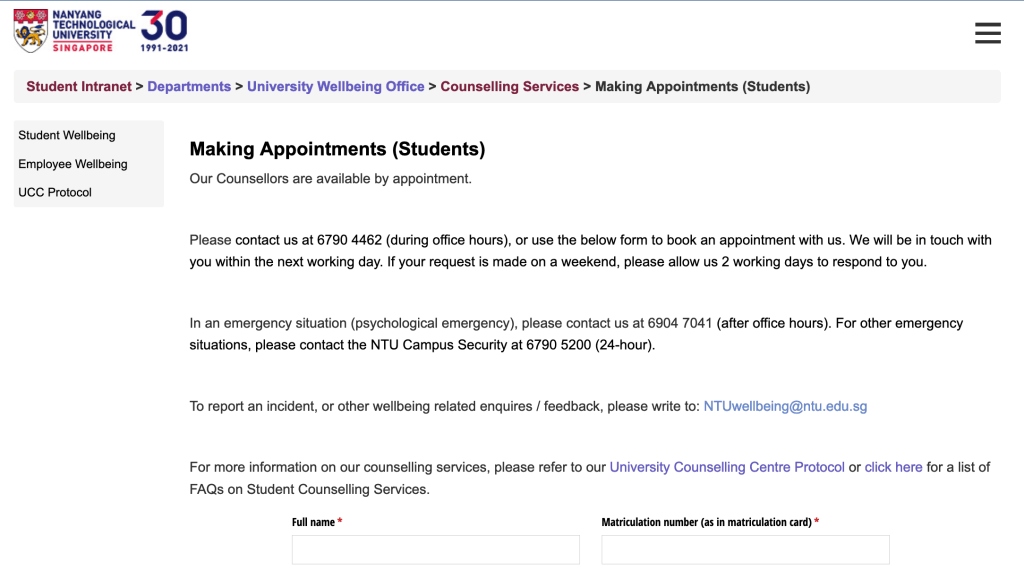
The appointment request form is on this page (login credentials required), but you can email the UCC at ucc-students@ntu.edu.sg or call 67904462. Getting to the request page is NOT an intuitive process (take note NTU); from a Google Search of “NTU counselling”, you need a minimum of four clicks on the correct links to get there.
The specific order is Student Intranet > Student Wellbeing (under Student Services) > Counselling > Making Appointments (Students) (under Student Wellbeing) – like how many Student Wellbeings do I need to see before I get to my destination LMFAO.
hello sgsecure? i am insecure
The intake call
Surprise, surprise: the appointment booking form I filled was not, in fact, for the counselling appointment. It was for an intake call. They contacted me through my email to arrange a call, and after some back and forth, we agreed on a timing. Anyway, they forgot to call me at the stipulated timing on the day itself, and I had to write in after a 15-min period of radio silence to remind them.
The intake call is a means of gathering initial information about the client through a series of questions (for the nitty-gritty, read here). The lines of enquiry that stood out to me were:
Any current issues/life transitions/symptoms experienced in the past month
My reason for seeking counselling; what I expect to get out of counselling
Any intentions for self-harm? (They were particularly meticulous about this)
Existing sources of social support I could draw upon
Naturally, I wanted to see the counsellor ASAP, but they informed me that the next appointment wasn’t available until a month later. I remember responding: the semester would have ended by that time – what would I have to talk about then? Can’t be helped, the caller essentially replied. It was crunch time for them because everyone gets stressed around the exam/assignment period. So, ironically, the time when students are most vulnerable is precisely when they are least likely to get opportune help because the centre can’t cope with the demand.
OK, well, whatever. I booked the appointment for the following month and promptly forgot about it. Later, I had to postpone it for another week because I had an urgent deadline that cropped up, which was a hassle. The other thing about UCC’s booking system is that it is internally and manually managed. There is no convenient online portal that you can log onto – like that of polyclinics – to book or reschedule appointments. You have to write/call in to deconflict and haggle for the timing that works best for you AND them.
[3] FINALLY, THE ACTUAL COUNSELLING SESSION
24 for me but same same
Counsellors, therapists, and psychiatrists
Before we proceed, a note between the differences between a counsellor and (psycho)therapist because there is a common misconception that they are the same. If you’re wondering where clinical psychologists are, they fall under the umbrella of therapists. Finally, neither counsellors nor therapists are psychiatrists, who are specialised medical doctors and the only ones that can prescribe medication for mental disorders. (Confused? This resource may help clarify.)
Therapists undergo more specialised training focusing on diagnosis and treatment, and minimally require a Master’s to practise professionally. Counselling does not require a Master’s, though there is a certification requirement of a few hundred hours of supervised training. The above does not mean one profession is better than the other – it just means they address different needs of the client. A counsellor is well-equipped to handle immediate problems causing distress and is a resource bank of coping strategies that the client can draw upon during trying times.
Think of counsellors as the “first line of defence”. If your symptoms are severe such that a counsellor’s assistance is insufficient, your case will be escalated to a psychologist or psychiatrist for further attention. But for many, seeing a counsellor will be enough. I think of counsellors as similar to GPs. We all get sick once in a while, and so seeking regular check-ups is a good habit to cultivate. But sometimes we have severe or recurring symptoms beyond their expertise, and that’s when they refer you to a specialist.
Nice to e-meet you
I opted for an online call because I didn’t want to travel down to Pulau NTU. Ah, the joys of technology! My counsellor was randomly assigned to me – I didn’t get to choose. I won’t disclose her name for privacy reasons, but she was sweet and approachable. And a great listener.
We started in an open-ended fashion, where she invited me to share what I’ve been up to and any challenges that I’d been facing recently. I’m a great rambler (ideal client type), so I wasted no time and jumped straight into rattling off all my problems. Throughout my monologues, she remained highly engaged, interjecting appropriately during my pauses.
When I shared my chronic belief of never being good enough, she gently guided me to elaborate and interrogate the causes of this belief. Examples:
When did I start feeling this way?
Is it really feasible to be the best at something (all the time)?
How do I deal with situations when I do not meet my expectations?
What is my relationship with myself?
As I attempted to answer these questions, I found myself exploring dusty places in my mind. I realised I possessed thought and action patterns that I had simply accepted as normal and automatically used without noticing their impact on me through the years. It was a pleasant surprise when her questions decentred me, throwing me off my usual line of self-talk, and pointed me in new directions to explore. It was exciting.
What I really liked was the new perspective that she offered to the things I took for granted. It’s easy to believe that we know everything about ourselves – after all, we live with the voices in our heads 24/7. And I’d already had extensive conversations with my loved ones and mentors before about the struggles I faced. While they are indubitably a valuable source of social support, I stopped learning anything new about myself from those repeated conversations at some point. So, gaining an outsider’s perspective was illuminating.
Problem-focused coping is my passion
Before ending the session, she provided me with a few coping methods to try over a few weeks. She mainly proposed journaling with specific adjustments. I mentioned that I have a habit of reviewing my day in writing, so she commended me (LOL) and recommended further minutiae I could try. Namely:
Write down the events of the day. Next, identify and label the emotions I experienced – positive or negative. Then validate them: was it reasonable to feel this way, given the circumstances? Would others have felt the same in similar situations?
If there are negative thoughts, create a separate column to reframe them: rewrite them as valuable takeaways to learn from.
Write one positive thing about myself every day (basically gratitude journaling), e.g. “I am proud of myself for powering through the day!”
You might think these sound commonsensical. I’d already learnt all of it before, and I know that these are helpful in theory. The thing is (again): it never occurred to me to practise doing these things. She reiterated that I don’t have to be ambitious or perfectionistic about this whole journaling endeavour: start small and build up slowly. The same goes for mental health, really – it’s a process.
Finally, we scheduled our second appointment for a month later, since one hour was grossly inadequate to work through two decades of self-doubt. Afterwards, she emailed me a cute diagram with tips on cognitive restructuring.
i will NOT break down today
UNTIL THE NEXT APPOINTMENT…
In summary, I would rate my experience as:
Appointment process: 2.5/5, as mediocre as me, needs improvement
Counselling experience: 5/5, exceeded expectations, would recommend to all
I firmly believe that counselling is a resource that everyone deserves and should use to better their well-being. I say this based on my experience seeking counselling and as a psychology graduate. The good news is that there are now many free counselling services available (see the end of this post for a list of community resources), and one’s educational institution is a great place to start.
Ultimately, my hope is that seeing a counsellor can be as normalised as going to your GP for a physical ailment. Fortunately, with mental health awareness steadily increasing in Singapore, that doesn’t seem such a far-off goal now. That being said, there’s always room for improvement… but that’s a story for another time.
Wishing you all wealth and health and that you will meet the counsellor who helps you flourish and be your best self!
For more quality content like this, subscribe by entering your email under the “VIP Club” section on the right side of the page! Alternatively, contact me hereor follow me @gwynethtyt on Instagram.
If my posts helped you and you’d like to show your appreciation, consider making a donation here! It keeps my blog running and my energies focused on writing quality content LOL. You’ll be contributing to my monthly donations to Share The Meal too.
Update (4/1/22): Dr Lim from the University Wellbeing Office commented on this post with further resources for NTU students!
Thank you for promoting and your championing of mental health and wellbeing for our youths. Regarding my suggestion to include a link for the students, you could consider this: https://ts.ntu.edu.sg/sites/intranet/student/dept/uwo/resources/Pages/default.aspx (NTU student intranet under UWO webpage). This page has different categories of self-help and will encourage exploration of the different resources and services available to the youths.
APPENDIX: USEFUL COMMUNITY RESOURCES
Fei Yue’s Online Counselling Service ec2.sg [Live chat] Mon-Fri: 10am-12pm; 2pm-5pm (Closed on Public Holidays) e-Counselling Centre
Singapore Association for Mental Health (SAMH) 1800 283 7019; 6283 1576 Toll-Free Helpline from 9am-6pm on weekdays (except public holidays) counselling@samhealth.org.sg A helpline for all mental health-related matters
Community Health Assessment Team (CHAT) https://www.chat.mentalhealth.sg/get-help/About_webCHAT/ 6493 6500 / 01 chat@mentalhealth.sg webCHAT operates from Tues to Sat, 1pm-8pm Provides a confidential and personalised mental health check for young persons between 16 and 30 years old. CHAT is NOT a counselling or crisis service
Touch Community Services 1800 377 2252 Mon to Fri from 9am-6pm TOUCHLine Youth Counselling Service
Care Corner 1800 3535 800 Daily from 10am-10pm (excluding public holidays) Toll-free Mandarin Counselling Hotline
National Care Hotline 1800-202-6868 Provides emotional and psychological support to those affected by the COVID-19 pandemic
IMH Emergency Help Line (24h) 6389 2222 Urgent intervention for those experiencing acute difficulties in their mental health
Samaritans of Singapore (SOS) (24h) 1800 221 4444 pat@sos.org.sg Facebook Messenger (6pm-6am on Mon to Thu and from 6pm-11:59pm on Fri) A 24-hour suicide prevention helpline to provide emotional support for those in distress








 baby g’s diary