every mistake you’ve made and every wrong you’ve experienced is a learning lesson — it happened so that you could be here, in this moment, as a wiser and stronger person.
it is terrifying to realise that no one owes you anything, i know. on the other hand, you are no longer bound to anyone’s expectations.
maybe liberation was meant to come together with loneliness? nothing in this world comes easy.
recently i’ve been playing, i’ve been played; i’ve been trapped in a prisoner’s dilemma. i confessed, i waited, they stayed quiet: i was punished for my faith, and then twice. i persisted until i was a willing party no longer: i had to, i have to, i need to act in my best interest.
but love isn’t a game; if it must be one, then the optimal outcome is not to play.
it doesn’t matter if you crawl back begging for forgiveness; there is nothing to repent for, because there was nothing between us in the first place.
and what about regret? again, i don’t regret anything — except what we could not have.
i want you to take all the time you need to find yourself — you deserve that much.
but neither will i be waiting for you at the world’s end. with, or without me: you take everything now or you go; it’s a hard yes or a no. we don’t have enough time for anything else.
in the end, it seems to be all about timing, doesn’t it? it is, and it isn’t. we are now locked in each other’s orbit forever, regardless of whether we are bound to meet again in this lifetime.
and so be it, paths crossed or not — i would rather die than settle for you.
I am turning 26 in two weeks. This piece attempts to reconcile the first phase of my life before I confront the vagaries of “real adulthood”. Singaporean-wise that means procuring a job and a house and getting married… all prospects that leave my bones trembling. But I digress.
I brazenly consider this as timeless advice from me to myself. I would tell this to my 20-year-old self, but I know my 30-year-old self would appreciate it (I’ll get back in 5 years on this). I hope anyone reading this enjoys it, too.
Organised in sections, pithy one-liners, and pointers for elaboration. Saved the best for last.
Accept that you will fail — all the time, without exception.
The things you are bad at, but more crucially, the things you are good at. Because making mistakes is one of the best ways to learn and improve.
You just have to keep trying and pick yourself up. Trying again (in a smarter way) is the only way you will get better.
Focus on your own progress.
IU wrote Palette at 25. I am writing this, HAHA. That’s okay. Everyone has their own value to contribute to the world. Even a small value may be significant (p < .05).
Don’t bother trying to emulate so-and-so successful person’s generic qualities. Focus on your spike – your unique combination of skills and interests that make you stand out.
Distinguish between what you’re doing because you want to and what you’re doing because you feel like you have to.
I used to think that my life was set and all I had to do was work towards a rigid set of predetermined goals. On reflection, it was because of my presumption that society thought it was good, so I assumed it would be good for me. It didn’t make me happy. It won’t make you happy either.
Reality is a mix of both. It is unrealistic to expect to pursue only what you are passionate about. There are oftentimes “have-tos” that seem like the best option for growth at the time, and it may not be what we love. But that’s fine as long as you recognise that and resist the allure of introjection, where you confuse others’ expectations for you with your own desires.
Relationships
Give because you want to and not because you expect something in return.
Consider any effort you put in for someone/something else as a gift from the goodness of your heart; don’t expect it back. If it does come back, treat it as a surprise.
I lived by this philosophy that everything is inherently transactional and people are only interested in others insofar as they are useful to one another. I still see evidence of that, but I have also realised that operating on an expect-returns basis is inane.
This includes lending anyone money: consider it gone by default and equivalent to the price of the relationship if it’s never repaid. Never give more to someone than you’re willing to lose, no matter how close they are, especially if they are close to you.
Treat a kind deed received as a pleasant surprise – a sign of good in the world. Just as you are willing to give for the sake of it, there will be someone out there who is the same. Cherish those people and those moments when it happens.
The inverse: you don’t have to give 100% to everyone or everything. Neither do you have to give if you don’t want to. And even if you’re willing to give someone everything, they might just call you silly. It is what it is.
Pick your battles wisely.
Don’t burn your bridges; you might need them later. That could mean holding your tongue and holding out for the future. Does that mean being two-faced? No — you can disagree with someone but maintain perfectly cordial relations with them and refrain from ad hominem attacks (you always can report facts about them… defamation suits don’t cover those).
And so what if we gossip about each other? Life is too short to waste on irrelevant people or haters. It is far easier to be a hater than a hated person because the latter requires you to achieve something that makes you powerful, relevant, and therefore threatening. You’re leagues ahead just by virtue of that fact. Let them talk the house down while you focus on doing your work. If they cared enough to do something, they would.
Don’t be a social justice warrior — don’t fight for people who don’t want to be fought for. At most, lay the groundwork and leave the action to them. But I would go as far as to say that that first step is not even worth your time. There are so many better ways you can spend it. Go pursue a passion project, or send your friends and family a loving text instead. Not everyone is worth it. If you feel that someone is still worth fighting for despite their evident reluctance to participate, perhaps you care about the cause more than the person. All of which suggests that your purpose is selfishly motivated. Having a personal agenda is fine, but leave others out of it.
If someone complains about X problem to you and you identify that something can be done about it, the onus shouldn’t be on you to take action — it should be that someone if they want to. Sure, you can offer advice if solicited. But if they don’t want to act on it, that’s their problem, never yours. As the psychologist joke goes: “How many therapists does it take to change a lightbulb? One, but only if the lightbulb wants to.”
Asking for help on the next action if you don’t know what to do.
Suppose you can’t apply the above rules. In that case, the issue is beyond your control, meaning there is nothing to worry about.
If you really care about the problem, improve your ability so that it becomes something within your zone of control.
Intensely personal (best for last)
My most personal opinion is one that has no evidence aside from anecdotal extrapolation and thereby the most debatable: I suspect people fundamentally don’t change, personality and motives-wise.
I scoured through my old journals recently, and it’s striking how much I am chased by the same monsters in different costumes. And what kind of person you really are is only apparent in hindsight because we convince ourselves we are some kind of person (biased by our ideals), but our past actions tell the truth.
I used to think I preferred to be loved more. I realise now that I have always wanted to love more, and I would light myself on fire over it. How silly indeed.
16Personalities would always say I was a thinker. Yeah nonsense. I’m a feeler. All the major decisions in my life have been made on whims and desires (how privileged… how incandescently lovely). Then again, that test is not known for its reliability. Don’t bother with it. Keep a journal instead.
Bonus: Life is a culmination of decisions made in a split-second… some of which will alter your trajectory forever. And you’ll never be fully prepared for those.
That’s okay. Feel your feelings. Forgive yourself. You’re all that you’ll ever have.
To my 30-year-old self: I love you. I accept you completely. I hope you’re happy, wherever you are.
I was part of the NTU Students’ Union 28th Executive Committee in AY2018/19 as the Corporate Communications Executive (Relations). I am here to share my story.
OK, now that I’ve got your attention, this post is not about any particular individual or even a set of people. It is about the NTU Students’ Union as an institution and mode of government.
I will not name anyone in this post because I know my peers would rather not be entangled in this matter, not to mention that they have moved on with their lives anyway. (Crucially, I am not interested in being SLAPPed with a lawsuit.) I’m only here because I’ve been in NTU for longer than most people I know – first as an undergraduate and now as a graduate student.
This post is a singular reflection of my experience with the Students’ Union: what I thought it was, what it really was then, what it is now, and what it could be.
Therefore, a confession of sorts, though I have nothing to be ashamed of, as you will see.
What the Students’ Union was to Me, Part 1: The Introduction
I was peripherally involved with Union activities in Year 1. I was a member-minion of the Open House Committee, and my task was to secure partnerships with external organisations. The Open House work was basic, but I enjoyed seeing the event coalesce via that invisible thread of camaraderie interlacing it. Through that opportunity, I met others, some of whom would eventually become my teammates in the 28th NTUSU Executive Committee (henceforth SU/Union and Exco).
When asked to consider running as an SU Exco member in Year 2, I was starry-eyed at the prospect. And why wouldn’t I be? It promised to be an avenue for me to create change as I envisioned it. And I had dreams: I wanted to revitalise the floundering Union magazine, U-Insight, and transform it into an avenue where students could express themselves. I wanted to improve the communication channels between SU and the student body, mainly so that student feedback, previously scattered across sources, could be consolidated into a single place to amplify its voice.
Here’s a part of my presentation script that I used in the 28th Council Election Rally (2018) in standing for the role of Relations Executive. If you’re wondering about its authenticity, note its dated nature – for example, the Nanyang Chronicle was quietly discontinued after 2019. Yes, I am old. Yes, I called it Nanyang Chron.
I will now elaborate on my aims and goals should I be elected to this role. First, I want to expand and distinguish U-Insight. It was moved online fully since last year and now has its own unique platform, rather than being integrated on the NTUSU website, but it’s still relatively rudimentary. Currently, it has 11 posts over 5 months, mostly focusing on events and new initiatives that NTUSU pushed out in the previous academic year. As you can see from the picture, it has a grand total of 2 tabs or sections. So what I want to do is expand what the editorial has to offer in a direction that distinguishes us from the other editorials/magazines in NTU, such as Hey! Magazine and Nanyang Chronicle. My vision for the magazine is a platform that represents the voice of the students – on top of sharing news about policies and events, we also make students feel like they have a part to play in the growth of this editorial. Currently, what I am looking at is including more sections in the editorial, and some that our student-members can contribute directly to. This may include opinion pieces, Q&As, interviews, and so on. I will work closely with my committee to achieve these goals. If possible, we may even look towards collaboration with other student-run editorials like Nanyang Chron.
Feedback is one of the most important things for me, and as such will be a priority. I understand that we currently have a feedback link that is attached to all the EDMs [electronic direct mailer, i.e. fancy way of saying emails] blasted by the SU. There is another link that is pasted on a few bus stop posters asking students to provide feedback, but that link does not work. What I want to do is clean up and simplify the feedback process by standardising it, as well as putting this link up on more platforms. To achieve this, my proposed committee includes the position of online engagement officer, whom I will work with to collect feedback across a variety of platforms and analyse it.
I had dreams, and I wanted to achieve them. The position of Relations Executive offered me just that; it gave me power – the ability to influence events in the direction of my will.
And who wouldn’t want that?
So off I went to the elections, full of hope and ambition.
What the Students’ Union was to Me, Part 2: The Election
Let me explain how the Union (Executive Committee) electoral process works. Again. Because I’ve done this before, but let me do it again.
The SU Executive Committee is not elected by the students. The Union Council is elected by the students. The Executive Committee is elected by the Council.
Some context is necessary.
Anyone who glances through the NTUSU website might think the Council is the Executive Committee. It is not.
The Council is composed of:
The Executive Committee
The Academic Constituent Clubs (a fancy way of saying “school clubs”) – e.g. School of Social Sciences Club, Biological Sciences Club. All students are part of the club whose name matches their school.
The Non-Academic Constituent Clubs (i.e. the Big Three Clubs that seem to pervade every aspect of CCA life) – WSC, Sports Club, CAC. All students are members of ALL NACCs (bet you didn’t know that! And that’s why you can vote in their elections, even if you don’t participate in their activities or volunteer).
The power distribution within the NTUSU Council has baffled me, though certainly, I had no interest in pursuing the matter given that the arrangement benefited my position. How I understood it during my time was (might be inaccurate):
The Council, as a totality, is concerned with all student members. They discuss things sporadically. The duration between successive meetings can span up to months.
ACCs and NACCs are more concerned with things happening within their student sections. They primarily run events for their own members.
Exco is concerned with all “26,000 undergraduate students of NTU” and counting. They implement the decisions of the Council, kind of. They organise events for and represent everyone. They are the closest point of contact to the NTU management.
(If you’re wondering about the postgraduate students, they’re covered by another group entirely irrelevant to this discussion – the Graduate Students’ Association [GSA]. There are also the non-constituent clubs, which are the smaller clubs catering to more specific interests.)
When I write about it that way, there seems to be an overlap between Council and Exco. Hmm. The Council makes some decisions, but the Exco makes others, though the Exco is responsible for most of the legwork. Another interesting factoid: the current Constitution says that the Council “has the power to” exercise control over the Executive Committee. I am not sure how it works in practice.
I digress. Back to the electoral process.
Again: The SU Executive Committee is not elected by the students. The Union Council is elected by the students. The Executive Committee is elected by the Council.
There are two “levels” of elections happening here.
The first election, at the NACC/ACC level. Students vote here for the Committee Members of their NACC/ACC Club. This is what you vote for on Union Day. The President of the ACCs at this level – and only the President, not other committee members – becomes a Council Member. For NACCs, two (President and VP/Hon Gen) become Council Members.
The second election, at the council level. Council members, empowered by students as representatives of their clubs, vote here to decide which specific council members become members of the Executive Committee.
In other words, students do not elect anyone in the Executive Committee. The Presidents of their Clubs do.
A more concrete example to illustrate – myself. Students elected me as the Union Representative of the School of Social Sciences, and I became a Council Member. (That, or at least a temporary member who could stand for elections in the Council. The definition of a Union Representative is wonky.) Then, I was voted in by the 28th Council Members to become a member of the Executive Committee. If by any chance the Union Rep is not elected due to lack of confidence or a contesting candidate winning, they are required to resign from the Council basically immediately. In case I get questions on this, yes, my role was uncontested. (But I’m sure you’d vote for me even if it was contested. :-))
I noticed a lot of fanfare on the ground over students being unable to directly elect the Exco. Note that this election process is neither unfair nor problematic per se. The Prime Minister of Singapore is chosen similarly. The Prime Minister is defined as the leader of the Parliament, and the leader is decided through a “consensus among peers” involved. The voting public has limited influence over the final decision of who is selected as the PM – though, of course, it can have its preferences, and its opinions are sought by the government. A Mothership video explains it better than me here (unfortunately).
By the way, I can’t find the past Students’ Union Council Rally meeting minutes. The election archives (which I had to google to find and which doesn’t seem directly accessible from the main NTUSU website) only have the results of the ACC/NACC-level elections. If anyone can find the past Council meeting minutes, please leave a comment below, thanks. It is 5:51 a.m., and I am not in the headspace to search for gold in the desert.
What the Students’ Union really was: The Exco and its Jurisdiction
I learned following my successful election that there were limits to my power. To give some perspective, I guess my role at that time is the equivalent of the current Public Relations Executive in AY2022/23. I had to report to my Vice-President, who was accountable for my actions; they had to report to the President, who was accountable for our actions. The President, in turn, was accountable to stakeholders with various interests.
I don’t want or need to elaborate on how the Union is aligned vis-à-vis the university management regarding decision-making. I am sure there are plenty of posts out there that can paint a picture for you. I will say that the Union is dedicated to protecting the peace of the status quo. This is hardly surprising; it would be surprising if it were anything else.
My role was mainly limited to communicator ex post facto rather than decision-maker, given the limits of my power. So I could consolidate feedback and I could attempt to persuade, but I had no say in the final decisions made.
One of my first projects was consolidating feedback via Union channels. As I promised in my rally, mind you! The hot topic that year was the issue of being unable to see the results of your S/Ued options, unlike NUS’s practice.
Ultimately, this was the end result we communicated to students. Relevant extract copied below.
Context: the bolded sentence is a question asked by a student we received via our newly released feedback channel. We gathered recurring themes and officially responded to them via our editorial website, U-Insight (responses in point form below the question).
Why can’t we see our results before choosing to S/U it? What has NTUSU done regarding this issue? – MECH/4
The University Management’s stance is that the S/U option is part of the broad level efforts undertaken by the University to nurture a holistic learning environment that puts less emphasis on grades and focuses more on learning and exploring courses beyond their core disciplinary studies. The University Management believes that the current S/U declaration period up to two working days after the last exam paper of the semester gives students sufficient time to weigh their choices of either opting for grade or S/U notation, rather than as a means to pull up their GPA […]
In AY14/15, after hearing from students, NTUSU successfully pushed for the S/U option to be available after exams, when it was previously available only before exams. NTUSU is constantly engaging both students and the management on this matter.
Note how the response is phrased. I leave the interpretation up to you, but I can tell you I oversaw its creation. By the way, the last sentence is true, even as it is broad. The point here is that students are given access to the outcomes of discussions involving the Students’ Union. As for the process, which is fundamental to participatory decision-making… that’s up to you to decide.
What the Students’ Union is, Now?
A few comments on the selection process based on my experience.
I was recruited due to my past experience as a member of a Union Committee before running for Executive. I believe this is a reasonable expectation to have for someone who is expected to represent the interests of students; aside from a desire to serve, it helps to have prior experience. But beyond demonstrating ability through your previous work, it is because you have made connections through your shared experiences.
“Connections” sounds like a dirty word, huh? But is it really? We know elected positions in the Council and across clubs, halls, and societies are almost always uncontested. It is the rule, not the exception. People ask why, but there really is no question. The simple answer is that succession planning occurs. Imagine you are a leader of some club or society. You would hope to leave it in good hands. You are now faced with a decision. Who do you pick to succeed you?
We can argue that the system is flawed if, and only if,
(1) Students are not given an equal opportunity to run for these positions, AND/OR
(2) Students who do apply are not evaluated fairly.
It is hard to argue (2) because most positions are uncontested. So, we focus on (1).
Now for the million-dollar question: did (1) happen with the transition of power from the previous Union Executive Committee to the current one?
I don’t know. Neither do I want to make any claim with absolute certainty.
What we can do is to look at the information we’ve been presented with, and you can decide for yourself.
What the Students’ Union Could Be?
Before evaluating what we have, consider this fascinating observation of mine.
The circle is closed, yes, but it is not impenetrable.
In the same Union Rally I attended to be elected, another position in the Exco was contested. Two people ran for it. One of them was unexpected. The unexpected one was dazzling in their purity, and I say that in the most respectful way possible. They had seen the club elections notice, and with pure hope, they had run for Union Rep, got elected by their students, and decided to run for the Exco with whatever they knew. Of course, the other candidate had done the same, but with a longer preparation runway. Only one of them was elected that night. Guess who won? You’d be surprised.
In the latest AY2023 Union Rally, the role of President was contested by the Union Rep of the Welfare Services Club. However, it seems that a technicality did not allow them to rally before the incumbent President was elected. Hmm… (It’s all reported on Soapbox – not my words!)
These two examples are few and far between. Still, they are sufficient to establish that theoretically nothing stops students from running for elections, whether as Union Rep at the club level or Exco members at the Council level. Theoretically. Please do not take this to mean that I am defending the current state of affairs.
The next question is: assuming students care enough to run (high bar in itself btw), do they know enough to run? If they do not know enough, can we argue that this results in unequal access?
Information Asymmetry, Example 1
Let’s backtrack into the election process again.
I knew I had to be elected into the SSS Club as Union Rep to become an Exco member later. I knew this because I was familiar with the election procedure. And I knew this because I knew someone who knew this. Of course.
I suspect that many students are not aware of this requirement.
The above does not mean that students are not allowed to run in club elections. In my case, the SSS Club elections in my time were open to all, and people were free to run for whatever positions they desired (- I think!). There was at least an email informing people that applications were open. There was an open “candidate evaluation process” which consisted of them pasting applicants’ entry forms onto big boards displayed in the foyer for passersby to gawk at. Was mine there too? I can’t remember – it’s been years. The devil may be in the details, but I don’t remember anything amiss.
But that’s missing the point.
Information Asymmetry, Example 2
Another thing I noticed is that the NTUSU Instagram page (managed by the Exco only, the Communications department in particular) does not list the names of the Union Representatives contesting for Exco positions. I chalked it up to lack of transparency initially, but on second thought, it makes sense in a pedantic way. The Union Reps have yet to officially hold any positions in the Council/Exco. So, there is technically no need to declare your interest in a specific Exco position until you get to the Council Rally, which is a closed-door event anyway. (This feels like the kind of argument phrasing that got the current SU PR department in hot soup.)
To be even more pedantic, one could argue that students have access to information regarding who their Union Reps are – you can find out via the results release of the elected positions via the ACC/NACC club documents. They’re just not widely publicised, so it takes a lot of effort to find out.
I repeat: information asymmetry.
Anyhoo, if we’re focusing on improvement, I would love to see more details of Union Reps interested in Exco positions being released by NTUSU moving forward. After all, if someone is going to represent my interest and that of 26,000 others, I feel like they deserve a certain level of public scrutiny and evaluation. Let me hear your pitch! Let me see your résumé!
To summarise, one thing is clear: there is a gap between the current communication of the SU’s election/decision-making procedures and students’ understanding of it.
The equation is simple: if students don’t know what to do or how to do it, they cannot do it.
I would say both the Union and the students share a responsibility on this matter – the former for conveying information, and the latter for seeking information. But suppose I am right in assuming that a severe information asymmetry is present at the moment. In that case, the onus is on the SU (led by the Exco) to resolve it. (This post is an attempt to rebalance this asymmetry, but I am old and retired!)
Conclusion: For Students, by a Student
Institutions – especially established ones – always tend towards inertia. There is little incentive to change what works if it has been working fine for the people who benefit most. But at some point, we will be knocked off our feet and then forced to recalibrate – who is this system benefiting? And if there is a discrepancy between what was promised and what is, how do we fix it? I can’t offer anything else more feasible, but I am genuinely encouraged to see that more students are challenging what we’re used to in hopes of something better. It may seem disingenuous for me to say this as someone who was part of “the establishment”, but after all… the goal of the Students’ Union was always to represent students’ interests, right?
If you’ve read this far – thanks, even if you skimmed everything. Here, I just want to share something personal. I didn’t know if I should post this or even start writing this. But acting almost on compulsion, I sat down at 2am in front of my laptop and started typing anyway. It is now 7:46am. I could not stop once I started. I guess I’ve wanted to say something for a long time, and after a long while, the time has finally come. Whatever it is, I hope students can continue to speak up on what matters to them.
P/S: If you think I’m doing this for attention – well, maybe. I could have posted this anonymously, but with the level of detail I went into, it was bound to be a matter of time before I was doxxed anyway. If there’s something in it for me (aside from more readers <3), I believe this post captures the transparency I wanted to achieve in my time in the NTUSU. Regardless, I hope there’s something that you can take away from this.
And those conclusions are for you to hold and act on, not me.
Final disclaimer: I tried my best to be accurate, but let me know if anything is false. I will revise my post, where reasonable, with credits to you. (Please don’t sue me.)
If you’re interested in something similar I wrote before, read this. It’s basically a precursor to this post.
Exclusive section for blog readers only, haha~
Just some additional sharing on a personal note. I was inspired to write this post by Lee Kuan Yew. Yes, you read that right. I was watching one of his speeches from the CNA Special “Lee Kuan Yew: In His Own Words” – specifically, his speech at the Swearing-in Ceremony on 13 September 1988.
In this speech, he delineates three criteria for evaluating political leaders. It struck a chord with me, which moved me to write this post. It’s cheesy but it’s true.
I am unsure if I can quote him here on this blog due to copyright concerns, so I will link the YouTube video with the timestamp instead for your leisure viewing (28:53-29:25). Watch with captions!
Alternatively, you can also find his full speech via this document publicly available for viewing (see page 2).
As my fans and haters are well-aware, Gwyneth is a feminist (and the whole world must know). That’s a loaded label that can mean a lot of different things depending on who you are and what you believe. Not everyone can relate to my definition of it, i.e. equality of the sexes. In fact, there exists a notable group of people who sincerely believe that men and women have achieved equality in society (and by extension, that the ladies don’t know their place by asking for more). Evidently, they have never taken a class in sociology, but then again I’ve never taken a class in men’s rights.
Yet because I am equipped with debilitating self-awareness, I recognise that I can’t criticise others for being keyboard warriors without being hypocritical. I’m the liberal here, and liberals are only good for getting triggered :-). So I’ll save you the trouble and call myself out first. The difference between me and the rats out there is that I hope to impart a lesson through this piece, rather than merely inconveniencing others. If I am a keyboard warrior, at least let me be an enlightened one.
baby g in her natural habitat.
Disclaimer before we proceed: this piece is written in opposition to a specific subtype of man. Certainly, it would be unfair to generalise the beliefs and behaviours of a select few to the entire population, so I would like to clarify in advance that I am in no way saying “all men are trash”. If you’re reading this and it hits too close to home, know that I frame your opinions as a manifestation of social evil. That is to say, I may have personal vendettas against you (as you may have with me), but for the purposes of this essay, I am discussing the problem at a group level. For stylistic and venting purposes, I will also be pulling ad hominems – because I can and I want to. To sum up, the entire argument to follow is grounded on three cornerstone assumptions.
Men as a group, vis-à-vis women, occupy a superior position in the existing social hierarchy.
Regardless whether individual males are aware of, or acknowledge this imbalance of power, they are beneficiaries of a structure that systematically privileges them on most grounds.
I understand that the above may be contradictory. If you are confused or simply disagree, feel free to defend yourself by hashtagging #notallmen. It’s the quickest way out and you don’t even have to expend any mental energy. This is also not to say that the lives that males have by virtue of their existence is a path of rainbows and flowers. But overall, they do get away with a lot more. If I had to elaborate further I would require the space of another blog post, but why expend the effort when we have Wikipedia and Google Scholar?
Well then, if you’re still here, let the proselytising begin.
THE LEGACY OF SEXUAL DISEMPOWERMENT
Where do I begin my journey of triggeredness? All it took was a single statement, really. Virgin girls = best girls. But as we will learn, nothing is ever that simple. A single statement can reveal a lot about one’s underlying perspectives and values.
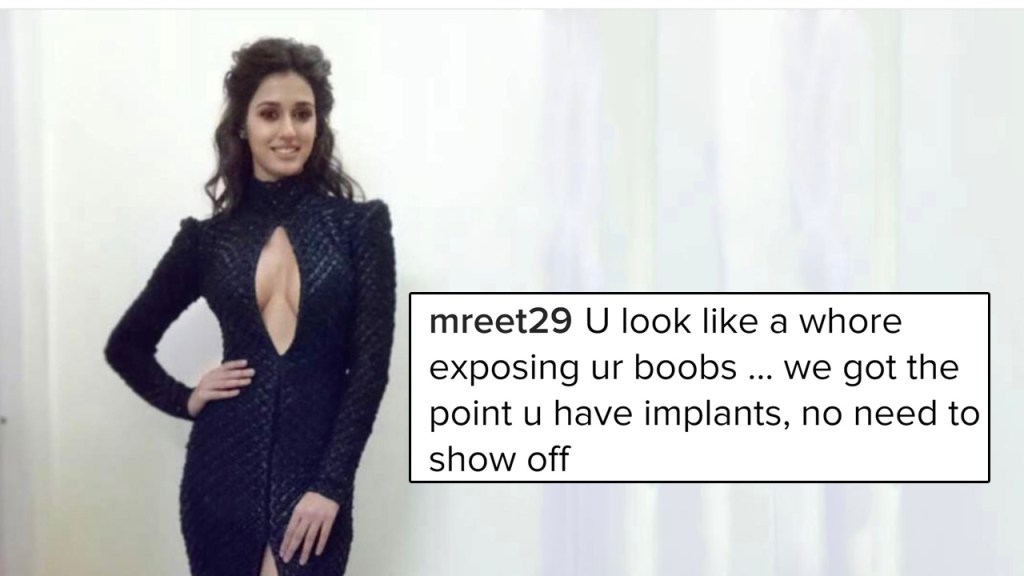
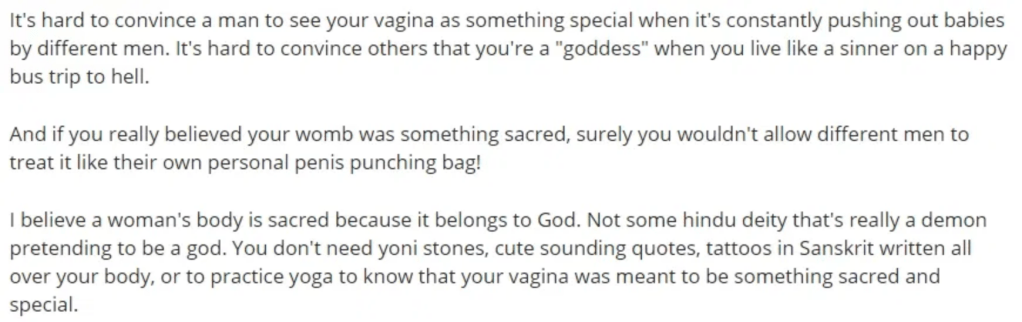
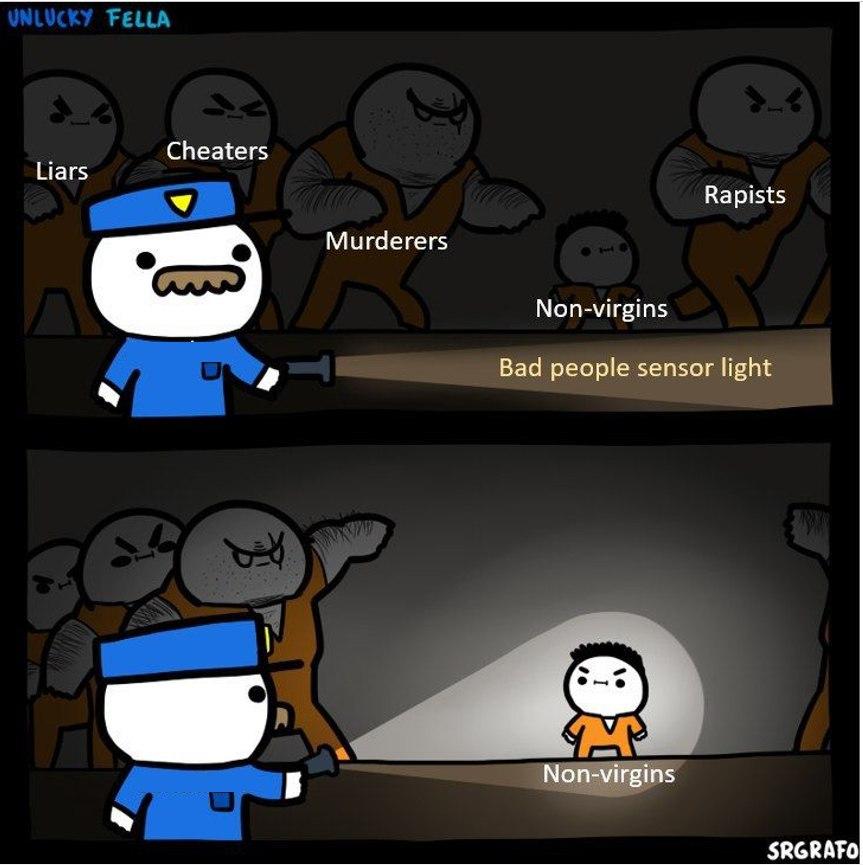
Slut-shaming has existed for eons, though it emerged in popular discourse more recently. In short: it’s the act of denigrating women as long as they are perceived to fall outside acceptable standards of (sexual) behaviour. To simplify my explanations, I will let the pictures do the talking. They range from subtle to blatant. And, sadly, it can be perpetrated by women too.
absolutely. It’s also usually young women who get slut-shamed.
i lost it at penis punching bag
Slut-shaming encompasses a wide range of aspects – anything from dress to the number of sexual partners. Sound familiar?
VIRGIN GIRLS ARE THE BEST
A picture says a thousand words. So do statements, especially when they come with a ton of Bigotry Baggage. Here, together, let us break down what “virgin girls are the best!” really means, irrespective of the identity of the person who advanced it.
Virgins = good.
Non-virgins = not so good.
Let’s spice up the above by assuming that the person is speaking of virginal status before marriage. It flows logically: without it, the speaker would merely be reduced to someone with a fetish for virgins, plus they would be attacking everyone around them who is not a virgin, including their parents. Perfectly valid, except rather strange. Now, the implications rise.
Unmarried virgins = good
Unmarried non-virgins = not so good
Based on the above, losing your virginity before marriage somehow degrades you or makes you less desirable as a female (girl).
Sound familiar?
In the following section, I express my reservations with the above logic, or should I say plainly, slut-shaming mentality. They come in two forms. First, the emotional “effeminate” argument, where I just get mad and yell because women are apparently more emotional creatures. Second, to counteract the previous statement, we have the logical “masculine” argument. But don’t worry – there isn’t much substance in the latter either because, well, there’s not much you can put against irrationality, ha ha.
r/menwritingwomen
The ad hominem, emotional, feminine argument, where I attack the person behind the argument instead of targeting its content because I’m triggered. Think of all this repressed anger as the inevitable culmination of a whole lifetime of misguided individuals attempting to instruct me what I should or should not do with my body.
Some boys (not real men, since we’re playing the game of “constructing arbitrary differences within groups”) really be out there saying bullshit like this before they, in the same breath and without a trace of irony, ask me why I detest the male enterprise. For the benefit of all then, I have to explicate my distaste by overtly referencing dumb quotes that I can’t believe I’ve heard sometimes.
What’s worse than a chauvinist? A chauvinist who acts as if he is a proponent of gender equality, while acting to limit the freedoms of women. Kudos for creating an artificial distinction between women on the basis of their private affairs that has nothing to do with you in the first place. You’re not the one sticking your dick into them anyway, so why is it any of your business? But then again, it’s not as if we haven’t had centuries of experience of men sticking their noses (and dicks) into places where they don’t belong (see: abortion), because ~women are weaklings that need to be protected by their morally and intellectually superior counterparts~.
It’s okay, you can simply write me off as a dumb female going on a rant about imaginary oppression that doesn’t even exist. There’s so many other more meaningful things that one can focus on – like sieving out the virgin females to chase. Not that you’re getting any either way.
Thelogical, rational, masculine argument, where I attempt to present a coherent argument against this virginal rubbish, though I shouldn’t have to because any decent person who respects others would realise that this line of reasoning is problematic in the first place. Whoops, ad hominem!
I decided to rephrase my argument in a way that appears logical, since well, ladies are too emotional and need to be more rational. Side-track: yes, I was informed by a kind man recently that inherent biological differences between men and women mean that the latter are predisposed to be more emotional creatures. Of course I had to deconstruct his argument thoroughly by repeatedly asking questions to clarify, because no smart man, virgin or not, will explicitly acknowledge that he actually holds such beliefs without some prodding. Because of how broad this statement is, let’s delve in a little deeper to investigate: what emotions are we talking about? To what extent do they differ, and why do they differ? Consider the following from a psychological study on gender differences in emotion. The frequency and intensity of emotions experienced by men and women from two samples (Australian/International) was measured. Effect size refers to the “practical magnitude” of the phenomenon in question.
[In the Australian group], there are significant gender differences for the frequency of Affection, Joy, Pride, Fear, Anger, and Sadness. The effect sizes for Affection, Fear and Sadness are small, and those for Joy, Pride and Anger are extremely small. In terms of intensity, significant differences are only found for Affection, Pride, and Sadness. The effect sizes for Affection and Pride are extremely small, and that for Sadness is a small effect. The means for Pride are in the opposite direction from the other positive emotions with males scoring higher than females.
In the international group, there are gender differences for the frequency of Affection, Joy, Contentment, Fear, Anger and Sadness, with females scoring higher in all cases. The effect size for Anger is extremely small and none of the others is more than small with 0.30 for Affection being the largest. The results for intensity in the international group differ from the Australian. Significant gender differences, with females scoring higher, are found for all emotions except Pride. Apart from the extremely small effect for Guilt, the other effect sizes fall within the range of small effects.
From these results it is apparent that there are significant gender differences in the reported frequency and intensity of some emotions, particularly in the international group. But the differences are uniformly small or extremely small. Any stereotyping of females as more emotional than males for these emotions is, therefore, based on small differences between the genders. […] This interpretation lends support to views like Brody’s (1997) that the perception of gender differences in emotional expression are exaggerated by stereotyping, and are acquired during the process of socialization rather than being physiological or neurophysiological or genetic in nature,Buss (1999).
(You know, some research has found that men tend to be angrier than women. But you can probably tell from this post alone that I am chronically angry too. LOOOOL.)
With that addressed, let us revert to the point. On what basis is a virgin “better”? We’ll leave the scripture part out of this, because otherwise there would be no need for a “rational” segment of this piece. Actually, that doesn’t leave much to address, but I’ll do my best.
THE PERILS OF MARRIAGE
Why is marriage in particular so revered as a milestone? Sure, it is a rite of passage signifying commitment and usually stands as a celebration of love. But does being unmarried dilute the love that two people (or more, if you like) share? Radical concept in our society for now, perhaps, but there is a rising trend of unmarried parents in the world today. These people possess all the characteristics that a married couple would have – cohabitation, children, long-term commitment – everything sans the legal binding. Are they less “good”, just because theydecided to have pre-marital sex?
And not even marriage is a guaranteed. There were 7,344 divorces and annulments in 2018. What if two people (both abstinent prior to marriage) wed and then have spectacular coitus, but decide to divorce later on? Since they are now technically single but no longer virgins, what category do they fall under? Are they inferior beings until they remarry? Surely it is apparent by now that determining the worth of a person via such arbitrary standards makes for sticky situations.
This is merely a conjecture on my part, but it almost seems as if the desirability of a virgin to the believers of premarital-virgin supremacy lies in the [female] virgin’s propensity to be deflowered. So that you belong solely to the one who marks you, as if you’re territory to be conquered by dick. The pinnacle of objectification. Sorry but that only works in young adult erotica, which is the furthest thing removed from reality possible. (People in there neither need lubricant nor have refractory periods at all. But I’m getting ahead of myself.)
Lastly, if you’re having sex only for the purpose of procreation, I can only say I feel sorry for you. Not a valid argument, but really. Really.
CRITICAL COMMENTARY: IT’S YOUR CHOICE
I have no qualms against virgins, male or female. Prude-shaming is as toxic as slut-shaming. It is fair game if one has a sexual preference for virgins or non-virgins. That’s fine. That’s like having a preference for males or females, or even neither. Or like, BDSM play (shame me more, daddy!). What is not fine is attempting to impose your standards on others regarding what is considered good, bad, pure, impure, right, and wrong on matters relating to their bodies. The issue is compounded when it disadvantages certain groups over others.
It makes me most sad when I see women themselves slut-shame each other, or subscribe to these outdated ideologies. Imagine learning to hate your natural propensity for pleasure – very much a part of you, and your body – because you were told that your desirability as a person somehow stems from suppressing your sexuality.
damn liberals be coRRuptiNg thE sOciAL orDeR
My main goal of writing this piece was, surprisingly, not to let my anti-feminist counterparts know how misguided they are (still, if the shoe fits, you are welcome to wear it). Change comes from within, rather than outside. This was targeted at my readers who are ambivalent about this issue or who find themselves taking a middle-ground on such matters. Slut-shaming hurts both men and women. It is a tool of control. Remember that the next time you’re reading an article and find yourself exacting certain standards that may not be fair to all parties involved. Remember that when you hear your friends making a demeaning comment disparaging someone because they “stepped out of line” on some arbitrary standard of sexual behaviour. If they want to have sex with 30 people because they can, and it doesn’t hurt anyone, you don’t have any right to lecture them. You’re not superior because you didn’t have sex or had less.
Consider this a declaration of intent. Every time someone says something dumb like “virgin girls are the best”, I’m going to call it out for its bullshit. The era of sexism, well-intentioned or malicious, is passé. Talk shit and get hit. You’re going to learn that your words and actions have consequences even if you like to coop yourself up in your little bubble. You can say it again; I will simply call you out for it once more. The age of laughing it off as a joke, or as the oversensitivity of a fragile woman, is long over. If you suddenly feel prosecuted because you have a penis, perhaps you will finally understand how it feels like be someone with a vagina who is constantly told that they should feel guilty for embracing the basic instinct that is sex, original sin or not. If my ladies want to keep their virginity until marriage, fine. I cannot stop them from celebrating orthodoxy when it comes to matters of their own body (although neither should they be allowed to infringe on the rights of other women). But god forbid it be men who get to do so.
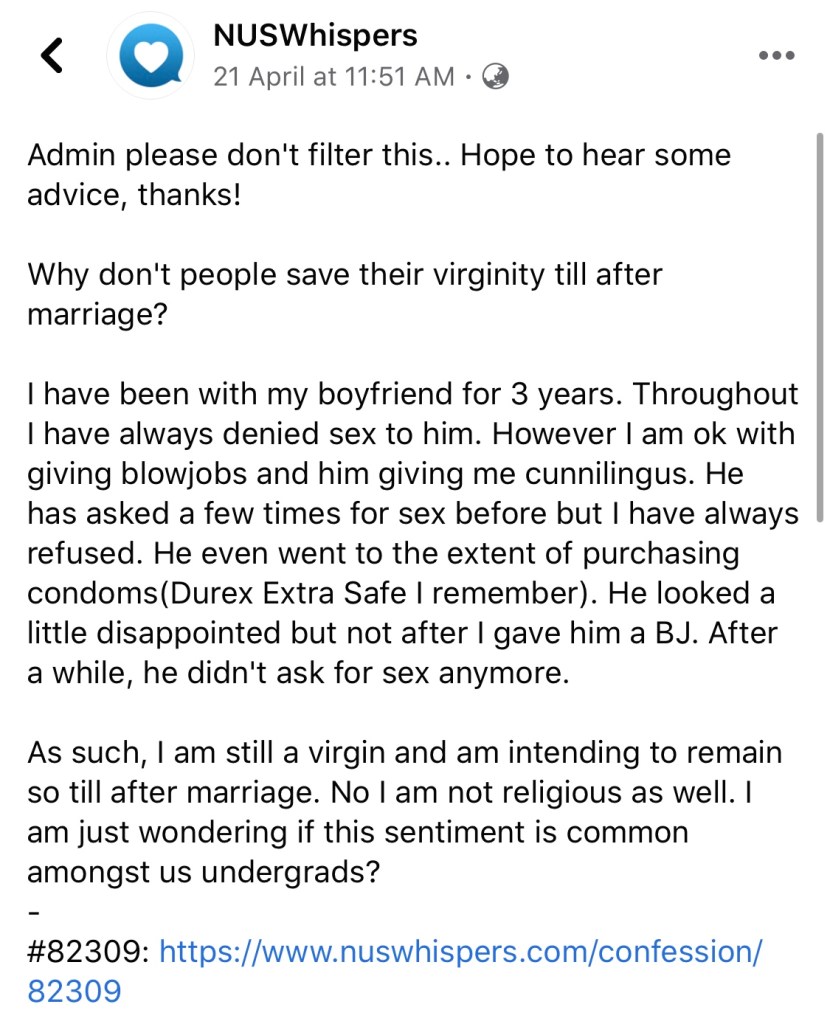
The good news is that with the passing of time the younger generation (our age) is starting to become more comfortable with their sexuality, even in our socially conservative climate. (But don’t take my word for it – I use markedly biased samples such as NTU Confessions and NUS Whispers LOL). Sometimes I see posts that imply people are stressed over their virginal status instead. Hopefully this is a sign that certain regressive mindsets are slowly being swept away. Either way, let’s continue work hard at making the social world a better place for all. And do yourself a favour: after this circuit-breaker, go out and indulge in the sex that you deserve. Unless you don’t want to.
Two weeks ago, I had my first classes at McGill University. It is a gorgeous, sprawling institution located in Montréal, a city in Canada’s province of Quebec. (Took me a while to get that sentence too – geography eludes me.)
Introductory day was spectacular, setting my existential crisis into motion. I walk into morning class to be greeted by a course syllabus with no exams and massive class participation. Anyone who knows me recognises my enthusiasm for group work. And a posterexhibition worth 40%. What? But the module is on the sociology of science! I’d be a fool to let that go for some adjustment issues.
Three hours later, I am late for a seminar because it is a 15-minute hill away from the second lecture, and also because of my abysmal time management. (There’s no way around either.) I awkwardly fumble for a seat at the makeshift discussion space, made up of four rectangular tables aligned such that sixteen people can stare daggers at each other simultaneously. Sixteen. The instructor is devastatingly charming, up to the point he casually mentions that everyone in class will inevitably and individually lead a class discussion. You could pull that phrase apart into single words and I’d be as horrified. Individually / lead / class / discussion.
I share my personal difficulties with being nervous in social situations with two friendly classmates, as they walk me to my fourth and final class out of goodwill. They are mildly sympathetic. Or not. Could I chalk it down to cultural differences or personal weakness? I have no answers, and it doesn’t matter.
I attempt to strike a conversation with an aloof, if cordial, student seated beside me in the lecture theatre. She doesn’t catch my accent half the time. It’s fine. I won’t be seeing her in the next lesson, or the next, or any of the following lectures really. We sit in silence, and I make a comment on how the theatre is packed.
She replies: “Ah, don’t worry about that. The numbers start falling off in a few weeks.”
Me, intrigued and dumb: “Why? Is it because they drop the class?”
Her, blandly: “No. They just stop coming.”
well, there’s that.
I leave the theatre confused by my professor’s rambling on development, colonialism, and what the definition of “betterment of society” really entails. I am emotionally and socially depleted, and I don’t have anyone to go home to. To mitigate my nagging loneliness, I go searching for John William’s Stonernear my place as an alternative to the morescandalous books I currently possess. It’d be easier to read in public. There, on level 2, an older man’s fingers dance across the piano at an adjoined café as mine run across pages and glossy covers. The book’s not available.
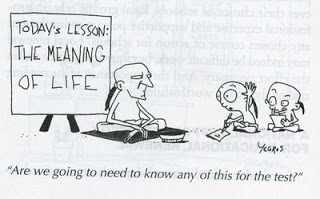
On my way home, I ruminate on why I’m so worried about my performance when I’m being graded on a pass/fail scale. I could even get away with missing class occasionally (obligatory disclaimer: not that I intend to). The answer, introspectively derived, is that it’s not only my performance that I’m worried about. I’m worried, and I always have been, about how others perceive me. And that is inextricably intertwined with my fear of failure, in the words of my lecturer on human motivation. To be precise, it would be inaccurate only to say that I want to do well; it’s more that I can’t accept not doing well.
I am positively sickened at the prospect of sitting in a group discussion feeling like I’m the only one who hasn’t done the reading. That happened on the second day of class, actually. I forgot to read one paper in advance, I admitted it to the four other girls I was grouped with, and the discussion promptly continued as if Thanos had snapped his finger and scattered my humiliated ashes to the wind. For all I know, half of them didn’t do the reading either, a suspicion that was highlighted when they went off-topic multiple times. But I still hated every moment of being in that situation. I don’t know how the exchange student in my group last semester back at NTU managed to pull it off (not reading any assigned articles), though I do know I did not hide my contempt for him.
don’t do shit, get hit.
I recall one class presentation where it was readily apparent to me that I was putting out inferior work. Relatively speaking, at least, because the bell curve dictates that one’s work is judged only against the performance of compeers in the same module. Standing under the watchful eye of the lecturer and classmates, I remember thinking, why are you guys paying attention now of all times!? I was wringing my hands desperately, looking anywhere but at the lecturer (and the other students too) in case they discovered my incompetence.
Throughout the ordeal, the irrepressible urge to simply up and bolt out of the classroom held me hostage – a classic flight response to a situation rapidly spiraling out of control. Thankfully, I was too petrified to budge. It was not a good day. Failing is an incredibly noxious sensation that I don’t have the resources to handle.
The problem, then: isn’t failing a necessity for growth?
I can’t bring myself to relax now, because I’ve never allowed myself to under equivalent conditions. I’m deeply terrified of mediocrity, and my talent is escaping from that inevitability.
Still, I’m learning. I missed one day’s worth of class earlier this week. (Obligatory disclaimer: whoops.) I’m telling myself it’s okay, even if I didn’t understand half of what the lecturer said in the class on development today. (At this point, I’m inclined to think it’s him and not me.) Even if I don’t have anyone to help me catch up on the content. I will get through it as I always have. There will be no caveats here, only a commitment to self-acceptance. After all, exchange promised to be a time for growth. I’m going to make the best out of it – even if it means pulling apart and rebuilding myself in the process.





 baby g’s diary